
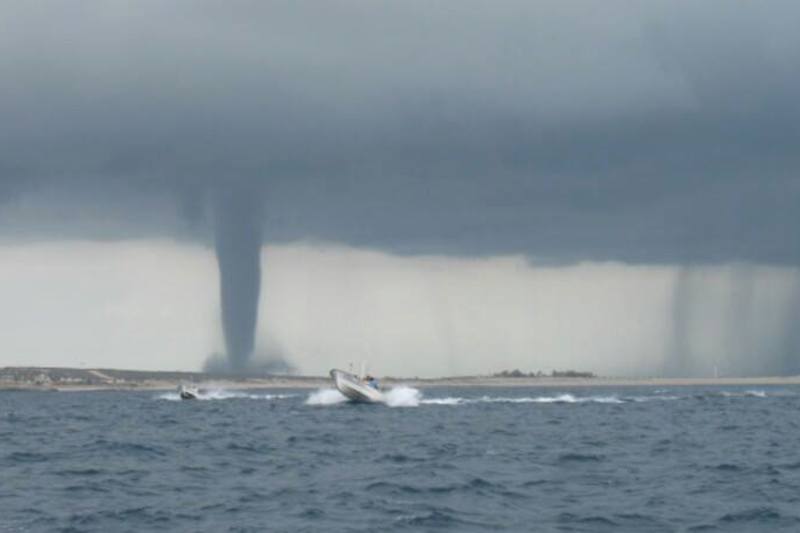
He’s not lamenting a messed up fishing vacation. Many of those who had the least, lost the most. (Photo from British news)
ODILE’s ORDEAL AND AFTERWRATH
Originally published the week of Sept. 30, 2015 in Western Outdoor News
When I wrote my last column two weeks ago about making the best out’ve your situation if your vacation gets slammed by a hurricane or other natural disaster, I had no idea. As I wrote that piece, it was your typical sunny Baja day on the beach. As I closed out, it was just starting to get a little cloudy. Rain drops were starting to fall.
I used that to underscore how quickly things can change. Especially in Baja. Especially in this el Nino year.
I was just trying to get my column out. Put some words together. I had no clue just how fast things would change. How fast life itself would change.
The “bit of rain” was part of a weather cell we had been watching half-heartedly watching for several days. It was just another ho-hum rainfall that started our way with a roar, but like a dozen others this season, we expected it would eventually bend out to the Pacific Ocean. We might get a “little afternoon precipitation.”
It was an understatement of historic proportions.
In the span of less than 12 hours the storm did the unexpected and put Baja right in it’s crosshairs. By midnight, Sunday the 14th, Hurricane Odile had turned into the largest and most powerful hurricane ever to hit Baja.
It slammed into Baja with Category 3 and 4 strength winds including gusts up to 140-150 miles and hour. By comparison, Hurricane Sandy that devastated the East Coast in 2012, had winds of “only” 115 miles and hour.
Those, like us with a fishing operation in La Paz, or have businesses that are affected by weather or happen to watch weather, had at least a bit of time to get ready. Get the batteries and water. Tape the windows. Get the rain gear. Tie and chain things down. Pull our boats onto dry ground.
Most of Baja was not ready. It was the weekend. It was the start of the 4-day Independence Day weekend festivities, the largest biggest holiday in the country. Folks were in a big-time party mode. Most government officials and civil workers were long gone. Thousands of tourists had no idea either.
It was pretty bad. You’ve probably seen the photos or watched the news. It’s hard to describe if you’ve never been in one. It’s like being inside a vacuum cleaner. It’s THAT loud. But add the glass breaking. Trees snapping. Our ceiling collapsed. Things shattering. It’s difficult to talk. To think.
This was my 10th big one and they are never the same. Like some perverse amusement park ride you know will end, it’s fascination, panic, awe, self-preservation and terror roller-coastering with each blast of wind.
And then it passes. It whimpers; runs outta steam; and moves on. And you sigh. And you exhale and like little Hobbits you gingerly creep out with everyone else into the light.
But, it’s not over.
In reality, it’s just starting.
The destruction is devastating. It looks like Godzilla danced on the town. Phone poles snapped in half. Giant old trees uprooted. Entire walls of buildings simply missing. Boats and yachts sunk or blown to dry land. Not a single window unbroken. Cars upended. Power lines draped limply across roads. Entire neighborhoods destroyed. Roads and bridges submerged. Hotels collapsed.
More than 30,000 tourists stranded with no immediate resources to handle them. An equal number of residents homeless.
And no water. No power. No electricity. No phones. Gasoline runs out. The brand new airport looks like it took an artillery barrage. It no longer exists.
Like being no a deserted island. No way out. No way in. No way to call home…or anyone else. No supplies.
One day post storm, it was shock and disbelief. Day two, it’s assessment.
By day 3, it was starting to get ugly. Tensions rising. Tourists are now ramping up the panic. Tourists and residents alike hit realization. And it’s nasty and ugly and scary.
The vacation has been trashed. The novelty has worn off. The margarita bar has been blown to Mazatlan. The fishing boats are sunk. And there’s no water, showers, food. Everyone is sleeping on the floor.
And worse…there’s no communications. Off the grid. That is especially terrifying . In a world where everyone has their nose stuck in a smart-phone, it’s the stone age. No way to notify family and relatives. No access to news. Still no way off the island. No airport. No planes.
In the cities, the afterwrath is worse.
Wholescale looting erupts. And it’s not just the dad trying to get some milk and tortillas for the family. Mobs break down windows, doors and metal barriers. Some gleefully. Large scale jubilant Christmas looting.
The big chain stores are attacked and emptied by the hordes. TV’s…clothes…exercise equipment…alcohol. If it’s not nailed down, it’s gone. Fighting breaks out. Police and law enforcement, already strained with the disaster are powerless. Rioters barricade streets so police cannot interfere. They don’t. They can’t.
In the neighborhoods, more looting. Assaults. Rape. Gangs roam the streets with machetes and arms. Neighbors set up their own security to protect their neighborhoods with guns, rocks and re-bar. Carjackings take palce. Fires are set to illuminate the dark. Neighbors dress in white to set themselves off from the bad guys.
Families fight off looters from the roof with bricks and chunks of concrete. One group beats back several assaults from gangs attempting to breach their walls by using sticks, rocks and baseball bats against knives and clubs.
Gunfire can be heard in the darkened streets at night. As one escaped resident told me, “It was medieval and primal. Complete lawlessness.”
The army finally rolls in and things quiet down.
Two weeks post-storm, the recovery is remarkable. The government, the phone and power companies; constructions companies and many others are still working around-the-clock to get going. The phoenix rises.
They said the airport in Cabo would be out for the rest of the year. By the time you are reading this, some limited flights might already be working. The La Paz Airport is already open.
La Paz is 95% back on the grid. Most of the city is cleaning up and back to normal but dealing with the huge influx of refugees. Cabo is 15% on the grid. Some hotels are actually back in business if somewhat limited.
Cell phones were not supposed to work for a month. They were back online in about a week.
But, it’s not over yet. Far from it. Odile’s “ordeal” continues on so many levels.
Many of those who had the least, lost the most. Or everything. The poorer areas, if not destroyed, have not been high on the list to restore services. It’s alot more than “my vacation got screwed” or “I never got to catch a fish” or “I went two days without a hot shower.”
Much more…
Many still have no water. Electricity is a flashlight at best. Or a candle. Food is scarce and many are in residences missing a roof…doors…windows…a wall. As one told me, “My family of 3 shares two buckets of water in the dark to wash, drink and cook.”
From others, “I have had no hot food in two weeks. Several days there was no food.”
“We sleep in the doorway because there is no light. By the doorway there is light from outside because we lost our doors. It is also cooler. But now the mosquitos come.”
“Our barrio (neighborhood) has yet to see a repair truck or anyone. They fix the tourist areas, but in two weeks we still have no electricity or water. We are forgotten. ”
Many businesses will never recover. If it was tourist related, there’s no tourists. If the building got blown away, there’s no insurance. It doesn’t matter if your family ran it for 2 generations. And there’s no “bailout” programs here in Mexico.
Odile shattered more than just some hotels and vacations. The most powerful storm ever to hit Baja indeed.
That’s my story

Jonathan
_______________
Jonathan Roldan has been writing the Baja Column in Western Outdoor News since 2004. Along with his wife and fishing buddy, Jilly, they own and run the Tailhunter International Fishing Fleet in La Paz, Baja, Mexico www.tailhunter-international.com. They also run their Tailhunter Restaurant Bar on the famous La Paz malecon waterfront. If you’d like to contact him directly, his e-mail is riplipboy@tailhunter-international.com or drop by the restaurant to say hi!
______________
Jonathan Roldan’s
Tailhunter International
TAILHUNTER FISHING FLEET #1 Rated on Trip Advisor
TAILHUNTER RESTAURANT BAR #1 Rated in La Paz on Trip Advisor
Now follow us on FACEBOOK TOO
Website: www.tailhunter-international.com
U.S. Office: 8030 La Mesa, Suite #178, La Mesa CA 91942
Mexico Office: 755 Paseo Obregon, La Paz, Baja Sur, Mexico
Phones:
from USA : 626-638-3383
from Mexico: 044-612-14-17863
.
Tailhunter Weekly Fishing Report:
http://fishreport.jonathanroldan.com/
Tailhunter YouTube Videos:
http://www.youtube.com/user/pangapirate
“When your life finally flashes before your eyes, you will have only moments to regret all the things in life you never had the courage to try.”







 That's My Story