Feeds:
Posts
Comments

Posts Tagged ‘cubera’

El NINO NEENER NEENER

blog_el-nino-waves1

“EL NINO NEENER NEENER”

Originally Published the Week of Nov. 10, 2014 in Western Outdoor News

It’s inescapable. There are just certain things that puzzle you so much and make you sit back and go “hmmmmm…”

Like, how come a pair of socks go into the dryer and only one side comes out?

Or how come birds overhead ALWAYS know when you’ve just washed your car?

Or two treble hooks left in a tackle box will ALWAYS hook into each other?

Anyway, I’m writing this while overlooking the marina here at Cabo San Lucas waiting for the start of the Western Outdoor News/ Yamaha Tuna Jackpot Tournament.

It’s a lively place and the excitement that’s going to kick off is pretty palpable. It’s quite the circus atmosphere as more than 130 teams from around the world get ready to fire it up.

But, for the rest of Cabo San Lucas, life goes on as “normal.” Whatever “normal is, in this fun place!

The cruise ships are downloading swarms of sandal-wearing sun-seekers looking for t-shirts and “authentic pottery”. The booze cruise has a deckload of bikini-wearing gals and tattoo’d boyfriends whooping and vibrating to some bass-laden song my kids would know; and the street vendors descend on tourists swaying down the sidewalk with red Solo cups in hand and “Cabo Wabo” t-shirts stretched across sunburned shoulders.

“Cuban cigars. Best price, amigo!”

“Silver jewelry. Almost free, pretty ladies!”

“Two for one tequila shots all day, right here, senores!”

But part of “normal” all of the folks fishing here who aren’t part of the tournament and this afternoon, I’m watching sportfishers unload their catches. Catch flags are flying and it’s always interesting to see what gets off-loaded.

There’s some dorado. There’s a few tuna. Hmmm…a marlin.   Wahoo on that boat, nice one. A few more dorado over there. Looks like a decent day on the water.

But one fish catches my eye and seems to be drawing a crowd. It’s about 15 pounds and in a plastic bucket and I hear someone say, “That’s the strangest yellowfin tuna. It’s a mutant.”

But, it’s not. It has the familiar football tuna shape, but the elongated pectoral fins…that’s no yellowfin tuna! It’s an albacore.

Yes, the “chicken of the sea.” Highly-sought commercially. Normally associated with 57-62 degree water. Caught in the dark-blue-purple oceans from California to Washington. But, caught here in Cabo? In 85 degree water?

I guess it’s just one more thing to chalk up to El Nino. Or is it?

After experiencing a season’s worth of signs indicative of El Nino conditions, the scientific forecasters have finally “decided” that we are surely in an El Nino year.

It has been highlighted to the delight/ dismay of many depending on where you live and what you do for a living!

  • Warmer waters than normal played havoc with fishing season. Dorado and marlin up the coast of the Pacific Northwest. Massive tuna schools in southern California. Wahoo on ½ day charter boats out of San Diego.
  • Those same unseasonably warm waters killed off the bait south of the border in many areas which meant the fish schools moved elsewhere or, there was little or no bait for the fishermen to use
  • The same conditions lead to more storms on the Pacific Coast of the U.S. and Mexico. Some 2 dozen big storms were charted as evidenced by the recent “Hurricane Vance” that just skimmed off Baja the week of Nov. 4th. But it numerically underscores the fact that the storm folks have almost gone through the whole alphabet naming all the storms.
  • Highly unusual to even see storms in November in Baja, but warm waters draw storms!
  • The highlight/ lowlight of the year was the devastating “Hurricane Odile” in September that ripped Baja and was the strongest storm in Baja history registering winds in excess of 150 mph.   Months of repairs and recovery continue almost 8 weeks after the blast.
  • Should “El Nino” continue as predicted, heavy rains might show up this winter and early next year for much of the drought stricken western U.S.

So, if this actually is an official El Nino season (they usually span parts of two successive years), then one would expect that warm water fishing would continue for Baja fishermen for species like marlin, sailfish, wahoo, tuna and dorodo. Conversely, fishermen on the West Coast of the U.S. should continue to enjoy their phenomenal year on unusual species as well.

But, hold on. Something doesn’t fit.

Colder winter winds are already starting to blow into Baja. Water temperatures are dropping in many areas.

The fishing is already changing too. I doubt we’ll see a full-blown “albacore” run in Cabo San Lucas, but the fact that an albacore was caught says something about a fish that has a messed-up directional radar or, has followed a cooler current of water. I tend to think it’s the later rather than the former.

Where we are in La Paz, we’re seeing fewer dorado and other warm water species and already getting sierra, amberjack, roosterfish, cabrilla and pargo. These are all fish associated with cooler conditions.

Our air is already many degrees cooler than normal and humidity has dropped considerably. Winds are blowing stronger from the north and there are areas that are already too rough to fish on some days.

Everyone asks me , “What do you think, Jonathan? What do you predict if we come fishing?”

I’m stumped. It’s one of those things that make me go, “Hmmmm….”

One of my captains just taught me the word, “Perplejo.” It means “perplexed.” And that’s me.   None of this year has made sense.

Roosterfish or dorado?

Bait or no bait ?

Full moon no moon ?

Rain or sunshine ?

I’ve been wrong more often than not this year. My crystal fishing ball is on the fritz. I stopped trying to over-think it and ultra-analyze it. I just tell people, “Come fishing.” Then I shrug.

It’s gonna be what it’s gonna be. Maybe we should be more concerned with fishing than what we’re gonna catch. It still beats work. And it’s still Baja!

That’s my story

Jonathan signature

Jonathan

Jonathan Roldan has been writing the Baja Column in Western Outdoor News since 2004.  Along with his wife and fishing buddy, Jilly, they own and run the Tailhunter International Fishing Fleet in La Paz, Baja, Mexico  www.tailhunter-international.com.  They also run their Tailhunter Restaurant Bar on the famous La Paz malecon waterfront.  If you’d like to contact him directly, his e-mail is riplipboy@tailhunter-international.com  or drop by the restaurant to say hi!

______________

Jonathan Roldan’s

Tailhunter International


TAILHUNTER FISHING FLEET #1 Rated on Trip Advisor

TAILHUNTER RESTAURANT BAR #1 Rated in La Paz on Trip Advisor


Now follow us on FACEBOOK TOO


Website: www.tailhunter-international.com

U.S. Office: 8030 La Mesa, Suite #178, La Mesa CA  91942

Mexico Office: 755 Paseo Obregon, La Paz, Baja Sur, Mexico

Phones:

from USA : 626-638-3383

from Mexico: 044-612-14-17863

.

Tailhunter Weekly Fishing Report:

http://fishreport.jonathanroldan.com/

Tailhunter YouTube Videos:

http://www.youtube.com/user/pangapirate

“When your life finally flashes before your eyes, you will have only moments to regret all the things in life you never had the courage to try.”

Read Full Post »

BILLFISH 101

IMAG0242

BILLFISH 101

Originally Published the Week of Sept. 2, 2014 in Western Outdoor News

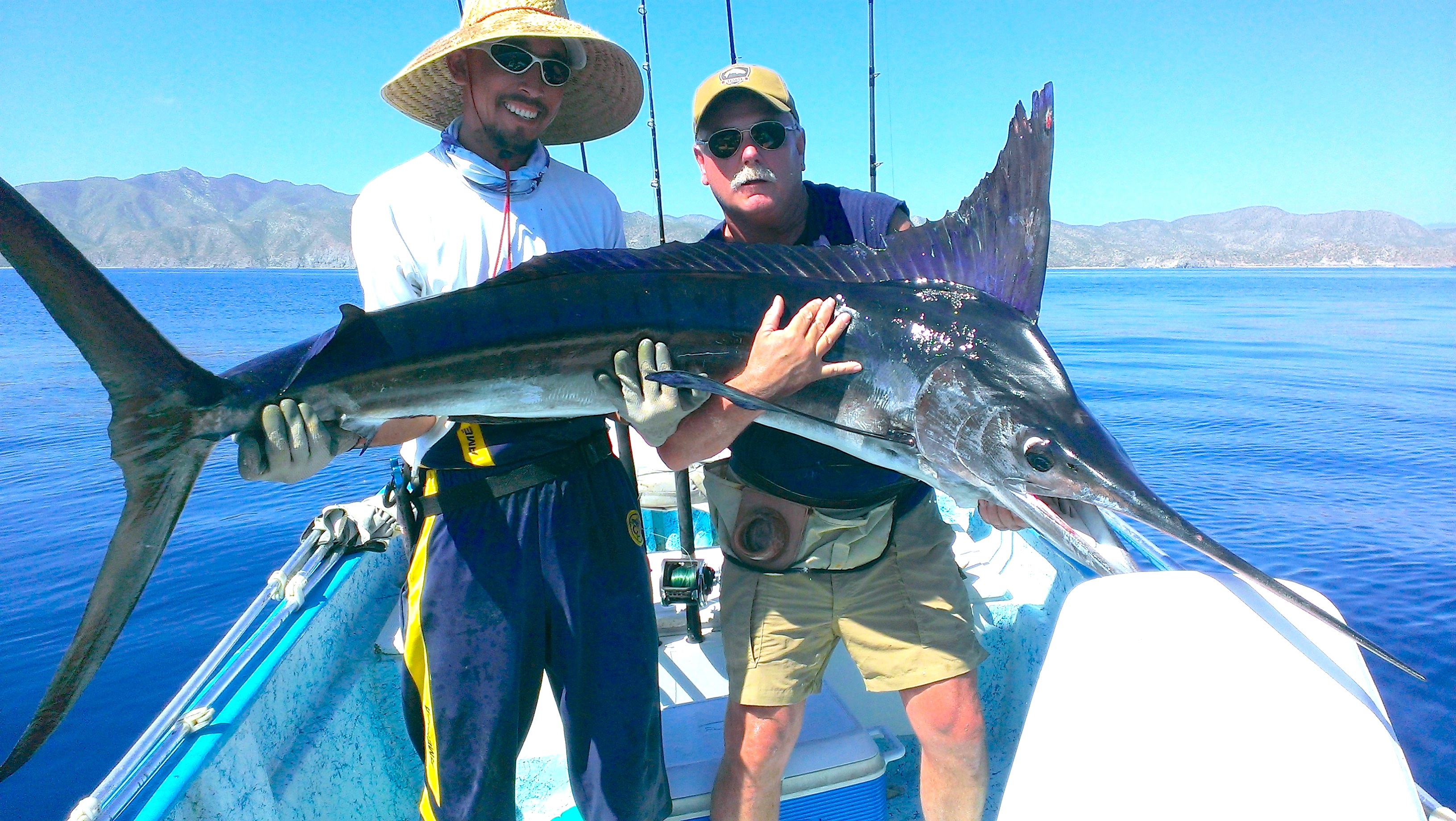
There are probably few places in the world where you have a better chance of hooking that billfish you’ve always wanted than the waters in the lower Sea of Cortez and the southern Baja Peninsula.


These “glamour” fish include both sailfish and marlin which are drawn to these waters by a number of variables. The landmass itself drops off quickly into deep water trenches that bring cool upwellings and nutrients from the abyss. These, in turn are the food source for the baitfish which attract all manners of gamefish to these waters.


Sitting at the apex of the foodchain the big billfish can attain sizes up to half-a-ton. At the lower end are the smaller sailfish. In ascending order (and size) come the striped marlin, black marlin and then blue marlin as the largest of the hunters.


Not only do they feed on the small baitfish like sardines, caballitos, jacks, mackerel and others. But, they feed in the middle of the food column as well regularly dining on the other predators such as tuna, bonito, dorado and other bluewater species. Basically, if it can fit in it’s mouth, it’s a possible meal.


So, if marlin are on your bucket list, like anything else, it’s all about “WWH” (WHEN? WHERE? HOW?).


Generally speaking, warmer months are better. But even then, that is not always the case. Every place is different.


Around Cabo, striped marlin have been known to “ball-up” in abundance just off the Pacific Coast between Bahia Magdalena and Cabo San Lucas. This takes place from November to January.


It’s a bit of a run from Cabo and it can be rough because it’s winter, but you can also catch a boat from several spots around Bahia Magdalena, but not many. Most anglers run up from Cabo.


It’s a long run, but the fishing can be incredible. It is not unheard of to hook and release dozens of marlin PER DAY! Again, food is the key. The marlin are there feeding on the huge schools of mackerel.


As the year ends, the stripers start to migrate south and around the tip of Baja and with each proceeding month start to move further and further north up into the Sea of Cortez.


So, while Cabo can see marlin year-round, the East Cape, La Paz, and to a lesser degree Loreto and cities north will see the billfish from spring to fall. But, not much in the cooler months.


So, pick your times carefully. Summer and fall are predominately the best opportunities to get into billfish in all areas.   Also waters are warm and seas tend to be calmer.


As for location…


To that end, generally speaking, the further south you go, the better. Although billfish can be caught in a multitude of spots in Southern Baja, you have a better shot at them in Cabo San Lucas, San Jose del Cabo and East Cape (Los Barriles and that area) than say Mulege or Santa Rosalia, although billfish are not out’ve the question in those great areas.


(No disrespect for northern areas which have their own spectacular fishing and their own particular claims to angling fame and shots at species not usually seen in some of the southern cities, e.g. yellowtail!)


Regarding fishing methods, there are a number of ways.


Be prepared to cover some water. So, a larger, faster boat might be preferred since these are rangy fish always looking for sources of food and capable of moving great distances very quickly.


Since you want to cover some water, trolling lures has been effective world-wide, especially, if you’re trying to locate fish.   If you’re in an area such as the East Cape or Cabo where the fish can be quite far, then a cruiser would surely be more comfortable, especially in Cabo which faces the open ocean.


However, that doesn’t mean you ALWAYS need a cruiser. Areas such as Loreto and La Paz do very well catching billfish using pangas insofar as fish are much closer to shore and the areas are less subject to big waves and rough seas.


Another method is to slow troll larger live or dead baits such as smaller bonito, larger mackerel and even small tuna properly rigged and dragged behind the boats.   There’s an old rule about “big fis-big baits” and you’ll be surprised how a huge bait that seems impossible to eat suddenly entices a big billfish to bite it!


One of my favorite methods is to simply troll a lure or dead bait behind the boat that has no hooks. This is a “teaser” method and requires that someone always keep an eye on the troll lines.


When a big billfish comes slashing at the teaser, another lighter rig with a live bait is then cast to the billfish. The live bait has a hook in it and the billfish will break off from the teaser and jump on the live bait.   Battling a big marlin or sail on this lighter live bait tackle can be incredible sport!


This same casting method can be used on a “sight-fish.” Basically, keeping a sharp eye on the water until a billfish is seen on the surface. Using some bit of stealth and a steady hand on the wheel, the boat is maneuvered so that a live bait can be properly cast directly in front of the fish…hopefully resulting in a big hookup!


Whatever you do, consider “CPR…Catch Photo Release” before you go fishing. Decide that you are going to release your billfish BEFORE you’re in the heat of battle. No matter what your captain tells you. Let him know that you plan to release your billfish and that his tips are NOT dependent on him killing the fish.


Try to keep the fish in the water to release it. Bringing the fish aboard not only damages the slime protection on it’s skin, but without the negative buoyancy of the water, internal organs can also be damaged by hauling it into the boat no matter how well intended.


Get as good a photos as possible then release it. All the best taxidermists now do fiberglass mounts that are incredible. All they need are a good photo or, in many case, not even that. All they need is an estimation of size to make that perfect keepsake trophy for your den!

That’s our story!

Jonathan signature


Jonathan

_______________

Jonathan Roldan has been writing the Baja Column in Western Outdoor News since 2004.  Along with his wife and fishing buddy, Jilly, they own and run the Tailhunter International Fishing Fleet in La Paz, Baja, Mexico  www.tailhunter-international.com.  They also run their Tailhunter Restaurant Bar on the famous La Paz malecon waterfront.  If you’d like to contact him directly, his e-mail is riplipboy@tailhunter-international.com  or drop by the restaurant to say hi!

______________

Jonathan Roldan’s

Tailhunter International


TAILHUNTER FISHING FLEET #1 Rated on Trip Advisor

TAILHUNTER RESTAURANT BAR #1 Rated in La Paz on Trip Advisor


Now follow us on FACEBOOK TOO


Website: www.tailhunter-international.com

U.S. Office: 8030 La Mesa, Suite #178, La Mesa CA  91942

Mexico Office: 755 Paseo Obregon, La Paz, Baja Sur, Mexico

Phones:

from USA : 626-638-3383

from Mexico: 044-612-14-17863

.

Tailhunter Weekly Fishing Report:

http://fishreport.jonathanroldan.com/

Tailhunter YouTube Videos:

http://www.youtube.com/user/pangapirate

“When your life finally flashes before your eyes, you will have only moments to regret all the things in life you never had the courage to try.”
Read Full Post »