Feeds:
Posts
Comments

Archive for June, 2016

HASTA LA VISTA BABY!

LA NINA

HASTA LA VISTA BABY!

Originally Published the Week of June 21, 2016 in Western Outdoor News

Wish we could say it was fun.   Adios, Baby! Don’t let the screendoor bang your butt as you exit.


Yea, that’s right. Like the neighborhood kid who comes to hang out but overstays their welcome, we needed a break. Get this kid outta here!


Well, it’s official.


Meteorologists are officially declaring the demise of “The Baby” aka “El Nino.” After almost 2 years, the experts are saying the kid is finally on the way out.


The weather phenomenon we know as “El Nino” was first recognized centuries ago by Peruvian fishermen. They noticed that a warming cycle occurred every few years which changed their weather patterns and their fishing.


Insofar as it happened towards the end of the year around Christmas, it became known as “The Baby/ El Nino.”


Extremely waters is exactly what we’ve seen down here in Baja during this particular cycle and, in fact, on the entire Eastern Pacific bordering the western shores of North and South America.


In fact, this El Nino was one of the strongest on record superceded only by the last great El Nino in 1996-97.


The warmer waters produced more storms and more rain along the western U.S. which was much needed. But, conversely, it produced drought condition and water shortages in epic proportions on the other side of the Pacific.


However, for the first time since about 2014, the experts say that May was the official turning point. Last month produced cooler neutral water temperatures on our side of the Pacific for the first time.


El Nino hasn’t been very good to us down here in Baja and Mexico.


Sure, it produced rain. The problem is, it often fell all at once. In buckets.


In fact, two historically massive hurricanes, “Patricia” and “Odile”, were among the strongest ever experienced in Mexico. Odile pretty much flattened Cabo San Lucas which still bears some scars. Patricia would have been the strongest ever and barely missed crashing into highly populated Puerto Vallarta.


From a sportsman’s perspective, we know how good the fishing has been in areas around Southern California as warm-water species like tuna, yellowtail, marlin, wahoo and others followed the currents north. It’s been an economic windfall for the sportfishing industry not to mention, a lot of fun.


Those areas produced some of the most exotic and finest fishing ever recorded. In fact as I’m writing this huge bluefin tuna are being caught in S. California waters. Hey, and what about all those sharks cavorting in the surf off California beaches? Great fun, right? I’m being facetious.


But for us down here in Baja, the warmer waters weren’t very kind to us. Without the cooler upwellings from down deep, nutrients for baitfish never arrived. Accordingly, baitfish never arrived either which either starved or moved to more fertile waters.


In the foodchain, no bait meant no larger sportfish or certainly smaller sportfish. That was a big ouch to the sportfishing industry here in Mexico.


But, everything is cyclical on this planet. Things come. Things go.


With El Nino headed out, the meteorologists are now telling us to get ready for “La Nina.” (The little sister!). What? Another bratty kid? C’mon already!


But yes. Chances are this little girl is a bit chillier.


However, according to the experts, La Nina isn’t exactly a complete opposite of El Nino. Ice won’t start coating the ocean’s surface.


Whereas El Nino involves huge warm spikes over a short period of time, La Nina is more of mild extended cooling event. The pros say it’s a return to an extended period of “normalcy.” Whatever “normal” means these days.


But, like every planetary phenomenon, what’s good for some is less-so for others.


While El Nino surely helped the drought ravages in the United States, it wasn’t enough to break it as many expected it would. La Nina won’t help at all as fewer storms can be expected.


That’s good for hurricane and tropical storm watchers in Mexico.


Over the past 2 years, there were times when every week one storm after another appeared on the radar and we had to brace for perhaps another onslaught and wonder if the “next one” would hit. Or would it race out to sea towards Hawaii?


However, conversely, the Eastern and Gulf states will be on higher storm and hurricane alerts now with La Nina. Atlantic hurricane predictions are usually elevated during La Nina patterns.


Likewise, along Eastern Asia, the waters will now be warmer on that side of the Pacific. After two years of crippling drought and heat waves, those poor folks will have to contend with the looming aspect of monsoons and cyclones.


And what will this do to the fishing in Baja?


After so many crazy things these past few years, I don’t know what “normal” looks like anymore. I threw my “fishing charts” out the window awhile ago.


I just go fishing. The weather will be what the weather is. There’s always something biting if it’s Mexican waters. And it still beats sitting in traffic.


Hasta la vista, Baby. Thanks for the visit.

That’s our story…

Jonathan signature

_______________

Jonathan Roldan has been writing the Baja Column in Western Outdoor News since 2004.  Along with his wife and fishing buddy, Jilly, they own and run the Tailhunter International Fishing Fleet in La Paz, Baja, Mexico  www.tailhunter-international.com.  They also run their Tailhunter Restaurant Bar on the famous La Paz malecon waterfront.  If you’d like to contact him directly, his e-mail is riplipboy@tailhunter-international.com  or drop by the restaurant to say hi!

______________

Jonathan Roldan’s

Tailhunter International


TAILHUNTER FISHING FLEET #1 Rated on Trip Advisor

TAILHUNTER RESTAURANT BAR #1 Rated in La Paz on Trip Advisor


Now follow us on FACEBOOK TOO


Website: www.tailhunter-international.com

U.S. Office: 8030 La Mesa, Suite #178, La Mesa CA  91942

Mexico Office: 755 Paseo Obregon, La Paz, Baja Sur, Mexico

Phones:

from USA : 626-638-3383

from Mexico: 044-612-14-17863

.

Tailhunter Weekly Fishing Report:

http://fishreport.jonathanroldan.com/

Tailhunter YouTube Videos:

http://www.youtube.com/user/pangapirate

“When your life finally flashes before your eyes, you will have only moments to regret all the things in life you never had the courage to try.”

Read Full Post »

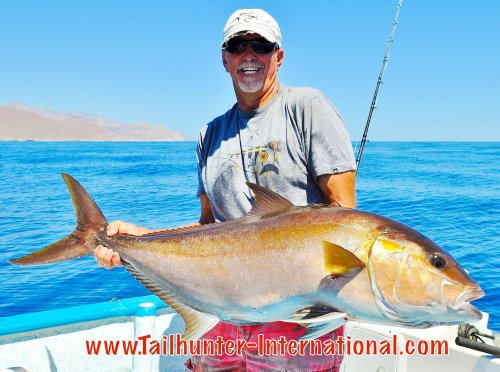
The Mighty El Pez Fuerte

amberjack small tags roger thompson 4-15

THE MIGHTY EL PEZ FUERTE

Originally Published the Week of June 8, 2016 in Western Outdoor News

Whenever someone catches this particular fish, the uninitiated usually bust out the usual comments…

“I caught a what?”

“Is this like…uh…a tuna or something?”

“Is this a junk fish?”

“Should I throw it back?”

“Any good to eat?”

“My brother caught one once and said it was good fertilizer.”


OUCH! Talk about no respect. Into the rosebeds with the mackerel, the Miracle-Gro and the mulch.


The Mexicans call this fish the “ el pez fuerte.” And it’s name is well-deserved. Nothing fancy, colorful or elegant. It surely doesn’t rise to the level of say, “wahoo.” Or maybe “sailfish.”


They call it like they see it. “ El Pez Fuerte” means “the strong fish.” Simple. Clear. Word economy at it’s best. At it’s most descriptive.


Most of the rest of us know it as the amberjack. And yea, it’s pretty strong.

Like the rest of the members of it’s family.


That includes the more famous, yellowtail (jurel). And glamorous roosterfish (pez gallo) . And the hard-charging jack crevalle (toro) and pompano (pompano…no fancy name at all. ). All three of these sure get a lot more press than the amberjack.


Folks line up to get in on the bite when the yellowtail are going off. Anglers come from all over the world to hook up on a Baja roosterfish. Jack crevalle are a favorite of light tackle and flyfishers.


So, why does the amberjack get slighted?


Better known as the Almaco Jack or the Pacific Jack, these guys sport the same bad attitude as their cousins. Bullish runs. Dogged battles. Quick to bend rods and just as easily send anglers into frustration as they dive back to cover and snap tackle.


They are just bigger and stronger. Actually, they are the largest of the jack family. Fifty…sixty…seventy pounders and larger are not uncommon.


It’s like the old saying about a good big guy is usually better than a good small guy, the amberjack here in Baja are characterized by the big thick powerful bodies of the roosterfish (but without all the fancy rigging on their back.)


They have linebacker bodies compared to, for example yellowtail which are more slender.


They have muscular tails and blunted heads. And yes, they do get bigger.


The current IGFA record of 132-pounds was caught in Baja waters. In my 20 years here in southern Baja, I’ve seen larger fish that never got to the certified scales.


It happens more than you think. Several years ago, a fish estimated at close to 150-pounds got carved up on the beach before we could stop our amigo who had visions of delicious sashimi dancing in his eyes!


Because for sure, they make great eating. Amberjack in other areas are often tossed back or tossed into the rose bushes. These are the same fish. The pez Fuertes we see here are famously tasty.


Roosterfish and jack crevalle have dark stringy strong-tasting meat. Most captains will tell you to release then. Yellowtail and amberjack are at the other end. Definitely keeper fish.


The amberjack is a culinary surprise for most folks. Imagine the tender moist meat of the yellowtail. Only better.


I had one marine biologist tell me that the amberjack are not as migratory as their kin, the yellowtail. They tend to be more “homeguard” fish and their diets include shellfish, shrimp and mollusks. So, imagine the succulent flavor of flaky white yellowtail with a slight hint of crab or shrimp!


As sashime, it’s meat is almost translucent and velvety in its’ texture and highly prized. But rarely found because they’re not commercially chased.


So, that leaves it to us sportfishermen…and ladies.


Fishing-wise, folks genuinely are surprised to catch them. It’s not too different from fishing for yellowtail in Baja.


Usually, they are found near structure which would include rocks, reefs, boulders and deep drop-offs like canyons. When scuba diving, I seem to encounter schools where there are vertical objects like rock walls where the fish hold at certain levels.


They’ll take live and dead bait like squid, mackerel and caballitos (a smaller member of the jack family). You can fish them on the flyline (with no weight). Or, you can fish them with a sliding egg-sinker on a Carolina rig or similar. Depending on the depth.


They will often school. Find one and you’ll find others. If they’re hungry, look out. They don’t “nibble” and will slam a rod right out’ve your hand.


And they are not shy. Being the big dog, they don’t have to be. I’ve had spearfishermen tell me they didn’t shoot amberjack because the fish will swim right up to them out’ve curiosity and look right at the point of the speargun.


“It didn’t seem fair to shoot a fish that swims right up to the gun!” said on spearfishing client.


And, they do love lures too.


Slow trolling a diving lure like a Rapala, Yo-Zuri, Mirro-Lure or other lipped-lure produces well.


If you like to fish the iron or knife jigs, this is another popular way to get hooked up.   Drop down and crank like your arm is going to fall off.


Basically, fish like you’re fishing for yellowtail. And that’s why folks get surprised when their reel goes screaming; they’re double-bent; and they pull up a fish that doesn’t quite look like a yellowtail.


Often copper-colored or even golden tan in the sun, it’s definitely not a junk fish. And yes, it tastes darned good. Save something else for the fertilizer!


The other great aspect is that a good time to fish for them is during the same season as the yellowtail. That would be the late winter and early spring.


However, when the yellowtail have moved off to follow the colder waters, the amberjack can stick around for many months into the summer or even longer.

That’s my story!

Jonathan signature

Jonathan

_______________

Jonathan Roldan has been writing the Baja Column in Western Outdoor News since 2004.  Along with his wife and fishing buddy, Jilly, they own and run the Tailhunter International Fishing Fleet in La Paz, Baja, Mexico  www.tailhunter-international.com.  They also run their Tailhunter Restaurant Bar on the famous La Paz malecon waterfront.  If you’d like to contact him directly, his e-mail is riplipboy@tailhunter-international.com  or drop by the restaurant to say hi!

______________

Jonathan Roldan’s

Tailhunter International


TAILHUNTER FISHING FLEET #1 Rated on Trip Advisor

TAILHUNTER RESTAURANT BAR #1 Rated in La Paz on Trip Advisor


Now follow us on FACEBOOK TOO


Website: www.tailhunter-international.com

U.S. Office: 8030 La Mesa, Suite #178, La Mesa CA  91942

Mexico Office: 755 Paseo Obregon, La Paz, Baja Sur, Mexico

Phones:

from USA : 626-638-3383

from Mexico: 044-612-14-17863

.

Tailhunter Weekly Fishing Report:

http://fishreport.jonathanroldan.com/

Tailhunter YouTube Videos:

http://www.youtube.com/user/pangapirate

“When your life finally flashes before your eyes, you will have only moments to regret all the things in life you never had the courage to try.”

Read Full Post »