Feeds:
Posts
Comments

Posts Tagged ‘sailfish’

“Through the Looking Glass”

IMGA0082

The famous arch on the public pier in La Paz welcoming visitors to the “Port of Magic.”

“THROUGH THE LOOKING GLASS”

Originally Published the Week of Oct. 15, 2013 in Western Outdoor News

Here in La Paz, we call the waterfront area, the Malecon.  It’s the Mexican equivalent of “fisherman’s wharf” in so many ocean-front areas in the U.S.  And, like it’s counterparts north of the border, the malecon is a hub of commercial and social activity.

Restaurants, stores, cantinas and tourist shops dot the area and cater to the numerous locals and tourists enjoying the mile-long stretch of beach and concrete boardwalk.

Smack dab in the middle is the city pier.  At the entrance to that pier is an arch proclaiming “Bienvenidos al Puerto de Illusion” (Welcome to the Port of Magic).

I never really gave it much thought.  Just another chamber-of-commerce slogan to welome tourists.  Yawn.  Lo que sea (whatever).   A bit like U.S. towns annointing themselves the “Cucumber Capital of the World” or “The Place Where Teddy Roosevelt Went to Middle School.”

And I live and work in the “Port of Magic.”  Right.  OK.

And for about 10 months of the year, we are myopically focused on running our fishing business and restaurant 24/7.  Boats in and out.  Clients and amigos coming and going.  Flights to catch and meet.  Luggage and fishing gear hauled and carried.  Fish to be packed and frozen.

We’re out’ve salsa.  The  pork ribs didn’t arrive. There’s a busted toilet.  The beer truck only brought half our order.  The drummer in the band is sick.  Two TV’s are don’t work and we have a full house for football games.

Did I just hear a bunch of glasses shatter? What do you mean we have no tortillas tonite?  Which panga just broke down?  Your buddy just heatstroked and needs a doctor?  No, I don’t know where you put your passport!  I don’t know why the bait is so small this year.   Yes, it’s OK to drink the water.

It’s crazy.  It’s hectic.  We’re little gerbils on a treadmill.  We love our lives and are immeasurably blessed.  But, after months with zero days off, we’re human.

We bump into walls.  We growl at each other.  Patience is thin. Sometimes our smiles aren’t as ready or as genuine as we would like.    How many times can I answer, “Where are the tuna?”  or “So, how come the captains don’t speak English?”

But every now and then the cosmos send down a message that gives us pause to remember where we are and what we really do.

It happened just this week.   Rick was on his 2nd trip in two years with us here at Tailhunters.  He’s a fireman.  He pulled me aside one evening at the restaurant.  He grabbed my hand in his big paw, shook it and gave me a big brotherly-bear hug.

“Hey man, I just want to thank you for having me here, “ he said sincerely.

“Oh sure, glad you’re having a good time!” I replied somewhat generically.  I was kind of in a hurry and didn’t really have a long time to chat.  The restaurant was filling up and I was expecting a big load of arrivals from the airport.  My anxiety was a little piqued.

“No, Jonathan, I really appreciate being here with you and Jill, “ he replied a bit quietly.  He wouldn’t let go of my hand.  “This place stitches my soul.”

Pause.  He looked at me eye-to-eye.  It slowed me down.  “Stitches my soul?”

“I’m a fireman.  I see a lot of things.  For a few days a year, being here in Baja helps put my soul back together.  For a few days on a boat and with my friends, it helps me make sense of things again.  When, I’m fishing my reality is simplified down to a bit of nylon string and a bit of bait.   Things start to make sense again.  It’s my happy place.  It helps me do what I do the rest of the year.  Thanks, man.”

With that, he gave me another bear hug  and let go of my hand.  He grinned and went upstairs to join the rest of his amigos already into their beers.

I stood there in my own moment.

Stiches my soul.  A place where things make sense again.  His happy space.

It’s good to remember that this isn’t just about how many fish you catch.  It’s not about “just a vacation.”

There’s often a bigger picture here.  I have to remind myself that we’re especially blessed to be part of it.   It’s indeed a magic place and a magic space through which we pass.  Vamos al Puerto de Illusion!  Find your happy place, amigos.

That’s my story

Jonathan

_______________

Jonathan Roldan has been writing the Baja Column in Western Outdoor News since 2004.  Along with his wife and fishing buddy, Jilly, they own and run the Tailhunter International Fishing Fleet in La Paz, Baja, Mexico  www.tailhunter-international.com.  They also run their Tailhunter Restaurant Bar on the famous La Paz malecon waterfront.  If you’d like to contact him directly, his e-mail is riplipboy@tailhunter-international.com  or drop by the restaurant to say hi!

______________

Jonathan Roldan’s

Tailhunter International


TAILHUNTER FISHING FLEET #1 Rated on Trip Advisor

TAILHUNTER RESTAURANT BAR #1 Rated in La Paz on Trip Advisor


Now follow us on FACEBOOK TOO


Website: www.tailhunter-international.com

U.S. Office: Box 1149, Alpine CA  91903-1149

Mexico Office: 755 Paseo Obregon, La Paz, Baja Sur, Mexico

Phones:

from USA : 626-638-3383

from Mexico: 044-612-14-17863

.

Tailhunter Weekly Fishing Report:

http://fishreport.jonathanroldan.com/

Tailhunter YouTube Videos:

http://www.youtube.com/user/pangapirate

“When your life finally flashes before your eyes, you will have only moments to regret all the things in life you never had the courage to try.”
Read Full Post »

“That’s How We Rolled”

BeachVW_t670

“That’s How We Rolled”      

Originally Published the Week of October 2, 2013 in Western Outdoor News

You can always tell when people think you’re a knucklehead.  Their voice goes up at the end of their sentence.   Try it.

“You’re going… SKYDIVING?”

“You ate …SUSHI?”

“You’re going to school in…THAT ?

“You went to Vegas and did… WHAT?”

And my favorite:

“You’re going to drive to…MEXICO?”

Followed by the leave-no-doubt-affirmation:

“Are you a knucklehead, or what?”

Love the, “Or what” part.

To true Baja rats, “driving the  Baja” evokes some great sensorial memories. Having taken the wheel several dozen times from border-to-tip and back, to me, the drives were truly an adventure back in the day.

Once you passed the border checkpoint, you could just feel that you had left everything unimportant behind.  Back there…back with freeways and office buildings…crowds and social vampires sucking out your essence.

Now you were in “the Baja.”

Cassettes or 8-track cartridges littered the  inside of the  truck.  Jackson Brown or the Eagles eased me down the highway and my dog cocked an eyebrow every time I hit a s sloppy high note.  Generally, he was more interested in the bag of Doritos on my lap while I sipped out of a real Coke bottle picked up at a roadside Mexican mercadito.  “I’ve got 7 women on my mind…”

Stashed among my fishing, diving and camping gear were cans of motor oil, rope, duct tape, gas can, flashlights, ice chest, tarp, flares, two extra tires, a shovel, extra hoses and, the most important thing…toilet paper!  “Well, I’m standing on a corner in Winslow, Arizona, I’m such a fine site to see…”

You prepared for the worst.  You hoped for the best.  Better to have it and not need it than to need it and not have it.

And everything including me, powdered with a good layer of Baja dust.  On the dashboard.  On the seats.  On my lips.  On the dog.  The grit of La Frontera   “It’s a girl my Lord in a flatbed Ford…”

You got there when you got there.  If your head was right, you realized that you’re south of the border so you’re already there.  No stress, Dude.  Already there.

You stopped when you stopped.  Slept in the truck, pitched a tent or paid a few bucks for a room with a single lightbulb and a great taco stand out front with plastic seats and a smiling senora searing chunks of beef and spooning up salsa to die for.

You had a general idea of where you needed to be but often a side road beckoned to a deserted beach or spectacular vista.  Sometimes the side road was a necessity.  You had no choice as parts of the highway simply weren’t there.  Washed out or under construction.  Potholes the size of your car.  Rocks and goats.  Cows and arroyos.  You got used to the word, “Desviacion” (Detour) posted on a makeshift sign.

Time was measured by the sun coming up and the sun going down and the growl in your tummy or the thirst in your mouth.  The sun gave no quarter.

Gas was sold by a guy with a hand pump and a 55-gallon drum.  You strained it through a t-shirt and were grateful it was available.  You didn’t argue about the price.  No, he didn’t offer to wash your window or check under the hood.

You drove as fast or as slow as you dared.  There were no shoulders.  Wrecks could be seen at the bottom or deep canyons where other intrepid vehicle before you didn’t make the turn.  Trucks coming the opposite way came close enough to see the color of the other drive’s eyes.  Your fingers always tightened on the steering wheel reflexively.  And eased as you continued past.  You also stopped holding your breath.

And that’s how we rolled back in the day.   The trip WAS the destination. It was the whole point…being on the road.  Whether you reached your destination was almost secondary.  You KNEW you’d be seeing gorgeous beaches and incredible mountains.  You were going to eat some great street food and make new friends along the way.  Every day was going to be it’s own “Kodak moment!”

But now…fast forward in the time machine.

There’s now pretty much a super highway from border to tip.  Mostly four-lanes of good highway.   And there’s mini-super markets along the way.  And actual gas stations with real pumps.  The Mexican government has “green angels” driving up and down the peninsula checking for and offering mechanical aid to tourist cards that might have problems along the way.  In the major towns, you’ll find the golden arches and the colonel from Kentucky smiles down from his red and white bucket .

Chain hotels dot the landscape and if that’s not your style actual developed campgrounds beckon your stay.  Police along the way greet you with smiles and are instructed in “tourism sensitivity.”  “Tenga un buen viaje senor.  Bienvenidos a Baja.” (Have a great trip and welcome to Baja, Sir!”)

Car parts?  If you need them, Walmart and Auto Zone are here now.

It’s just the way it is now …for better or worse.

But, in between all of that, there’s still adventure.  There are still deserted white beaches and aqua waters.  Somewhere along the way is a palm tree next to a palapa with a hammock waiting.  Just for you.  And you know it as you tool down the road.  You have no doubt.

And, the only snow you see will be in your ice chest or in a margarita glass.  Shoes not optional.  Shoes are discouraged!

“You’re going to…MEXICO?”

“Yea, I’m going to Mexico.  And I’m driving.  Don’t be a knucklehead.  Come with me!”

And the DVD player kicks in…”Take it Easy…”

Let’s roll.

That’s my story!

Jonathan

_______________

Jonathan Roldan has been writing the Baja Column in Western Outdoor News since 2004.  Along with his wife and fishing buddy, Jilly, they own and run the Tailhunter International Fishing Fleet in La Paz, Baja, Mexico  www.tailhunter-international.com.  They also run their Tailhunter Restaurant Bar on the famous La Paz malecon waterfront.  If you’d like to contact him directly, his e-mail is riplipboy@tailhunter-international.com  or drop by the restaurant to say hi!

______________

Jonathan Roldan’s

Tailhunter International


TAILHUNTER FISHING FLEET #1 Rated on Trip Advisor

TAILHUNTER RESTAURANT BAR #1 Rated in La Paz on Trip Advisor


Now follow us on FACEBOOK TOO


Website: www.tailhunter-international.com

U.S. Office: Box 1149, Alpine CA  91903-1149

Mexico Office: 755 Paseo Obregon, La Paz, Baja Sur, Mexico

Phones:

from USA : 626-638-3383

from Mexico: 044-612-14-17863

.

Tailhunter Weekly Fishing Report:

http://fishreport.jonathanroldan.com/

Tailhunter YouTube Videos:

http://www.youtube.com/user/pangapirate

“When your life finally flashes before your eyes, you will have only moments to regret all the things in life you never had the courage to try.”
Read Full Post »

“You Mean I Can Keep It?”

What do you think?  It looks to me like Aiden's self-esteem is just fine!

Yes…I think we can bring this one home!

You Mean I Can Keep It?

Originally Published the Week of September 20, 2013 in Western Outdoor News

You Baja veterans should probably just web surf something else.  This might be old stuff to you.

But, often when you do something so long or something is “old hat” you forget that there’s still newbies out there who have valid questions about things that old Baja rats like us take for granted.

It’s a simple, but important issue.  I receive enough e-mails and phone calls asking if it’s OK to bring home fish.

Sometimes, my auto-response in my brain says, “Well..duh…that’s kinda dumb!  That’s like asking me if it’s OK to dip you chips in salsa!”

Of course, I can’t and would never say that because there are no such thing as dumb questions.  It’s a legitimate question and well-asked.   I mean, if you’re coming fishing in Baja, one would need to know if it’s OK to keep your catch.  Corollary to that, is it OK to bring some home!

But, I get asked about it enough as new folks are discovering Baja that I figured it was time to do another column about it and update my thoughts.

The question used to surprise me more.  But, having been in the industry now for almost 2 decades, us west-coast anglers might be surprised to learn that  there are many world-class fishing destinations that severely limit what you can keep.

Pay several thousand dollars a day and you get to keep say…one fish!  Or, you must release all fish.   Yes, it’s true!   For most of us who have fished the Baja since the age-of-dirt,  we pretty much always assume that as long as we’re within limits, everything hooked is coming home.

There may come a day when severe limits will be enforced, but that’s the subject of another column and someone with a lot bigger brain and bigger column than mine.

For now, the simple answer is yes, you may bring home your fish that you catch here in Baja.   As long as you’re within limits, by all means, bring some home.  Or have some cooked up while you’re still on vacation.  Nothing will taste better than fresh caught fish that was swimming around earlier that day!

Bringing fish home starts with taking care of the catch.  Treat it well and you’ll preserve the quality.

Once the fish is caught, if you can, have your captain or deckhand bleed it.  That’s not always possible when the action is fast-and-furious and lines are flying and it’s a three-ringed-water-circus out there.  However,  bled-fish…even lower-grade meat fish like bonito or skipjack will taste world’s better if it’s freshly bled.

Maybe the most important thing whether it’s bled or not is to keep it cold.  Warm water fish are…well…they’re warm!  As soon as they’re dead, like anything, they start to deteriorate.   And the hot Baja sun is not a friend to your future dinner!  Leaving a fish on the deck or even in a fish box without ice is pretty much like putting the fish in the oven.

So, at all levels from catch-to-stove or barbecue…keep your fish cold.  Ice is your buddy.   It’s a good question to ask when you book your trip if there’s ice aboard to keep your fish chilled.

After that, you need to store your fish while you’re still on vacation.

I see two cardinal sins all the time.  One is rinsing your fish in fresh water.  Or, even soaking it in fresh water.  That takes out all the flavor.  Secondly, the fresh water gets in and then freezes and now your have fresh water crystals in your fish which detracts from the quality and flavor.

Additionally, I often see people rinsing their fish in warm or tepid water.  Especially in Baja!  Water coming from pipes here is often very warm…or hot!  Amigo…not only is it fresh water, but moreso, you’re cooking your fish in the warm water.  If you have to use fresh water, make sure it’s cool water!    Ideally, clean saltwater is best.

The ideal method is to have your fish vacuum sealed.  It’s worth it!  Nothing is worse than beautiful fish fillets in a big giant frozen ball in your freezer.  You take it out and it’s either freezer burned or you now have a 10-pound ball of thawed fish.  And you really only need two fillets for dinner!  The rest get wasted.  Or the cats get it.

Vacuum sealing is the difference between fish that lasts a few weeks or fish that can last many months in your freezer so that your dorado caught in June tastes great in December!

If you can’t vacuum seal it, at least put it in good quality zip-lock style freezer bags.   Only put in what you’re planning to thaw for a meal.

An old Mexico trick is to put fillets in the freezer bag then lowering the bag into a bucket or sink of water.  The water forces the air out and then press the seal.  You get instant Mexican vacuum sealing!

Lastly, it’s really important to keep your fish in a good place while you enjoy the rest of your vacation.  As crazy as it sounds, we often encounter folks here who book their hotels and either do NOT have freezer or do not allow fishermen to store their catch.   That’s gonna be a buzz-kill.

Others, simply put, have crappy freezers that aren’t worth a hoot.   So, check on that.  The places that cater to fishermen or have a reputation for good fishing also have good storage facilities.  Or, if you’re booking through a charter operation, ask them about storing your fish in freezers.

Remember, that warm fish often takes awhile to freeze.  Or the freezers at a given hotel get a load of fish every night from all the anglers.  In even the best freezers it sometimes takes 24-hours to get solid.

If you’re leaving the next day, that could seem like a problem.  It’s not.  Put your least frozen fish on the bottom of your cooler.  Put your most frozen fish on the top (cold travels down).  Add extra insulation with crushed crumpled newspaper or your dirty fishing clothes and your fish will be fine!

That’s our story!

Jonathan

_______________

Jonathan Roldan has been writing the Baja Column in Western Outdoor News since 2004.  Along with his wife and fishing buddy, Jilly, they own and run the Tailhunter International Fishing Fleet in La Paz, Baja, Mexico  www.tailhunter-international.com.  They also run their Tailhunter Restaurant Bar on the famous La Paz malecon waterfront.  If you’d like to contact him directly, his e-mail is riplipboy@tailhunter-international.com  or drop by the restaurant to say hi!

______________

Jonathan Roldan’s

Tailhunter International


TAILHUNTER FISHING FLEET #1 Rated on Trip Advisor

TAILHUNTER RESTAURANT BAR #1 Rated in La Paz on Trip Advisor


Now follow us on FACEBOOK TOO

Website: www.tailhunter-international.com

U.S. Office: Box 1149, Alpine CA  91903-1149

Mexico Office: 755 Paseo Obregon, La Paz, Baja Sur, Mexico

Phones:

from USA : 626-638-3383

from Mexico: 044-612-14-17863

.

Tailhunter Weekly Fishing Report:

http://fishreport.jonathanroldan.com/

Tailhunter YouTube Videos:

http://www.youtube.com/user/pangapirate

“When your life finally flashes before your eyes, you will have only moments to regret all the things in life you never had the courage to try.”

Read Full Post »

“Meet My New Fishing Buddy”

Diane on rod

Fishing “buddies” are changing a bit these days!

“MEET MY NEW FISHING BUDDY!”

Originally Published the Week of September 6, 2013 in Western Outdoor News

We always try to make a point of personally greeting each and every fishing clients who comes to visit us when they come from the airport.   After so many e-mails and phone calls prior to the trip, it’s great to finally put faces and names together…for all of us…clients included.

Several weeks ago, we were waiting at the hotel for two sets of brothers.  Bob and Pat Brown  and John and Terry Terrell were coming fishing together.  Super.

But, what a surprise when they stepped out of the airport van to greet us.  “Pat” turned out to be “Patricia” and “Terry” was “Teresa!”  Two couples!

After a laugh and some quick scrambling to re-arrange their hotel rooms to get king beds, I had some thoughts.  Several days before, half our fleet of pangas was occupied by couples.  Even one of my long-time captains commented about it.

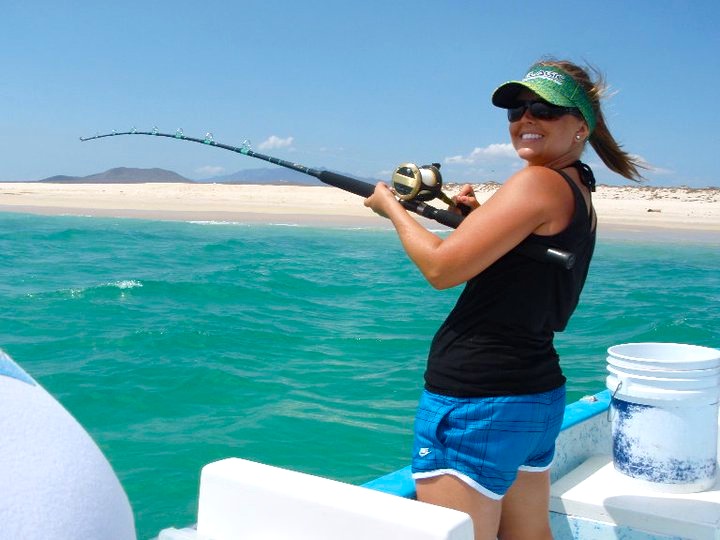
As I sit here and write this, I would say 40 percent of our clients fishing with us this very moment are women…that includes several wives…two sets of sisters…a daughter-in-law…and two single gals getting away from their guys for a quick fishing trip (tables turned!)

And this is panga fishing!  That means no big shiny cruisers.  It’s an open boat pushed off the beach old-school style!

Times are changing.

Fishing and Mexico aren’t just a guy’s domain anymore.  But, with increasing frequency, we’re seeing an increasing number of couples and women in general.  I attribute it to three things.

First, I think the ladies themselves have changed.  They are much more outgoing.  They’re used to travel. They’re used to a little adventure.  They’re up for it.  The younger ones grew up being outdoors and active.  The older ones, don’t sit at home on the couch anymore either now that the kids are out-of-the-house!  They’re on the move!

Many of the ladies can hang with the guys anyday and can keep up with them…and then some!  They fish…they hunt…they camp…they shoot…theyswim and dive!

They can be as hardcore as the boys!  Just try to elbow one trying to get to a screaming rod and you’re likely to get elbowed right back!  And do NOT ask them if they need help!  They’re just fine thank you!

Secondly, Mexico is changing.  Facilities are better.  Roads are better.  Hotels are nicer.  Heck…10 years ago, we were still wondering if we would have ice, let alone air-conditioning.  Now there are spas and white-tablecloth restaurants.  They can fish like crazy and still get a massage and pedicure in the afternoon right before pool time and happy hour.  Oh…and there’s shopping.  (most places!)

Also, Mexico itself is more welcoming.  It’s exotically close.  It’s a familiar culture, language and food.  It’s easy to travel to and easy to get around.  The country caters very well to visitors.

Lastly, I think us guys have changed too. We still love and need our “man-cations” with the bros, but it’s good knowing our ladies can hang with us too and frankly, from what I’m seeing we like hanging with them also.

Honestly, when I met my wife, Jilly, about 11 years ago, and found out she liked “football, fishing and beer…”   Whoa!  I had to buck up a bit.  She was definitely worth a 2nd look and, as one of my buddies advised me, “Jonathan, she’s a keeper!”

So, I kept her…and so far she hasn’t tossed me back either!  And I wouldn’t think of going fishing, camping, diving or traveling without her.

I’ve taken her rapelling on cliffs, whitewater rafting, horseback riding, paddleboarding, surfing and hiking.    She’s about to get her scuba certification and she’s asked many times when we’ll have time so I can take her on a “real long range fishing trip of at least 10 days!” She’s working up to run her first 10K.  She’s the one who wants to take ME to fish for peacock bass on the Amazon River and fish for catfish in SE Asia plus hiking Italy (while taking cooking schools). Amen!

I was talking to one couple that came into our restaurant after a great day of fishing.  The wife just gushed and gushed about what a fun day she had and how she couldn’t wait to go out again the next day.   It was the first time she had ever gone fishing.  It was the first time she had been on the ocean.  It was the first time she had been to Mexico.

She pulled out her camera to show me that she had caught the biggest fish of the day…even bigger than her husband’s fish!  He grinned and rolled his eyes, but you could tell he was beaming as well.

I asked her how come she had never gone fishing with him before.  She smiled.  She said she always wanted to and quietly was always envious of all his fishing trips.  She then took his hand.  She looked at him and said, “It’s because he never asked me!”

Gents…it might be worth asking.  Find yourself a new fishing buddy!

That’s our story!

Jonathan

_______________

Jonathan Roldan has been writing the Baja Column in Western Outdoor News since 2004.  Along with his wife and fishing buddy, Jilly, they own and run the Tailhunter International Fishing Fleet in La Paz, Baja, Mexico  www.tailhunter-international.com.  They also run their Tailhunter Restaurant Bar on the famous La Paz malecon waterfront.  If you’d like to contact him directly, his e-mail is riplipboy@tailhunter-international.com  or drop by the restaurant to say hi!

______________

Jonathan Roldan’s

Tailhunter International


TAILHUNTER FISHING FLEET #1 Rated on Trip Advisor

TAILHUNTER RESTAURANT BAR #1 Rated in La Paz on Trip Advisor


Now follow us on FACEBOOK TOO


Website: www.tailhunter-international.com

U.S. Office: Box 1149, Alpine CA  91903-1149

Mexico Office: 755 Paseo Obregon, La Paz, Baja Sur, Mexico

Phones:

from USA : 626-638-3383

from Mexico: 044-612-14-17863

.

Tailhunter Weekly Fishing Report:

http://fishreport.jonathanroldan.com/

Tailhunter YouTube Videos:

http://www.youtube.com/user/pangapirate

“When your life finally flashes before your eyes, you will have only moments to regret all the things in life you never had the courage to try.”

Read Full Post »

“OOPS! Now What?”

problem

Oops…you really didn’t mean to kill that fish! That’s a buzz kill. What ya gonna do now?

OOPS!  Now What?

Originally Published the Week of Aug 22, 2013 in Western Outdoor News

It’s a dilemma I see all the time with our fleet here in La Paz as well as elsewhere I have been fishing.  Anglers wrestle with it all the time.  It’s the “Oops Event.”

It usually pops up in two different situations.

In the first one, you’re fighting a fish.  It’s a big one.  Usually, it’s a billfish like a marlin or sailfish or you hook onto a sportfish like a roosterfish or a jack crevalle.

You un-intentionally killed a fish.  You were going to let it go either because they just don’t taste good; or you don’t like to eat fish; or you didn’t intend to bring any home.  More likely, you’re just a good-guy-sportsman and planned to release the fish anyway.  It died.  Even after you tried to revive it.  Oops!

Or, hey…I’ve been there.  In the heat of battle, you’ve got the adrenaline running and the sweat pouring off your head and you didn’t speak up fast enough. And dangit…you WANT this beast in the boat for a photo! Well… An overzealous gaff swings and now there’s a dead fish on the boat.  Oh man…Oops!

Alternatively, in the other situation I see, anglers fish a few days.  They fish within limits.  The have a great time. They get what they want.  Release what they don’t.  All-in-all, just another great fishing trip to Baja.

Until, they pack up their fish to leave.  They start dropping frozen fish into the coolers and realize… “Hey, oh-oh.  We’ve got way too much fish.  It won’t fit in the ice chest and the airlines is gonna charge an arm-and-a-leg for being overweight.”  Oops.

Now what?  Dead fish on the deck.  Too many fish in the box.  Ice chest too heavy.  Oops!

I hear and see it pretty much every week.  When the fishing is running, it’s a common dilemma.   It happens.  No fish slaughter was intended.  No one broke any rules.  There was no malicious intent.  It’s just that suddenly there’s either an un-intended dead fish or there’s more fish than you wanted or needed.

I guess to me it’s really simple and there’s (to me) obvious solutions, but I’m asked about it often enough that it’s worth a column.

There’s several options.

First, feed yourself!  You’d be surprised when I tell people they can take fish to any local restaurant and have the eatery cook up fresh fish.  You should see the quizzical looks when I make the suggestion.   Really?  You can?  They will?

I mostly get this reaction from first-timers, who sometimes have a hard time wrapping their minds around the idea that you can just bring a bag of fish into a restaurant and have them cook it up.  When it hits them, they bust out the big smiles.  And the smiles get even bigger AFTER dinner when I ask them how it tasted.  It’s like an epicurean epiphany of sorts!

It’s just so uncommon to do that in the states, but here in Mexico, it’s pretty much given that some of the BEST meals you can have is taking your own fish to a restaurant to have it cooked up. Baja veterans look forward to it as one of the highlights of their trip.  It doesn’t even have to be a fancy restaurant.

We do it daily in our own Tailhunter restaurant here in La Paz with our own clients.  As I often tell our diners “nothing will ever taste better than fish that was swimming around that morning. That fish’s bad day will be YOUR great dinner!”

Secondly, remember.  Nothing gets wasted.

If you visit the touristy cities, or never leave the tourist areas,  it’s hard to conceive that many many people in Mexico virtually live on beans, tortillas and rice.  If that.

Sadly, that well-dressed waiter serving you that lobster dinner on the white table cloth has never actually eaten lobster or a piece of fresh tuna or dorado.  How would he ever afford it?  Believe it or not, most folks have never been fishing.  That’s what gringos do.

Or the smiling senora who diligently cleans your hotel room every day, probably goes home to a houseful of kids each night.   She makes-do with some dried machaca meat and beans or cup-o-noodles made with boiled water for dinner and some cans of Coke.

That great taxi driver who shuttles you all around town, earns 20 bucks a day after a 12 hour day. On a good day.  He goes home to a 2 BR apartment with a wife, 3 grown kids and 2 grandkids all living there and somehow that 20 bucks has to stretch.

Even in the pueblos, scarcity is even a bigger part of life.  Commercial and sportfishing captains and crews eat OK, but well…

Donations of fish are welcome, but most don’t have big refrigerators or freezers.  I know some that literally have the size-refrigerators kids put in their dorm rooms.  So, there’s not a lot of space for fish.  But, they have the means to catch food to eat.

However, friends and neighbors often do not have that ability.  So donations  of fish to any of these folks will usually be greeted with a huge grateful smile. Gifts to captains and crews get spread to the neighbors.

Even heads and carcasses that fishermen usually just toss into the garbage have huge amounts of meat on them and make great soup.  Nothing gets wasted.

As a third alternative,  most established fishing operations have charitable connections.  Be it a church, senior home or orphanage or the like.  If you leave fish with them, they’ll be sure to get it to folks who need it.

Bottom line is that never ever dump your fish.  There’s always someone who will be grateful for it!  Your  accidental “oops” can be turned into grins.

That’s our story!

Jonathan

_______________

Jonathan Roldan has been writing the Baja Column in Western Outdoor News since 2004.  Along with his wife and fishing buddy, Jilly, they own and run the Tailhunter International Fishing Fleet in La Paz, Baja, Mexico  www.tailhunter-international.com.  They also run their Tailhunter Restaurant Bar on the famous La Paz malecon waterfront.  If you’d like to contact him directly, his e-mail is riplipboy@tailhunter-international.com  or drop by the restaurant to say hi!

______________

Jonathan Roldan’s

Tailhunter International

Website: 

http://www.tailhunter-international.com

Mexico Office: Tailhunter International, 755 Paseo Obregon, La Paz, Baja Sur, Mexico

U.S. Mailing Address:  Tailhunter International, P.O. Box 1149, Alpine  CA  91903-1149

Phones:

from USA : 626-638-3383

from Mexico: 044-612-14-17863

.

Tailhunter Weekly Fishing Report:  http://fishreport.jonathanroldan.com/

Tailhunter YouTube Videoshttp://www.youtube.com/user/pangapirate

“When your life finally flashes before your eyes, you will have only moments to regret all the things in life you never had the courage to try.”
Read Full Post »

“COVERING THE SPREAD”

“COVERING THE SPREAD”

Originally Published the Week of Aug. 8, 2013 in Western Outdoor News

Lately, at least here in Southern Baja, there seems to be a dearth of live, or even dead bait.  It happens.  You still have to do your best to raise fish.  I mean, you’re already here.  It’s no one’s fault that the bait gods just didn’t happen to smile on your particular vacation dates.  So be it.

Be prepared.  Get ready to troll.  Cover some water.  I get asked all the time what would I recommend.

I usually don’t get hung up on having every color in the rainbow.  The days when I neede  two kinds of every conceivable lure is long gone and disappeared with the days of cheap airline tickets.  Besides, I’m too lazy and too old to carry that much gear anymore.

Now, I bring one dark and one light colored trolling feather in small, medium and large.  That’s it.  If my fishing partner or partners is bringing gear, I cut it back even further.   Let them carry the extra and pay for it!

But, honestly, agree among yourselves who is bringing what.  Gear can be shared as can the weight and the cost.

No sense in duplicating efforts and, given the penchance for airlines to charge for every extra bit of weight, it’s ridiculous to bring tons of stuff that will never get used.  Besides, you can only troll a limited number of lures at a time.  There’s no logic in bringing 20 or 30 lures!  Fight the urge.  You can do it!

Once you’re on the water, there’s a number of schools of thought on how to drag your lures and presenting a spread to the fish.  Veterans have their own multitude of theories and mine is just one guy’s opinion.

I used to subscribe to the technique of running light-colored lures during the brighter hours and the darker lures in the darker hours. Lots of fishermen do well with that.  But, for many years, now, I’ve been most productive with staggering my lure colors.

I run my brighter lures further back in the pattern.  I run my darker lures closer to the white prop wash.  If I have the ability to run more than 2 lures, I stagger them where one dark lure is right in the wash.  Another dark one on the edge of the wash and then two brighter ones staggered further back beyond says the 3rd and 5th wave behind the boat.

I believe the darker lures have a better presentation in the white water or near the white water where they create a more visible silhouette to the fish.

Regarding trolling speed, my general rule of thumb is somewhere in the neighborhood of 6-8 knots.  But I vary that.  The important thing is how the lures are swimming behind the boat.

I want the most action I can get from them so they create some kind of commotion.  I am also often reminding folks that pretty much any fish that has the ability to bite one of these feathers has the ability to swim way faster than the boat.  So goosing the throttle a few nudges to get the lures swimming correctly is a no-brainer.

That brings up another important variable.  Not all lures are created equal.  There are pusher heads (flat faced/ concave faced) .  Bullet heads (shaped like bullets natch).  Bubble/Jet heads (drilled with holes to make “smoke” bubble trails).  Slant heads (cut on an angle to dart back and forth or jump).  And others.

All of them have different characteristics.  Some work better at different times than others.

My general rule is the rougher the water, the more action I want from my lure to cut through all the surface disturbance on top of the water.  I want them to stand out as something “different” up there to potential predators.

To that end, again, trying to save space and weight is to pack bubble/jet heads or pusher head designs.  I like dragging them behind the boat so that they come jumping out of the face of trailing waves then dive back into the water with lots of splash and action.

Several stray suggestions:

If you only have small feathers or lures, consider making larger lures simply by sticking one inside of another.  Also, if you want to get down deeper, especially when nothing is close to the surface, either stick a torpedo sinker or egg sinker behind the head of the lure or simply tie a torpedo sinker to a leader ahead of the lure to make it swim deeper.

Give it a try!

That’s our story!

Jonathan

_______________

Jonathan Roldan has been writing the Baja Column in Western Outdoor News since 2004.  Along with his wife and fishing buddy, Jilly, they own and run the Tailhunter International Fishing Fleet in La Paz, Baja, Mexico  www.tailhunter-international.com.  They also run their Tailhunter Restaurant Bar on the famous La Paz malecon waterfront.  If you’d like to contact him directly, his e-mail is riplipboy@tailhunter-international.com  or drop by the restaurant to say hi!

______________

Jonathan Roldan’s

Tailhunter International


TAILHUNTER FISHING FLEET #1 Rated on Trip Advisor

TAILHUNTER RESTAURANT BAR #1 Rated in La Paz on Trip Advisor


Now follow us on FACEBOOK TOO


Website: www.tailhunter-international.com

U.S. Office: Box 1149, Alpine CA  91903-1149

Mexico Office: 755 Paseo Obregon, La Paz, Baja Sur, Mexico

Phones:

from USA : 626-638-3383

from Mexico: 044-612-14-17863

.

Tailhunter Weekly Fishing Report:

http://fishreport.jonathanroldan.com/

Tailhunter YouTube Videos:

http://www.youtube.com/user/pangapirate

“When your life finally flashes before your eyes, you will have only moments to regret all the things in life you never had the courage to try.”
Read Full Post »

“Ouch That’s Gotta Hurt!”

mexican-fishing-license-291x300

If only it was as easy as finding a KINKO’s to print them out!

OUCH THAT’S GOTTA HURT! (..again)

Originally Published the Week of July 23, 2013 in Western Outdoor News

So, often we hear the phrase “shot itself in the foot.”  So-and-so screwed up again and “shot itself in the foot.”  Sadly, when it comes to Mexico, you have to scratch your head.  Give it a shake and wonder, if it has as many feet as a centipede.   How many times can it cap a round into it’s own tootsies and keep walking?

Maybe you’ve already heard the latest.

You can’t get a Mexican fishing license in Mexico.  Chew on that for a minute.  Mexico has no fishing licenses.

You must still have a Mexican fishing license.  They inspectors are still out there.  But, you’ll be hard-pressed to find someone that will be able to sell you one down here.

Here in La Paz, at our Tailhunter operations, we normally have licenses to sell.  We sell a heap of licenses every year to our clients; our competitors clients as well as walk-in anglers.  We don’t make anything on them.  It’s a nice convenience for everyone and we’re happy to do it.

Previously, getting a fishing license was a 2-3 day ordeal and test of stamina and resilience, even here in big La Paz.  You filled out several forms.  You had to go to the CONAPESCA office.  Then off to the bank to pay the fee.  Then bring your bank receipt back to CONAPESCA.  Big difference from buying things over-the-counter at Walmart!

So, being one of the few places allowed to sell the fishing permits in 10 minutes is a wonderful convenience for everyone involved.

Several weeks ago, we were informed by CONAPESCA (Mexican Fish and Game) that they didn’t have any more licenses this year.  Not just us.  Everyone!

Loreto.  East Cape.  Cabo.  And not just us in S. Baja.  It was the WHOLE of Mexico.

We spoke with Tracy Ehrenberg from the Pisces Fleet in Cabo San Lucas and she phoned the main offices of CONAPESCA in Mazatalan.  Here’s their “We-shot-ourselves-in-the-foot” story.

Try to follow this.  According to Tracy, the new head of CONAPESCA simply “didn’t budget” for the printing of enough of the paper licenses to sell for the WHOLE COUNTRY.  Think about that one.  What no KINKO’s?

So, while some smaller outfits or out-of-the-way places might still have a stash of permits, they government is counting on YOU to purchase your fishing licenses online before you come down to Mexico!

There’s a few problems with that.   First, not everyone has computers.  Second, not everyone has printers.  Third, not everyone is computer savvy enough to navigate the Mexican website that sells the permits.  And…

Fourth, the website is about as primeval like it was built by a first-year intern as a school project.  It’s difficult to figure.  It makes mistakes.  It crashes all the time.  It sometimes takes your credit card, but gives you nothing to print out.   It’s very frustrating.

Several weeks ago when I notified our own clients about the situation, and posted the problem on our fishing reports, I must have gotten 20 phone calls and e-mails a day from livid, confused and frustrated anglers.

In fairness, eventually, with enough persistence, everyone got their licenses.  It eventually works and it seems that someone there at CONAPESCA has put the website on a larger server.  It doesn’t crash as often.

But, Mexico tourism didn’t need another SNAFU like this.  It’s supposed to be making it easier and more stress-free to visit, not throw another hurdle in the way of a vacation! How many times can it fire a round into it’s foot again?

Can you imagine the outcry if all the Fish and Wildlife operations in the U.S. “forgot” to print up enough fishing licenses or hunting tags…and yet still enforced them with inspectors out there in the field and on the water?

If you’re coming down, just make a note about the licenses and bear through it.  Here’s how to do it:

Here is the website:  https://www2.ebajacalifornia.gob.mx/Pesca/


•    Click the American flag and it will be in English

•    You want to purchase the fishing license for the “FEDERAL ZONE.”

•    Do not be alarmed at the price…it’s in pesos!!!  So just divide by 11 or 12 and that’s the rate in dollars and it will show up on your credit card statement in dollars.

•    If it’s slow or doesn’t work at first, try again later.  With this announcement, everyone in southern Baja has to purchase their licenses this way! 

There is also some other alternatives:

You can also get them from CONAPESCA San Diego, but must send a cashier’s check.  They also process the paperwork the same day and will mail you your permits.   Here’s the link:  http://www.conapescasandiego.org/.  Their phone number is: 619-233-4324

There’s a third option as well.

In Southern California, a number of well-known fishing tackle stores sell them and, if you can’t go to visit, they will take your information over the phone or via e-mail.  They will process the form for you and mail you out your fishing fishing licenses.  It’s fast, it’s easy.  But they have limited amounts as well, and after they sell their stash, they’ll be having trouble getting licenses as well.

Also many of the sportfishing landings in Southern California, especially in San Diego all have fishing licenses to sell.  That’s another alternative.

Most of the time, the website works fine these days.  Just persevere if it doesn’t work the first time.  There’s also the other aforementioned ways to get your license.

Don’t cancel your trip.  Just take a breath and know that it’s as frustrating for us down here as well and we don’t want you being surprised when you get down here and there’s no fishing licenses.

That’s my story!

Jonathan

______________

Jonathan Roldan has been writing the Baja Column in Western Outdoor News since 2004.  Along with his wife and fishing buddy, Jilly, they own and run the Tailhunter International Fishing Fleet in La Paz, Baja, Mexico  www.tailhunter-international.com.  They also run their Tailhunter Restaurant Bar on the famous La Paz malecon waterfront.  If you’d like to contact him directly, his e-mail is riplipboy@tailhunter-international.com  or drop by the restaurant to say hi!

______________

Jonathan Roldan’s

Tailhunter International

Website: 

http://www.tailhunter-international.com

Mexico Office: Tailhunter International, 755 Paseo Obregon, La Paz, Baja Sur, Mexico

U.S. Mailing Address:  Tailhunter International, P.O. Box 1149, Alpine  CA  91903-1149

Phones:

from USA : 626-638-3383

from Mexico: 044-612-14-17863

.

Tailhunter Weekly Fishing Report:  http://fishreport.jonathanroldan.com/

Tailhunter YouTube Videoshttp://www.youtube.com/user/pangapirate

“When your life finally flashes before your eyes, you will have only moments to regret all the things in life you never had the courage to try.”

Read Full Post »

THE BAJA HANDFUL OF KNOTS

They come in all shapes and sizes!

They come in all shapes and sizes!

MY BAJA HANDFUL OF KNOTS

Originally Published the Week of June 26, 2013 in Western Outdoor News Publications

If you ever want to start up a conversation among a group of fishermen or suddenly get a room of yakking party-ing guys to stop talking and gather around, there’s one sure-fire way that I’ve found.  It never fails.  Instant focus.

Just start talking about fishing knots.

Instant Pavlov’s dog and the dinner bells with 100-percent success.   It works even better if you happen to have a spool of line and some hooks.   If the crowd is relatively inexperienced, there’s almost a hush.

If the gathering has more veteran fishermen, it’s instant debate.  It’s like throwing bloody chum in the water or handfuls of  live bait into boiling tuna.  No one can resist plugging into the conversation!

I’m not even going to touch opening the subject with flyfishermen who’s knowledge and propensity toward complicated knot tying requires a PhD. In physics.

But for your average fresh and saltwater  weekend warrior and occasional Baja and long-range guy, everyone has an opinion on knot tying or is certainly “all-ears” to see what’s new and exciting or missing in their knot-tying arsenal.

I think almost all of us who have spent even a little time on the water know or, at some time back-in-the-day, learned the clinch knot or the improved clinch knot.  It’s the one they use to print on the back of packs of hooks and other accessories.  If  my fuzzy memory serves,  it was printed on a lot of Berkely produces and some still call it the Trilene knot.

I’m pretty sure it’s the one my dad first showed me.  Boy, did I practice and practice that one.  In fact, I remember mom catching me in my bedroom  floor long after bed-time.  I was  tying knots by the light of a flashlight  and using my 2nd grade scissors to trim off the tag ends! Mom just said, “Oh Jonathan…” and left me alone! I know when she told dad, he cracked up.

I guess in the passing of time, I’ve learned quite a few knots.   All serve their purposes.  What great names!  They sound like cocktails…The Bimini Twist…the Cat’s Paw…the Arbor…the Australian Braid…the Bristol…the Nail…the Blood knot…the Albright Special…the Orvis.  There are hundreds!

I once had a friend who would spend hours trying to develop some new knot just so he could claim it and have his name on it…forever…his legacy sealed in angling lore.  Terrible fisherman, but he sure knew how to tie knots!

Anyway, between you and me…frankly…the only reason to know that many knots is to impress people.  Like a name-dropper at a cocktail party.  People’s ears perk up when they hear names like the Palomar and the Spider Hitch.  And, I admit, when I want to direct attention to myself…like I said, start talking about knots and throw in some fancy names and it’s like a magnet!  Try it sometime.

Go get yourself a knot tying book or look up on the internet or youtube and there’s some great stuff to learn.  Then pull out some fancy names next time you’re among friends.  Like some guy who learned some card tricks, every fisherman within ear-short will be listening to you!

But, in full disclosure, for the several dozen knots I know,  there’s maybe only a handful that I ever really use and maybe only 3 or 4 that I use 95 percent of the time.  These are knots that you SHOULD know and with them under your belt, there’s not too much you can’t do.

It’s like rock ‘n’ roll.  If you know 3 simple chords and a decent 12-bar progression, you can probably play…well…just about anything!

The most important knot that I use is the San Diego knot.  I call it the most important because it’s the knot that joins my line to the hook.  It’s the last line of  attack and the part that attaches me to the fish.  So it better be a good knot!

It’s a variation of the Uni knot (you can look all of these up) and I’ve also seen it called the Duncan knot and the San Diego Jam knot.   It takes a few minutes to grasp the concept and a few more to learn it well.  But it’s worth it.

It has never failed.  The line might break but, in my experience, the knot has never broken, even on the largest fish I’ve tangled with.   I’ve seen tests run and it’s pretty hard to beat it’s breaking strength.  It’s variation called the  Double San Diego knot (merely doubling the lines) is even better and a standard knot here in Baja and on the long range San Diego fleet.

If you learn it well, it is also a handy knot to join to lines together like a mainline to a leader.

Which leads to my 2nd most important knot which is the Overhand knot.  It’s my personal favorite not only for joining lines, but especially to join lines of dissimilar diameter.  When you’re in a hurry to join  mono leader to braided line (not the best, but serviceable) it’s also handy.  If you know how to tie your shoe, this knot is that easy.  Learn it and remember it!

My last knot would be the Surgeon’s Loop.  It’s pretty much as easy as over…under…and through.  And you’re done!  Like the ads on TV…”even a caveman could do it.”  It’s great for …well…making loops to hold sinkers…to hold hooks.   I use it a lot.  I use it a lot more than the  dropper loop if I’m tying the loop to a sinker.

Fishing in rocks, if the sinker gets stuck on the bottom, the dropper will break easier than the dropper loop and at least let you get your main line back.

If I need a loop to tie the hook to…then the Dropper loop is my choice.

And that’s it!  Not much you can’t do with this handful!  Learn them and it will cover almost everything but the most specialized situations.

That’s my story

Jonathan

_______________

Jonathan Roldan has been writing the Baja Column in Western Outdoor News since 2004.  Along with his wife and fishing buddy, Jilly, they own and run the Tailhunter International Fishing Fleet in La Paz, Baja, Mexico  www.tailhunter-international.com.  They also run their Tailhunter Restaurant Bar on the famous La Paz malecon waterfront.  If you’d like to contact him directly, his e-mail is riplipboy@tailhunter-international.com  or drop by the restaurant to say hi!

______________

Jonathan Roldan’s

Tailhunter International

Website: 

http://www.tailhunter-international.com

Mexico Office: Tailhunter International, 755 Paseo Obregon, La Paz, Baja Sur, Mexico

U.S. Mailing Address:  Tailhunter International, P.O. Box 1149, Alpine  CA  91903-1149

Phones:

from USA : 626-638-3383

from Mexico: 044-612-14-17863

.

Tailhunter Weekly Fishing Report:  http://fishreport.jonathanroldan.com/

Tailhunter YouTube Videoshttp://www.youtube.com/user/pangapirate

“When your life finally flashes before your eyes, you will have only moments to regret all the things in life you never had the courage to try.”

Read Full Post »

There are times when it's just better and safe to hang by the pool for the day, but if you're headed out,  there's a few things you can do to make it easier to fish in rough water!

There are times when it’s just better and safer to hang by the pool for the day, but if you’re headed out, there’s a few things you can do to make it easier to fish in rough water!

PLAYING ROUGH!

Originally Published the Week of January 3, 2012 in Western Outdoor News

Memories of those calm balmy days fishing the Sea of Cortez definitely weren’t going through my brain this afternoon.  On the contrary.

Although the sun was out, I was relatively “bundled” for Baja fishing.   I was still customarily barefoot, but my fishing wardrobe long loose sweat pants and a layering of t-shirt; long sleeve Pendleton and waterproof windbreaker with hood over my head.  It hardly sounded like Baja fishing couture!

But, that being said.  I was chilly.  It was blustery and spray from the wave-tossed northern winds that sweep the Cortez had my clothes damp and my panga captain and I fishing with our hoods pulled way down!  Out of the corner of my mouth, I said in Spanish, “This is why we get paid the big money!”

He grinned and wiped the seawater that was splashing his face and he held onto the tiller!

It was choppy.  White caps tipped the waves even though we weren’t far from shore.  Brrrrr…

My client, a great guy from Oregon, used to fishing the dangerous mouth of the Columbia River was having a great time in his shorts and t-shirt!  “Heck, this is nothing… it’s cold and raining back home!” he laughed.

Well…yay.  Winter is still not my favorite time to fish, but when you gotta work, you gotta work.  Often fishing in winter in the Sea of Cortez or any of Baja waters can be a challenge.  Forget all the fancy brochures.  Weather is still weather and there are some times of the year that are better than others to fish!

That doesn’t mean there’s no fish, but you have to change your tactics a bit when playing in rougher water.

For one, there’s a good chance you might be doing more trolling than normal.  When waters are rough or when it’s off-season, it’s often difficult to purchase bait because either the bait guys aren’t working.  Or, it’s sometimes too rough to net or hook sardines, mackerel or other baitfish.

So, be prepared to troll.

If you have a water temperature gauge, at least try to find the warmer temperature breaks to work.

Also, given the turbulence on the surface,  certain lures work better.  I put away all the “bullet” headed trolling lures and reach for lures with heads that are heavier to dive beneath the chop.  I like using heads that have slanted or flat heads or have “jet holes” that will also create more action as they are pulled through the waters.

You have to be careful about your lure speeds.  It’s not like you can put it on auto pilot on the console or in your brain.  If you’re in waves and swell, your boat speed will vary constantly depending if you’re going upswell or surfing downswell or getting hit sideways.

Which brings up another point.

In heavy weather, use fewer lines.  And run them equidistant from the transom.  Some guys like to run them close.  Others far from the prop wash.  But either way, fewer lines and keeping them equidistant reduces the frequency of tangled lines, especially if you’re doing “S” patterns or the chop is really pushing the boat and the lines around.  Personally, I like running the lines a bit closer than normal.  Don’t worry about the fish.  Believe me, most fish out there can swim faster than the boat can move so if they’re inclined, they’ll hit your lures even if you’re having to run a little faster or slower than normal.

Finally…

It should go without saying to use common sense at all times.  If it’s too rough, no fishing is ever worth jeopardizing anyone’s safety.  Keep it fun!  Either stay onshore or know when to head for the beach and call it a day!

That’s our story!

Jonathan

________________

Jonathan Roldan has been writing the Baja Column in Western Outdoor News since 2004.  Along with his wife and fishing buddy, Jilly, they own and run the Tailhunter International Fishing Fleet in La Paz, Baja, Mexico  www.tailhunter-international.com.  They also run their Tailhunter Restaurant Bar on the famous La Paz malecon waterfront.  If you’d like to contact him directly, his e-mail is riplipboy@tailhunter-international.com  or drop by the restaurant to say hi!

______________
Jonathan Roldan’s
Tailhunter International
 
TAILHUNTER FISHING FLEET #1 Rated on Trip Advisor
TAILHUNTER RESTAURANT BAR #1 Rated in La Paz on Trip Advisor
 
Now follow us on FACEBOOK TOO
 
 
Website: www.tailhunter-international.com
U.S. Office: 3319 White Cloud Drive, Suite A, Hacienda Hts. CA 91745
Mexico Office: 755 Paseo Obregon, La Paz, Baja Sur, Mexico
Phones:
from USA : 626-638-3383
from Mexico: 044-612-14-17863
.
Tailhunter Weekly Fishing Report:
http://fishreport.jonathanroldan.com/

Tailhunter YouTube Videos:
http://www.youtube.com/user/pangapirate


“When your life finally flashes before your eyes, you will have only moments to regret all the things in life you never had the courage to try.”

 

Read Full Post »

Shearer Family goofy tags 5-11

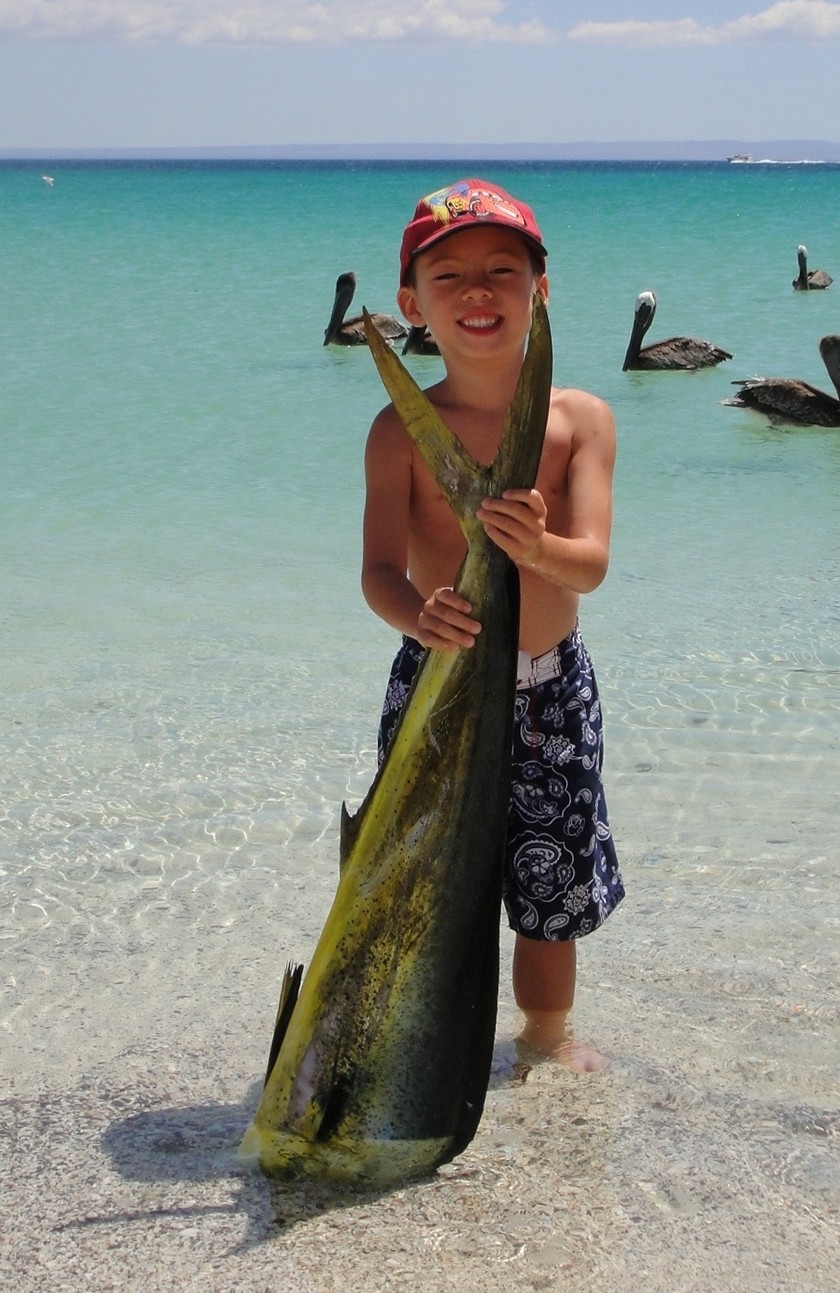
Winter is a great time in Baja and a great time to bring the family! As the our amigos, the Schearer family, from Montana found out with us, Baja is alot warmer than Montana and you don’t have to go out very far to get fish like this!

BECAUSE WE CAN!

Originally Published in Western Outdoor News the Week of Dec. 20, 2012


I’m often asked why we would fish in the winter time?

I guess the quick and wise-guy answer and knee-jerk response is “Because we can!”

But there’s more to it than that. 

During the winter time, the complexion of our Baja vistors changes.  During the regular season,  the majority of our folks are generally fishers.  Or at least have a general focus of getting on or under the water during our warmer months.

During the colder times of the year, I think we see more “escapees.”  These are folks just trying to get away from the chill, ice and wet of home.  “Just lookin’ for some sunshine…any sunshine!” is what I often hear.

While us locals are bundled up in long pants, shoes, and down vests against the “chilly” 60-70 degree weather, folks from Vancouver, Canada…Bozeman, Montana…Portland, Oregon. …happily stroll through town in tank-tops and cargo shorts.   God bless ‘em, they are in sunshine Nirvana!

But, they are often discouraged from fishing when they find out that so many places are rough, windy, or certain “glamour” species like marlin and tuna just aren’t biting in the winter. Or, if they are biting, heading off-shore to catch them can be a long rolling bumpy wet adventure more akin to the very conditions they left back home!

It’s much simplier to park it on a bar stool with a cold umbrella drink and gaze out over the sand and water or take the glass bottom boat ride in the harbor.  Yawn. Right up there with going to listen to a time-share presentation so you can get the free lunch and discount shopping coupons.

But, they shouldn’t let winter discourage time on the water.

One of the great things about fishing in Baja and Mexico is that there is always SOMETHING to catch! 

Frankly, the further south you go, the warmer it will be and the better the chances of catching a glamour fish, but even then, remember that it’s still winter and most of Mexico and Baja’s Pacific coast faces the open ocean (which is why winter surfing in Hawaii is so great!).  There’s big waves and there’s big winds.

It’s no fun being wet and cold and bounced around.

So…

Consider fishing inshore.  So few folks ask for it and so few of the outfitters or charter operators offer it, especially for someone who just walks in or walks up to sign on for a day of fishing.  Which is what so many winter visitors do.  They go fishing on a whim. 

“Honey, instead of visiting the Mayan pottery store,  let’s go ‘deep sea’ fishin’ tomorrow!”

But, chances are you’ll light up a big smile if you ask for inshore fishing.  For the captain our agent or outfitter, it’s a lot more economical since they won’t be burning up a lot of gas.

 Secondly, there’s a lot more inshore fish than offshore blue-water fish .  Therefore,  the chances or success are much greater for them to have smiling anglers at the end of the day.  Finally, believe me.  They don’t want to get beat up out there on the big water any more than you!

From the anglers perspective, waters will probably be calmer.  You’ll have more action with rods in your hands rather than long days of trolling offshore.  Pragmatically, you don’t need a big expensive sportfishing cruiser either.  You can downgrade of fish from pangas since most of the action will be closer to the shores, beaches and reefs. So, it’s less expensive!

In fact, often you’ll just be yards from the shore.  You will often see the bottom and, very often you’ll actually see the fish as they bite. 

And there’s so much variety and action to be had.  Exotic roosterfish…giant pargo…tough jack crevalle…sierra…cabrilla…pompano…are just some of the species available inshore.

And don’t think these fish are any less tough or formidable just because they inhabit the inner waters.  Pargo can be 30-50 pounds with sharp teeth and gillplates as they attack from the rocks.  Roosterfish can swarm in schools or be the big trophy sluggers between 30 and 100 pounds that have made them famous in Baja and the world.  Catch 20 five-pound sierra or a half-dozen 30 pound jack crevalle and I can guarantee your arms will still be sore!

Another bonus is that this is very pro-active fishing. Since you’re not simply dragging lures offshore waiting for hits, you’ll have a rod in your hand most of the time.  This is a great plus if you’re fishing with first-timers, family members or the kids!  Everyone participates.  Everyone has fun.

And, at the end or the day, inshore fish is among the best eating!  So, don’t let winter deter some great fishing fun!

That’s our story!

Jonathan and Jill

__________________

Jonathan Roldan has been writing the Baja Column in Western Outdoor News since 2004.  Along with his wife and fishing buddy, Jilly, they own and run the Tailhunter International Fishing Fleet in La Paz, Baja, Mexico  www.tailhunter-international.com.  They also run their Tailhunter Restaurant Bar on the famous La Paz malecon waterfront.  If you’d like to contact him directly, his e-mail is riplipboy@tailhunter-international.com  or drop by the restaurant to say hi!

______________

Jonathan Roldan’s Tailhunter International

TAILHUNTER FISHING FLEET #1 Rated on Trip Advisor

TAILHUNTER RESTAURANT BAR #1 Rated in La Paz on Trip Advisor


Now follow us on FACEBOOK TOO

Website: www.tailhunter-international.com U.S. Office: 3319 White Cloud Drive, Suite A, Hacienda Hts. CA 91745 Mexico Office: 755 Paseo Obregon, La Paz, Baja Sur, Mexico Phones: from USA : 626-638-3383 from Mexico: 044-612-14-17863

Tailhunter Weekly Fishing Report: http://fishreport.jonathanroldan.com/

Tailhunter YouTube Videos: http://www.youtube.com/user/pangapirate

“When your life finally flashes before your eyes, you will have only moments to regret all the things in life you never had the courage to try.”
Read Full Post »

« Newer Posts - Older Posts »