Feeds:
Posts
Comments

Posts Tagged ‘live bait’

“IN THE PRESENCE OF GIANTS”

Deb_&_whale

A moment of clarity ?

IN THE PRESENCE OF GIANTS

Originally Published in Western Outdoor Publications the Week of March 5, 2014

“Look deep into nature and you will understand everything better.”

Albert Einstein

Oooo!  Wow!  Oh my!  Lookit!  It’s coming right to us!

Squeels.  More ooo’s and ahhhs!

But, then everyone jostled to the starboard side of the panga. Whoa!  For a moment there was an air of apprehension as everyone hung on.

But Mexican pangas are built for stability and although there was a bit of a list, attention quickly focused on what was making it’s way towards us.

For most of us, we grow knowing we’re at the top of the heap.  We are the  apex of intelligence, power and the food chain.  Master of all we see.  Conquerors of time, space and dimension.

That is, until we’re suddenly faced with the fact that there are creatures larger and stronger than us.

That is, until those creatures are not behind some cage in the zoo giving us a false sense of security.

That is, until one of those creatures is right next to us and literally smack in our laps!

Looking at us.  And we touch it. And in some cases, it tries to touch us.  And maybe communicate with us?

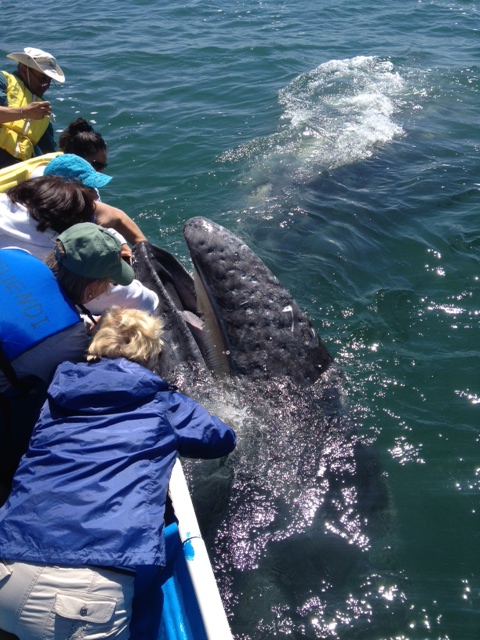
Something like a whale.  Even a 15-foot baby…and it’s uh…its 40 foot mom!

And both were rising and approaching like two big grey submarines towards our awestruck panga full wide-eyed-cellphone-camera-snapping eco-tourists.

You feel small.  And vulnerable.  And utterly amazed.

This isn’t a video.  This isn’t the Discovery Channel or Animal Planet or National Geographic.  Or Sea World.

We’re not in the safety of our Lazy-Boy lounger in the living room in front of the big-screen.

We’re in Mexico. The light hum of the panga outboard is real.   The water and the salt air is real. The sun and breeze on your cheeks isn’t virtual reality. The smell of damp things from the ocean is real.

We’re not outside the aquarium.  We’re on the other side of the glass today.    And we’re in the presence of giants!

And then, the magic happens.

The mom stops just a few feet from our panga.  And the calf comes right up.  And stops and raises his head.  And it’s eye opens and you can swear it’s looking right at you with seemingly the same wonder that that you have for it!

And you reach out and you touch the rough skin and other hands also touch and scratch the youngster.  And in those few moments, you feel like you’re doing more than just touching.  It seems to transcend just a touch.

Two seeming intelligent creatures from different worlds…one above and one below the waters… reach across the abyss of eons and it’s unlike anything you have ever experienced.

Is the little calf really smiling and enjoying the scratches.  Is it wondering about the funny creatures in the floating panga as much as we wonder about it?  Can it sense us?  In some cosmic way, are we communicating?  Will we ever?

Whether one believes in a divine being or creator, I’ve never known anyone to come away from the experience without feeling something very special and different has happened or feeling humbled by the magnificence.   For many, it certainly gives new perspective to our place on the planet.

Every year from approximately, January to March, the gray whales arrive at in Baja at the end of the longest migration of any animal on earth.  Starting at the Bering Sea up by the Arctic Circle, they arrive in Bahia Magdalena, Scammons Lagoon and San Ignacio, three warm water lagoons on the Pacific Coast of Baja.

Once, almost hunted to extinction, they now arrive by the thousands, to breed, mate and give birth.  It is estimated that some 20,000 whales now make the seasonal migration to these protected areas.  In the 1800’s it was once suggested that they exceeded more than 100,000 in population.

But, these areas provide an incredible opportunity to get close to observe these magnificent creatures.  For many, it’s a once-in-a-lifetime experience and the calm, protected sanctuaries make an ideal place to see dozens of whales a day on many occasions.

Baja is currently experiencing perhaps one of it’s best whale-watching seasons in years.  If you have a chance, take a trip.  Look into an inquisitive eye of a creature larger than yourself.  Be in the presence of gentle giants.  And perhaps come away understanding a little bit more about so much more.

That’s our story!

Jonathan

Jonathan signature

_______________

Jonathan Roldan has been writing the Baja Column in Western Outdoor News since 2004.  Along with his wife and fishing buddy, Jilly, they own and run the Tailhunter International Fishing Fleet in La Paz, Baja, Mexico  www.tailhunter-international.com.  They also run their Tailhunter Restaurant Bar on the famous La Paz malecon waterfront.  If you’d like to contact him directly, his e-mail is riplipboy@tailhunter-international.com  or drop by the restaurant to say hi!

______________

Jonathan Roldan’s

Tailhunter International


TAILHUNTER FISHING FLEET #1 Rated on Trip Advisor

TAILHUNTER RESTAURANT BAR #1 Rated in La Paz on Trip Advisor


Now follow us on FACEBOOK TOO


Website: www.tailhunter-international.com

U.S. Office: 8030 La Mesa, Suite #178, La Mesa CA  91942

Mexico Office: 755 Paseo Obregon, La Paz, Baja Sur, Mexico

Phones:

from USA : 626-638-3383

from Mexico: 044-612-14-17863

.

Tailhunter Weekly Fishing Report:

http://fishreport.jonathanroldan.com/

Tailhunter YouTube Videos:

http://www.youtube.com/user/pangapirate

“When your life finally flashes before your eyes, you will have only moments to regret all the things in life you never had the courage to try.”


Read Full Post »

OLYMPUS DIGITAL CAMERA

Just having bait isn’t enough if you don’t know how to use it correctly!

“HOW YOU WIGGLE YOUR WORM”

Originally Published the Week of June 10, 2013 in Western Outdoor News

In the annals of bathroom graffiti, it’s probably not hall-of-fame material as far as that genre of graffiti goes.  But in our Tailhunter Restaurant here in La Paz, someone scribbled this in the men’s restroom:

“It’s not the size of the rod, it’s how your wiggle your worm.”

Any business owner knows that you have to wear many hats. Being the big-time chief executive officer and chairmain of the board and also head of bathroom graffiti eradication, I happened to be scrubbing it off the wall chuckling.   Beyond the most obvious bathroom connotations,  there’s a point of pescatory wisdom in there as well.

How one wiggles, jiggles or shakes one’s “worm” does make a difference and those nuances can make a big difference in your fishing experiences on a given day.

A perfect example is the type of fishing being experienced in many Baja locations this time of year.  We’re in a “transition” period as waters warm and we move out’ve spring and into summer conditions.  Cooler waters can still be found but there’s quite a mix of water situations both on the surface as well as vertically through the water columns with different thermoclines changing as the waters deepen.

The result is that the spring and early summer can often be a mecca of so many different varieties of fish and opportunities for anglers looking for changing angling experiences.

Here in La Paz is a perfect example.

Cool water inshore species such as yellowtail, amberjack, cabrilla, pargo, sierra and pompano can be caught while in the warmer water areas, billfish such as marlin and sailfish are starting to rev things up.  Likewise, bluewater species such as dorado, wahoo and tuna can be caught as well.  Add in roosterfish, jack crevalle, bonito and others and you probably won’t find this kind of variety during any other time of the Baja fishing season.

However, bait presentation a.k.a. “wiggling your worm” can make a big difference over what you catch.

For instance over all the decades here in Baja working and guiding plus working  on other boats out’ve S. California, I’ve noticed a few things.

Take dorado.  They don’t like dead bait as much as spirited live bait.  In fact, the livelier the better.  It’s like a cat.  If you put a ball in front of kitty, he’ll just stare at it.  But, if you roll that ball past Kitty, he pounces.  Same with dorado.

Big baits or small baits don’t matter to dorado.  I’ve seen 18-inch juveniles attack 10-inch mackerel or big caballitos.  I’ve seen 40-pound bull dorado fight each other for 4 inch sardines…as long as the sardines are moving!

On the other hand, tuna can be fussier in their own way.  The smaller ones will take anything live or dead.  But, I’ve seen a tendency for a bit of laziness.

Tuna…and especially the larger ones…in a given school prefer the smaller baits.  And, they don’t mind slurping up dead ones or parts of dead ones!  That’s why chumming and chunking are so effective.

Chunks of dead bait are just fine.  They’re lazy fish.  They don’t necessarily like to have to chase their food.   So, if you don’t have small dead baits, then chunks of bigger baits like squid, mackerel, jacks are just fine by them!

Rock fish like cabrilla, yellowtail and amberjack won’t generally eat dead baits but yellowtail and amberjack don’t want to chase too hard for their live baits.  Somewhat like larger tuna.

However, these “structure fish” tend to stick close to protection and will dart out to strike their prey.  Therefore, the closer you fish that live bait to their hiding spots like rocks, reefs, weeds and cliffs, the better your chances.

Yellowtail are a bit pickier…the FASTER and LIVLIER that bait, the more it gets their juices rolling.  That’s why yo-yo jig fishermen prefer high-speed reels when they fish their lures.  That’s to get those lures moving FAST through the water.

Beach and shore fish like jack crevalle, pompano and roosterfish have a weird tweak.  They don’t even need to be hungry to chase a bait.  They’re just aggressive fish.

But, they will take the liveliest bait and run with it and not eat it!  They will tear into sardine schools, ballyhoo, caballitos, mullet and lady fish and simply terrorize the school.  Just because!  No other reason!

I’ve seen them rip into the baitfish and leave dead and thrashing baits lying around on the surface or grab a big baitfish like a ladyfish (sabalo) and merely gnaw it up like a bit dog gnaws on socks.  Then, tosses it into the air and lets it go.

While other species might come back for injured baits, some of these “beach bullies “simply swim off and let the gulls and pelicans deal with the maimed!

So, fishing for these fish, just be prepared for the bite with the liveliest bait  but then give it time so make sure the fish also has the hook!   If it drops the bait, even if the bait seems dead and floating, some quick jerks on the line can cause the jacks to turn and erupt for a second pickup…and your hookup!

That’s my story!

Jonathan

______________

Jonathan Roldan has been writing the Baja Column in Western Outdoor News since 2004.  Along with his wife and fishing buddy, Jilly, they own and run the Tailhunter International Fishing Fleet in La Paz, Baja, Mexico  www.tailhunter-international.com.  They also run their Tailhunter Restaurant Bar on the famous La Paz malecon waterfront.  If you’d like to contact him directly, his e-mail is riplipboy@tailhunter-international.com  or drop by the restaurant to say hi!

______________

Jonathan Roldan’s

Tailhunter International


TAILHUNTER FISHING FLEET #1 Rated on Trip Advisor

TAILHUNTER RESTAURANT BAR #1 Rated in La Paz on Trip Advisor


Now follow us on FACEBOOK TOO


Website: www.tailhunter-international.com

U.S. Office: Box 1149, Alpine CA  91903-1149

Mexico Office: 755 Paseo Obregon, La Paz, Baja Sur, Mexico

Phones:

from USA : 626-638-3383

from Mexico: 044-612-14-17863

.

Tailhunter Weekly Fishing Report:

http://fishreport.jonathanroldan.com/

Tailhunter YouTube Videos:

http://www.youtube.com/user/pangapirate

“When your life finally flashes before your eyes, you will have only moments to regret all the things in life you never had the courage to try.”
Read Full Post »

« Newer Posts