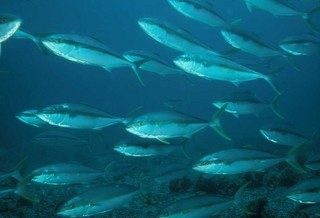
YELLOWTAIL FARMING?
BUT WILL THEY EAT A YO-YO JIG?
Originally Published the Week of March 20, 2014 in Western Outdoor News
While at the Long Beach Fred Hall Fishing Show a few weeks ago, I was directed to an interesting article by a friend who is a commercial fisherman and sportfisherman. The title kinda piqued my interest:
“NEW FARMED YELLOWTAIL HITS U.S. MARKET”
According to the article published in Seafood Source.com on March 7, 2014 (http://www.seafoodsource.com/en/news/aquaculture/25678-new-farmed-yellowtail-hits-us-market), these forkies are being formed right in Baja out’ve Bahia Magdalena. Yes, real yellowtail ranches!
Here’s the article:
“California-based seafood distributor Catalina Offshore Products, and Baja Seas have partnered to bring a new farmed yellowtail to the U.S. market.
Baja Seas will officially introduce its Baja farmed yellowtail, also known as Baja hiramasa, at Seafood Expo North America in Boston on 16 to 18 March. Catalina Offshore Products has been test marketing the fish and it has already appeared on menus in from San Diego and Chicago.
The original stock was bred for Baja Seas from fingerlings produced at Hubbs-SeaWorld Research Institute. The fingerlings were transferred to Baja Seas’ grow out facility on Bahia Magdalena, a bay in southern Baja California. Future seed will be sourced from Baja Seas’ own hatchery, Ocean Baja Labs.
Baja Seas uses Recirculating Aquaculture Systems (RAS) to create a small water footprint by diminishing pollution and disease; fish are fed sustainable protein- and omega-rich meal derived from sardines in a low Fish In-Fish Out (FIFO) ratio; the fish are raised without antibiotics or paraciticides; and semi-automated feeders and feed cameras prevent overfeeding.
“With consumers demanding more seafood and pressures on wild harvests increasing, we believe aquaculture is the one true sustainable model,” said Luis Astiazarán, Baja Seas’ director general. “Because of their growth rate when compared to other species, marine finfish are the future of aquaculture.”
“The debut of this Baja hiramasa is very exciting for us as it marks a major milestone for Mexico and for the U.S.,” said Dave Rudie, Catalina Offshore CEO. “It is not only a great, local alternative to Japanese or Hawaiian yellowtail, its presence in the domestic market will increase people’s access to a highly valued food source while decreasing pressure on our wild populations.”
It sounds like a good deal. I like eating yellowtail. I like catching yellowtail. I don’t know about the taste, but I have a feeling that the wild fresh stuff is gonna taste a lot better. I know wild salmon blows away farmed salmon.
But, I’m pickier than most because I grew up on Pacific coast fish. But, most folks I know wouldn’t know the difference.
I doubt that 90% of those ordering yellowtail in say, Red Lobster in the mid-west, would know the difference between wild or farmed yellowtail either. It’s probably going to taste just dandy to them.
Just like my friends from Montana and Idaho and Wyoming who are hunters. They can tell the difference between wild elk and ranch-raised elk meat. To me, it’s just good eating!
However, if there’s a viable way to take the pressure off the wild stocks so us sportsfishers can still throw an iron or dropper loop a bait yet help meet the demand of the market, I’m all for it. Win-win!
I’m especially interested in the aspect of this “farmed” yellowtail (no pun intended) if they’re raised with a small ecological footprint. Not using additives and anti-biotics in their food means the “fish poo” (excuse my Spanish), isn’t polluting the water.
That has been an issue in other aquaculture situations. Especially, since fish eat a tremendous amount of food to grow. What goes in…has to come out!
Additionally, if they’ve found a new way to feed these fish and NOT deplete the local bait situation, that’s a major plus for anglers. No bait…no fish! No fish…no fishing!
I talked to an amigo of mine, Scott McKenzie, Director of Quality Assurance at the huge American Seafoods in Seattle WA. Scott is also an avid Baja angler.
Here’s his take:
“The vast majority of Yellowtail consumed globally is farmed. Most of the farmed yellowtail comes out of Japan, with some small production in Australia and New Zealand. From what I’ve heard it is typically a 5:1 feed fish, meaning 5 lbs. of feed to return 1lb of fish weight. Not the most ideal species to farm with regard to feed conversion rates as those are typically down around 3:1, some are even down close to 1:1 these days.
One of the unsavory part of a lot of these farmed fish operations is they are often using low trophic species as the feed (sardines, mackerel, menhaden, anchoveta,…). The feed coming out of global fisheries that are nothing more than rendering fisheries ( primary products being fish oil, meal) rather than a by-product of a food fishery. In a nut shell, the ocean gets stripped of bait fish to be converted into feed for a farmed fish somewhere around the world.
The amount of antibiotics and crap that can go into them I will leave for another day…
Sad thing, most consumers get all warm and fuzzy thinking they are making green decisions when they opt for a farmed fish to eat- in so many ways, it is more environmentally detrimental than the wild caught equal.”
The world is growing. There’s more people to feed. Yet, we want a balance with our recreational activities. Everyone has an interest and a stake in things. It will be interesting to see how it plays out.
I wonder if farm-raised yellowtail can be released into the wild? I know they do it with salmon!
And, I for one, wouldn’t mind giving it a whirl on my dinner plate too!
That’s my story!
Jonathan

_______________
Jonathan Roldan has been writing the Baja Column in Western Outdoor News since 2004. Along with his wife and fishing buddy, Jilly, they own and run the Tailhunter International Fishing Fleet in La Paz, Baja, Mexico www.tailhunter-international.com. They also run their Tailhunter Restaurant Bar on the famous La Paz malecon waterfront. If you’d like to contact him directly, his e-mail is riplipboy@tailhunter-international.com or drop by the restaurant to say hi!
______________
Jonathan Roldan’s
Tailhunter International
TAILHUNTER FISHING FLEET #1 Rated on Trip Advisor
TAILHUNTER RESTAURANT BAR #1 Rated in La Paz on Trip Advisor
Now follow us on FACEBOOK TOO
Website: www.tailhunter-international.com
U.S. Office: 8030 La Mesa, Suite #178, La Mesa CA 91942
Mexico Office: 755 Paseo Obregon, La Paz, Baja Sur, Mexico
Phones:
from USA : 626-638-3383
from Mexico: 044-612-14-17863
.
Tailhunter Weekly Fishing Report:
http://fishreport.jonathanroldan.com/
Tailhunter YouTube Videos:
http://www.youtube.com/user/pangapirate
“When your life finally flashes before your eyes, you will have only moments to regret all the things in life you never had the courage to try.”













 That's My Story
“FINALLY READING BETWEEN THE LINES”
Posted in Baja, Baja Fishing, Baja Life, Baja Mexico Fishing, Baja Rockfish, Cabo San Lucas, cabrilla, dorado, Fishing, fishing reports, Fishing Tackle and Techniques, Fishing techniques, fishing tournaments, flyfishing, holidays in mexico, inshore fishing, inshore fishing in Baja Mexico, Jonathan Roldan, kids, kids fishing, La Paz, La Paz Fishing, Leisure, Living in Mexico, marlin, Mexican, Mexican business, Mexican culture, Mexico, Mexico economy, Mexico life, Panga Fishing, pargo, roosterfish, Salt Water Fishing, Sea of Cortez, Tailhunter International, tourism, Travel, Uncategorized, Western Outdoor News, Western Outdoor Publications, tagged baja, charters, commentary, fish, Fishing, fishing reports, Fishing Techniques, fishing tips, Jonathan Roldan, La Paz, mexican, mexico, mexico life, outfitters, sea of cortez, sportfishing, Tailhunter International, tourism, tourism growth, tours, travel, violence in mexico, western outdoor news, western outdoor publications on March 18, 2013| Leave a Comment »
Despite what many think, Mexico actually has one of the fastest growing tourism economies in the world as more folks are discovering Mexico as a great destination with Americans still comprising the majority of tourists with more than 24 million visitors expected this year.
“FINALLY READING BETWEEN THE LINES”
Originally Published the Week of March 20, 2013 in Western Outdoor News
It’s been an uphill battle.
Turn back the time machine about 2-3 seasons ago and it seemed that every other persons was asking me about the “violence in Mexico” or telling me they’d “Never go there again” or “I’d be in fear of my life!”
It seemed everyone had seen the news clips. Everyone had read the headlines. Everyone had a friend-of-neighbor-of-an-uncle-of-a-classmate who knew someone else who had been beaten, robbed, killed or eaten a bad taco.
Speaking at seminars and appearing at countless trade, travel, hunting and fishing shows over the years, it seemed the negativity was endless. Protest as I might…how could any of us who enjoy living and working in Mexico ever overcome the omnipotent power of the broadcast and print media?
We’re just little old us…mom and pop operations in Mexico…
How does one prove a negative? How do you prove something is NOT happening? How do we go up against CNN and FOX and the others and say, “Hey, thousands of tourists are NOT getting murdered!” “Hey, 200,000 Americans crossed the border today and NOTHING happened to them!”
Sigh…wring hands…shrug shoulders. Exhale. And hope.
But maybe things are changing. Lately, people specifically ask me if Baja is safe. Or is La Paz (where we live) or Cabo San Lucas safe. Things like that.
I tell them yes. Maybe show them some statistics and they’re fine with that. “I thought so,” they’ll usually say. Then, they move onto the good stuff like, “So, when’s the best time to come fishing?”
A few years ago, people would argue with me. Not so now.
Or, in the alternative, they affirm what we’ve been telling everyone.
They come out and pointedly tell me, that they’ve visited Cancun and Cozumel and Puerta Vallarta and Loreto and other tourist destinations and found them to be safer or at least as safe as being home. And enjoy travelling to Mexico. It’s a great value. The people are great. Love the food. Blah…blah…blah! Stuff we’ve always known, right?
Now, no one is saying Mexico doesn’t have a problem. Far from it. Mexico has some serious crime problems. But folks have been quick to point out that, “Hey, it’s not directed at tourists.”
“It’s in places we shouldn’t go anyway…like back alleys of Ciudad de Juarez!”
“Don’t do things you shouldn’t be doing and going to places you shouldn’t be going and you’ll be fine…like American cities. Every place has it’s bad areas. Don’t be an idiot. Stay out of bad areas!”
“I go to Mexico all the time. I feel safer there on the beach in San Carlos or Los Barriles than I do where I live in Phoenix and my car gets busted into all the time and several of my neighbors have been burglarized.”
“I’m tired of all the negativity. It’s in the news every time an American or tourist gets his wallet stolen in Mexico. How often does that happen in downtown New York and it never makes the news.”
It’s kind of refreshing in a strange way to have people trying to convince ME that it’s OK to be in Mexico. People are figuring it out on their own.
Unlike many tourist destinations, Mexico took 3 big strikes to it’s travel sector. First, was the economic downturn that seems to have hit the whole planet.
Second, of course, is the nervousness over violent crime.
Third, was the swine-flu scare. (Don’t get me started on that fiasco! Again… everyone knew a friend-of-a-friend-of-friend who had been stricken…sheesh).
But, Mexico’s on the rebound.
I’m not completely convinced yet that it’s due to an overall economic recovery for everyone. There’s still alot of bad stuff going on and we’re far from over. But, maybe folks are just adjusting to it all. Maybe they still know Mexico’s a good value and it’s close and yea…they’ve adjusted to the fact that it’s a pretty safe place to hang out with the bro’s and the family.
Indeed, statistics show that Mexico has one of the fastest growing tourist economies in the world. In excess of 24 million visitors take to Mexico yearly now. Americans make up the majority of Mexico’s tourism base as something like 4-8 million Americans visit annually. And suffer nothing more serious than a self-induced margarita hangover or a bad sunburn.
As a matter of fact, the fastest growing segment of Mexico’s tourism is coming from places like China, Russia, Columbia, Brazil and the Ukraine. And for years, having lived in Baja, the Italians, French and Japanese have been constant visitors as well.
This is all good news for Mexico and should be an assurance to those contemplating a trip south of the border where the most violent thing you encounter might be in the salsa you spoon into your tacos! Andale!
That’s our story!
Jonathan
_______________
Jonathan Roldan has been writing the Baja Column in Western Outdoor News since 2004. Along with his wife and fishing buddy, Jilly, they own and run the Tailhunter International Fishing Fleet in La Paz, Baja, Mexico www.tailhunter-international.com. They also run their Tailhunter Restaurant Bar on the famous La Paz malecon waterfront. If you’d like to contact him directly, his e-mail is riplipboy@tailhunter-international.com or drop by the restaurant to say hi!
______________
Jonathan Roldan’s
Tailhunter International
TAILHUNTER FISHING FLEET #1 Rated on Trip Advisor
TAILHUNTER RESTAURANT BAR #1 Rated in La Paz on Trip Advisor
Now follow us on FACEBOOK TOO
Website: www.tailhunter-international.com
U.S. Office: 3319 White Cloud Drive, Suite A, Hacienda Hts. CA 91745
Mexico Office: 755 Paseo Obregon, La Paz, Baja Sur, Mexico
Phones:
from USA : 626-638-3383
from Mexico: 044-612-14-17863
.
Tailhunter Weekly Fishing Report:
http://fishreport.jonathanroldan.com/
Tailhunter YouTube Videos:
http://www.youtube.com/user/pangapirate
“When your life finally flashes before your eyes, you will have only moments to regret all the things in life you never had the courage to try.”
Read Full Post »