Feeds:
Posts
Comments

Archive for the ‘dorado’ Category

“COVERING THE SPREAD”

“COVERING THE SPREAD”

Originally Published the Week of Aug. 8, 2013 in Western Outdoor News

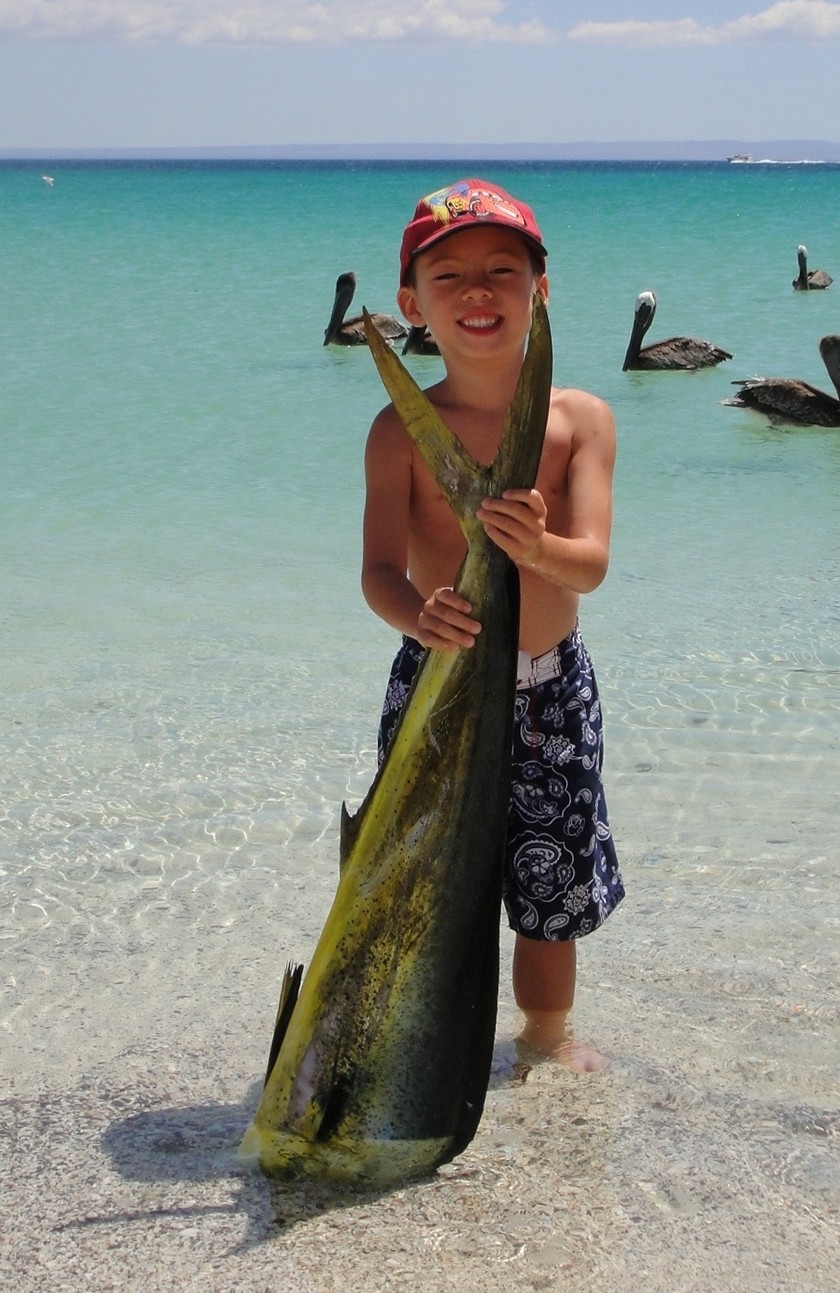
Lately, at least here in Southern Baja, there seems to be a dearth of live, or even dead bait.  It happens.  You still have to do your best to raise fish.  I mean, you’re already here.  It’s no one’s fault that the bait gods just didn’t happen to smile on your particular vacation dates.  So be it.

Be prepared.  Get ready to troll.  Cover some water.  I get asked all the time what would I recommend.

I usually don’t get hung up on having every color in the rainbow.  The days when I neede  two kinds of every conceivable lure is long gone and disappeared with the days of cheap airline tickets.  Besides, I’m too lazy and too old to carry that much gear anymore.

Now, I bring one dark and one light colored trolling feather in small, medium and large.  That’s it.  If my fishing partner or partners is bringing gear, I cut it back even further.   Let them carry the extra and pay for it!

But, honestly, agree among yourselves who is bringing what.  Gear can be shared as can the weight and the cost.

No sense in duplicating efforts and, given the penchance for airlines to charge for every extra bit of weight, it’s ridiculous to bring tons of stuff that will never get used.  Besides, you can only troll a limited number of lures at a time.  There’s no logic in bringing 20 or 30 lures!  Fight the urge.  You can do it!

Once you’re on the water, there’s a number of schools of thought on how to drag your lures and presenting a spread to the fish.  Veterans have their own multitude of theories and mine is just one guy’s opinion.

I used to subscribe to the technique of running light-colored lures during the brighter hours and the darker lures in the darker hours. Lots of fishermen do well with that.  But, for many years, now, I’ve been most productive with staggering my lure colors.

I run my brighter lures further back in the pattern.  I run my darker lures closer to the white prop wash.  If I have the ability to run more than 2 lures, I stagger them where one dark lure is right in the wash.  Another dark one on the edge of the wash and then two brighter ones staggered further back beyond says the 3rd and 5th wave behind the boat.

I believe the darker lures have a better presentation in the white water or near the white water where they create a more visible silhouette to the fish.

Regarding trolling speed, my general rule of thumb is somewhere in the neighborhood of 6-8 knots.  But I vary that.  The important thing is how the lures are swimming behind the boat.

I want the most action I can get from them so they create some kind of commotion.  I am also often reminding folks that pretty much any fish that has the ability to bite one of these feathers has the ability to swim way faster than the boat.  So goosing the throttle a few nudges to get the lures swimming correctly is a no-brainer.

That brings up another important variable.  Not all lures are created equal.  There are pusher heads (flat faced/ concave faced) .  Bullet heads (shaped like bullets natch).  Bubble/Jet heads (drilled with holes to make “smoke” bubble trails).  Slant heads (cut on an angle to dart back and forth or jump).  And others.

All of them have different characteristics.  Some work better at different times than others.

My general rule is the rougher the water, the more action I want from my lure to cut through all the surface disturbance on top of the water.  I want them to stand out as something “different” up there to potential predators.

To that end, again, trying to save space and weight is to pack bubble/jet heads or pusher head designs.  I like dragging them behind the boat so that they come jumping out of the face of trailing waves then dive back into the water with lots of splash and action.

Several stray suggestions:

If you only have small feathers or lures, consider making larger lures simply by sticking one inside of another.  Also, if you want to get down deeper, especially when nothing is close to the surface, either stick a torpedo sinker or egg sinker behind the head of the lure or simply tie a torpedo sinker to a leader ahead of the lure to make it swim deeper.

Give it a try!

That’s our story!

Jonathan

_______________

Jonathan Roldan has been writing the Baja Column in Western Outdoor News since 2004.  Along with his wife and fishing buddy, Jilly, they own and run the Tailhunter International Fishing Fleet in La Paz, Baja, Mexico  www.tailhunter-international.com.  They also run their Tailhunter Restaurant Bar on the famous La Paz malecon waterfront.  If you’d like to contact him directly, his e-mail is riplipboy@tailhunter-international.com  or drop by the restaurant to say hi!

______________

Jonathan Roldan’s

Tailhunter International


TAILHUNTER FISHING FLEET #1 Rated on Trip Advisor

TAILHUNTER RESTAURANT BAR #1 Rated in La Paz on Trip Advisor


Now follow us on FACEBOOK TOO


Website: www.tailhunter-international.com

U.S. Office: Box 1149, Alpine CA  91903-1149

Mexico Office: 755 Paseo Obregon, La Paz, Baja Sur, Mexico

Phones:

from USA : 626-638-3383

from Mexico: 044-612-14-17863

.

Tailhunter Weekly Fishing Report:

http://fishreport.jonathanroldan.com/

Tailhunter YouTube Videos:

http://www.youtube.com/user/pangapirate

“When your life finally flashes before your eyes, you will have only moments to regret all the things in life you never had the courage to try.”

Read Full Post »

“Ouch That’s Gotta Hurt!”

mexican-fishing-license-291x300

If only it was as easy as finding a KINKO’s to print them out!

OUCH THAT’S GOTTA HURT! (..again)

Originally Published the Week of July 23, 2013 in Western Outdoor News

So, often we hear the phrase “shot itself in the foot.”  So-and-so screwed up again and “shot itself in the foot.”  Sadly, when it comes to Mexico, you have to scratch your head.  Give it a shake and wonder, if it has as many feet as a centipede.   How many times can it cap a round into it’s own tootsies and keep walking?

Maybe you’ve already heard the latest.

You can’t get a Mexican fishing license in Mexico.  Chew on that for a minute.  Mexico has no fishing licenses.

You must still have a Mexican fishing license.  They inspectors are still out there.  But, you’ll be hard-pressed to find someone that will be able to sell you one down here.

Here in La Paz, at our Tailhunter operations, we normally have licenses to sell.  We sell a heap of licenses every year to our clients; our competitors clients as well as walk-in anglers.  We don’t make anything on them.  It’s a nice convenience for everyone and we’re happy to do it.

Previously, getting a fishing license was a 2-3 day ordeal and test of stamina and resilience, even here in big La Paz.  You filled out several forms.  You had to go to the CONAPESCA office.  Then off to the bank to pay the fee.  Then bring your bank receipt back to CONAPESCA.  Big difference from buying things over-the-counter at Walmart!

So, being one of the few places allowed to sell the fishing permits in 10 minutes is a wonderful convenience for everyone involved.

Several weeks ago, we were informed by CONAPESCA (Mexican Fish and Game) that they didn’t have any more licenses this year.  Not just us.  Everyone!

Loreto.  East Cape.  Cabo.  And not just us in S. Baja.  It was the WHOLE of Mexico.

We spoke with Tracy Ehrenberg from the Pisces Fleet in Cabo San Lucas and she phoned the main offices of CONAPESCA in Mazatalan.  Here’s their “We-shot-ourselves-in-the-foot” story.

Try to follow this.  According to Tracy, the new head of CONAPESCA simply “didn’t budget” for the printing of enough of the paper licenses to sell for the WHOLE COUNTRY.  Think about that one.  What no KINKO’s?

So, while some smaller outfits or out-of-the-way places might still have a stash of permits, they government is counting on YOU to purchase your fishing licenses online before you come down to Mexico!

There’s a few problems with that.   First, not everyone has computers.  Second, not everyone has printers.  Third, not everyone is computer savvy enough to navigate the Mexican website that sells the permits.  And…

Fourth, the website is about as primeval like it was built by a first-year intern as a school project.  It’s difficult to figure.  It makes mistakes.  It crashes all the time.  It sometimes takes your credit card, but gives you nothing to print out.   It’s very frustrating.

Several weeks ago when I notified our own clients about the situation, and posted the problem on our fishing reports, I must have gotten 20 phone calls and e-mails a day from livid, confused and frustrated anglers.

In fairness, eventually, with enough persistence, everyone got their licenses.  It eventually works and it seems that someone there at CONAPESCA has put the website on a larger server.  It doesn’t crash as often.

But, Mexico tourism didn’t need another SNAFU like this.  It’s supposed to be making it easier and more stress-free to visit, not throw another hurdle in the way of a vacation! How many times can it fire a round into it’s foot again?

Can you imagine the outcry if all the Fish and Wildlife operations in the U.S. “forgot” to print up enough fishing licenses or hunting tags…and yet still enforced them with inspectors out there in the field and on the water?

If you’re coming down, just make a note about the licenses and bear through it.  Here’s how to do it:

Here is the website:  https://www2.ebajacalifornia.gob.mx/Pesca/


•    Click the American flag and it will be in English

•    You want to purchase the fishing license for the “FEDERAL ZONE.”

•    Do not be alarmed at the price…it’s in pesos!!!  So just divide by 11 or 12 and that’s the rate in dollars and it will show up on your credit card statement in dollars.

•    If it’s slow or doesn’t work at first, try again later.  With this announcement, everyone in southern Baja has to purchase their licenses this way! 

There is also some other alternatives:

You can also get them from CONAPESCA San Diego, but must send a cashier’s check.  They also process the paperwork the same day and will mail you your permits.   Here’s the link:  http://www.conapescasandiego.org/.  Their phone number is: 619-233-4324

There’s a third option as well.

In Southern California, a number of well-known fishing tackle stores sell them and, if you can’t go to visit, they will take your information over the phone or via e-mail.  They will process the form for you and mail you out your fishing fishing licenses.  It’s fast, it’s easy.  But they have limited amounts as well, and after they sell their stash, they’ll be having trouble getting licenses as well.

Also many of the sportfishing landings in Southern California, especially in San Diego all have fishing licenses to sell.  That’s another alternative.

Most of the time, the website works fine these days.  Just persevere if it doesn’t work the first time.  There’s also the other aforementioned ways to get your license.

Don’t cancel your trip.  Just take a breath and know that it’s as frustrating for us down here as well and we don’t want you being surprised when you get down here and there’s no fishing licenses.

That’s my story!

Jonathan

______________

Jonathan Roldan has been writing the Baja Column in Western Outdoor News since 2004.  Along with his wife and fishing buddy, Jilly, they own and run the Tailhunter International Fishing Fleet in La Paz, Baja, Mexico  www.tailhunter-international.com.  They also run their Tailhunter Restaurant Bar on the famous La Paz malecon waterfront.  If you’d like to contact him directly, his e-mail is riplipboy@tailhunter-international.com  or drop by the restaurant to say hi!

______________

Jonathan Roldan’s

Tailhunter International

Website: 

http://www.tailhunter-international.com

Mexico Office: Tailhunter International, 755 Paseo Obregon, La Paz, Baja Sur, Mexico

U.S. Mailing Address:  Tailhunter International, P.O. Box 1149, Alpine  CA  91903-1149

Phones:

from USA : 626-638-3383

from Mexico: 044-612-14-17863

.

Tailhunter Weekly Fishing Report:  http://fishreport.jonathanroldan.com/

Tailhunter YouTube Videoshttp://www.youtube.com/user/pangapirate

“When your life finally flashes before your eyes, you will have only moments to regret all the things in life you never had the courage to try.”

Read Full Post »

hogar-de-ancianos-santa-marta

LEAVING SOMETHING ON THE PLAYING FIELD

Originally Published the Week of July 9, 2013 in Western Outdoor News

In all the years down here in Baja, one of the funnest things I ever did had nothing to do with being on the water.  It had a lot to do with being on this planet.

But there we were…us and a handful of fishermen running up and down the aisles of the local La Paz grocery store tossing handfuls of everything in the basket.  Money and cost be damned!

It was like turning kids loose in a candy store!

Remember those old TV shows where the winner got 10 minutes to put as much of anything the could find into the shopping cart before the buzzer rang?  That’s what it was like.   Gleeful fun.  Giddy fun.

Store attendants looked on in horror!

Jimmy was putting bags of rice and beans in his cart and piling that-up with cartons of eggs.

Mike was literally doing a balancing act by pulling cans of soup or vegetables into his cart and making a mess dumping boxes of cereal and soap and juice into his overflowing cart.

Terry had parked in the produce section.  He was busy bagging tomatoes and apples, onions and oranges and trying to squeeze watermelon underneath near the wheels.

On the other end of the store, Larry already had some huge frozen hams in his cart.  He had just laid wasted to the bacon, poultry and hot dogs and was now assaulting the dairy section for milk, yogurt and butter.  See, Larry run!

Laughing like a little kid, I found Mario in the liquor aisle putting jugs of wine on top of boxes of cookies…donuts… and potato chips!

I looked at him puzzled…”Not exactly healthy stuff there, Mario!”

“Hey…they’re OLD…they’re not DEAD! They should have some fun!” he yelled back.

I had to laugh.  All of this “largesse” was headed to one of the old-folks home here in La Paz.  Yes…”old but not dead and certainly entitled to fun!”

As soon as all of this was loaded into the van, we were headed there to the senior home to play summer-time Santa Clause…a total surprise!

Every year this group pulls this crazy stunt.  Their last day in town is a “run through the market” followed by a visit to the senior home to big smiles, hugs, and grateful handshakes from a group so often forgotten.

The seniors are so often forgotten.  They’re not cute.  Many can’t speak.  They sit for hours just staring.     One of the gents gets a special smile as he pulls the bottle of tequila from the boxes of groceries and flashes a toothless grin!  I  would have bet the barn that he squirrels it under his shirt and sneaks back to his room!

But they aren’t the only ones.  We have another group of anglers that takes all the fish from their last day of fishing. They donate it to whatever cause seems to be the most needy.  Sometimes, it’s the seniors.  Sometimes it’s the kids.

It doesn’t matter.  It seems that they fish especially hard that  last day because they know that even “junk fish” like bonito will be more than welcomed.  Jack crevalle and triggerfish all go into the ice chests ready to fillet!

Again, the smiles are priceless.

I have another group of good-Joes.  They fish with us and eat at our restaurant.  They automatically put up $50 bucks a head.  They order and eat off the $50.

They order a 10-dollar burger or plate of tacos and nachos.  The remainder is a donation to charity.   If they have 10 or 20 guys…that can be a nice sum that buys a lot of dry goods,  toiletries, rice, beans and yes…pampers and toothpaste.

Others aren’t so grand, but bring whatever they can.

A dentist brings cases of the extra sample toothbrushes  sent to his office. He has us give it to an elementary school near Las Arenas.  A doctor gets boxes bandages.

A guy who sells paper products brings note pads and colored-pencils.  Kids who treasure each piece of paper act like gold,  bust out huge smiles.

Another group collects old sporting goods cast-off by their own kids who have outgrown them. They come down with baseball gloves,  a catchers mask,  some old rubber bases and deflated soccer balls and basketballs that can be inflated again.  Old sweaty baseball hats with MLB logos are treated like winning lottery tickets.

Eyes glow.  Handshakes exchanged.  No words necessary.   It’s universal.  Win-win.  Priceless friendship and gratitude.

Things that we so often take for granted like toothpaste and soap and shampoo are a luxury.   We go through sports gear as fast as we visit our sporting goods store and see a new model that promises to make us stronger, faster, or better.

We don’t give 2nd thoughts about how important something like pampers or socks or clean t-shirts might be.  Or just what a treat a cheap sip of wine might be  even if served in a Dixie cup.

You always hear athletes talking about “going all out” and “leaving it all out there on the court or field.”  Give it your all.  Regret nothing.

Here in Mexico, leaving even a little something behind on the playing field is makes everyone a winner.

That’s my story!

Jonathan

_______________

Jonathan Roldan has been writing the Baja Column in Western Outdoor News since 2004.  Along with his wife and fishing buddy, Jilly, they own and run the Tailhunter International Fishing Fleet in La Paz, Baja, Mexico  www.tailhunter-international.com.  They also run their Tailhunter Restaurant Bar on the famous La Paz malecon waterfront.  If you’d like to contact him directly, his e-mail is riplipboy@tailhunter-international.com  or drop by the restaurant to say hi!

______________

Jonathan Roldan’s

Tailhunter International


TAILHUNTER FISHING FLEET #1 Rated on Trip Advisor

TAILHUNTER RESTAURANT BAR #1 Rated in La Paz on Trip Advisor


Now follow us on FACEBOOK TOO


Website: www.tailhunter-international.com

U.S. Office: Box 1149, Alpine CA  91903-1149

Mexico Office: 755 Paseo Obregon, La Paz, Baja Sur, Mexico

Phones:

from USA : 626-638-3383

from Mexico: 044-612-14-17863

.

Tailhunter Weekly Fishing Report:

http://fishreport.jonathanroldan.com/

Tailhunter YouTube Videos:

http://www.youtube.com/user/pangapirate

“When your life finally flashes before your eyes, you will have only moments to regret all the things in life you never had the courage to try.”

Read Full Post »

THE BAJA HANDFUL OF KNOTS

They come in all shapes and sizes!

They come in all shapes and sizes!

MY BAJA HANDFUL OF KNOTS

Originally Published the Week of June 26, 2013 in Western Outdoor News Publications

If you ever want to start up a conversation among a group of fishermen or suddenly get a room of yakking party-ing guys to stop talking and gather around, there’s one sure-fire way that I’ve found.  It never fails.  Instant focus.

Just start talking about fishing knots.

Instant Pavlov’s dog and the dinner bells with 100-percent success.   It works even better if you happen to have a spool of line and some hooks.   If the crowd is relatively inexperienced, there’s almost a hush.

If the gathering has more veteran fishermen, it’s instant debate.  It’s like throwing bloody chum in the water or handfuls of  live bait into boiling tuna.  No one can resist plugging into the conversation!

I’m not even going to touch opening the subject with flyfishermen who’s knowledge and propensity toward complicated knot tying requires a PhD. In physics.

But for your average fresh and saltwater  weekend warrior and occasional Baja and long-range guy, everyone has an opinion on knot tying or is certainly “all-ears” to see what’s new and exciting or missing in their knot-tying arsenal.

I think almost all of us who have spent even a little time on the water know or, at some time back-in-the-day, learned the clinch knot or the improved clinch knot.  It’s the one they use to print on the back of packs of hooks and other accessories.  If  my fuzzy memory serves,  it was printed on a lot of Berkely produces and some still call it the Trilene knot.

I’m pretty sure it’s the one my dad first showed me.  Boy, did I practice and practice that one.  In fact, I remember mom catching me in my bedroom  floor long after bed-time.  I was  tying knots by the light of a flashlight  and using my 2nd grade scissors to trim off the tag ends! Mom just said, “Oh Jonathan…” and left me alone! I know when she told dad, he cracked up.

I guess in the passing of time, I’ve learned quite a few knots.   All serve their purposes.  What great names!  They sound like cocktails…The Bimini Twist…the Cat’s Paw…the Arbor…the Australian Braid…the Bristol…the Nail…the Blood knot…the Albright Special…the Orvis.  There are hundreds!

I once had a friend who would spend hours trying to develop some new knot just so he could claim it and have his name on it…forever…his legacy sealed in angling lore.  Terrible fisherman, but he sure knew how to tie knots!

Anyway, between you and me…frankly…the only reason to know that many knots is to impress people.  Like a name-dropper at a cocktail party.  People’s ears perk up when they hear names like the Palomar and the Spider Hitch.  And, I admit, when I want to direct attention to myself…like I said, start talking about knots and throw in some fancy names and it’s like a magnet!  Try it sometime.

Go get yourself a knot tying book or look up on the internet or youtube and there’s some great stuff to learn.  Then pull out some fancy names next time you’re among friends.  Like some guy who learned some card tricks, every fisherman within ear-short will be listening to you!

But, in full disclosure, for the several dozen knots I know,  there’s maybe only a handful that I ever really use and maybe only 3 or 4 that I use 95 percent of the time.  These are knots that you SHOULD know and with them under your belt, there’s not too much you can’t do.

It’s like rock ‘n’ roll.  If you know 3 simple chords and a decent 12-bar progression, you can probably play…well…just about anything!

The most important knot that I use is the San Diego knot.  I call it the most important because it’s the knot that joins my line to the hook.  It’s the last line of  attack and the part that attaches me to the fish.  So it better be a good knot!

It’s a variation of the Uni knot (you can look all of these up) and I’ve also seen it called the Duncan knot and the San Diego Jam knot.   It takes a few minutes to grasp the concept and a few more to learn it well.  But it’s worth it.

It has never failed.  The line might break but, in my experience, the knot has never broken, even on the largest fish I’ve tangled with.   I’ve seen tests run and it’s pretty hard to beat it’s breaking strength.  It’s variation called the  Double San Diego knot (merely doubling the lines) is even better and a standard knot here in Baja and on the long range San Diego fleet.

If you learn it well, it is also a handy knot to join to lines together like a mainline to a leader.

Which leads to my 2nd most important knot which is the Overhand knot.  It’s my personal favorite not only for joining lines, but especially to join lines of dissimilar diameter.  When you’re in a hurry to join  mono leader to braided line (not the best, but serviceable) it’s also handy.  If you know how to tie your shoe, this knot is that easy.  Learn it and remember it!

My last knot would be the Surgeon’s Loop.  It’s pretty much as easy as over…under…and through.  And you’re done!  Like the ads on TV…”even a caveman could do it.”  It’s great for …well…making loops to hold sinkers…to hold hooks.   I use it a lot.  I use it a lot more than the  dropper loop if I’m tying the loop to a sinker.

Fishing in rocks, if the sinker gets stuck on the bottom, the dropper will break easier than the dropper loop and at least let you get your main line back.

If I need a loop to tie the hook to…then the Dropper loop is my choice.

And that’s it!  Not much you can’t do with this handful!  Learn them and it will cover almost everything but the most specialized situations.

That’s my story

Jonathan

_______________

Jonathan Roldan has been writing the Baja Column in Western Outdoor News since 2004.  Along with his wife and fishing buddy, Jilly, they own and run the Tailhunter International Fishing Fleet in La Paz, Baja, Mexico  www.tailhunter-international.com.  They also run their Tailhunter Restaurant Bar on the famous La Paz malecon waterfront.  If you’d like to contact him directly, his e-mail is riplipboy@tailhunter-international.com  or drop by the restaurant to say hi!

______________

Jonathan Roldan’s

Tailhunter International

Website: 

http://www.tailhunter-international.com

Mexico Office: Tailhunter International, 755 Paseo Obregon, La Paz, Baja Sur, Mexico

U.S. Mailing Address:  Tailhunter International, P.O. Box 1149, Alpine  CA  91903-1149

Phones:

from USA : 626-638-3383

from Mexico: 044-612-14-17863

.

Tailhunter Weekly Fishing Report:  http://fishreport.jonathanroldan.com/

Tailhunter YouTube Videoshttp://www.youtube.com/user/pangapirate

“When your life finally flashes before your eyes, you will have only moments to regret all the things in life you never had the courage to try.”

Read Full Post »

OLYMPUS DIGITAL CAMERA

Just having bait isn’t enough if you don’t know how to use it correctly!

“HOW YOU WIGGLE YOUR WORM”

Originally Published the Week of June 10, 2013 in Western Outdoor News

In the annals of bathroom graffiti, it’s probably not hall-of-fame material as far as that genre of graffiti goes.  But in our Tailhunter Restaurant here in La Paz, someone scribbled this in the men’s restroom:

“It’s not the size of the rod, it’s how your wiggle your worm.”

Any business owner knows that you have to wear many hats. Being the big-time chief executive officer and chairmain of the board and also head of bathroom graffiti eradication, I happened to be scrubbing it off the wall chuckling.   Beyond the most obvious bathroom connotations,  there’s a point of pescatory wisdom in there as well.

How one wiggles, jiggles or shakes one’s “worm” does make a difference and those nuances can make a big difference in your fishing experiences on a given day.

A perfect example is the type of fishing being experienced in many Baja locations this time of year.  We’re in a “transition” period as waters warm and we move out’ve spring and into summer conditions.  Cooler waters can still be found but there’s quite a mix of water situations both on the surface as well as vertically through the water columns with different thermoclines changing as the waters deepen.

The result is that the spring and early summer can often be a mecca of so many different varieties of fish and opportunities for anglers looking for changing angling experiences.

Here in La Paz is a perfect example.

Cool water inshore species such as yellowtail, amberjack, cabrilla, pargo, sierra and pompano can be caught while in the warmer water areas, billfish such as marlin and sailfish are starting to rev things up.  Likewise, bluewater species such as dorado, wahoo and tuna can be caught as well.  Add in roosterfish, jack crevalle, bonito and others and you probably won’t find this kind of variety during any other time of the Baja fishing season.

However, bait presentation a.k.a. “wiggling your worm” can make a big difference over what you catch.

For instance over all the decades here in Baja working and guiding plus working  on other boats out’ve S. California, I’ve noticed a few things.

Take dorado.  They don’t like dead bait as much as spirited live bait.  In fact, the livelier the better.  It’s like a cat.  If you put a ball in front of kitty, he’ll just stare at it.  But, if you roll that ball past Kitty, he pounces.  Same with dorado.

Big baits or small baits don’t matter to dorado.  I’ve seen 18-inch juveniles attack 10-inch mackerel or big caballitos.  I’ve seen 40-pound bull dorado fight each other for 4 inch sardines…as long as the sardines are moving!

On the other hand, tuna can be fussier in their own way.  The smaller ones will take anything live or dead.  But, I’ve seen a tendency for a bit of laziness.

Tuna…and especially the larger ones…in a given school prefer the smaller baits.  And, they don’t mind slurping up dead ones or parts of dead ones!  That’s why chumming and chunking are so effective.

Chunks of dead bait are just fine.  They’re lazy fish.  They don’t necessarily like to have to chase their food.   So, if you don’t have small dead baits, then chunks of bigger baits like squid, mackerel, jacks are just fine by them!

Rock fish like cabrilla, yellowtail and amberjack won’t generally eat dead baits but yellowtail and amberjack don’t want to chase too hard for their live baits.  Somewhat like larger tuna.

However, these “structure fish” tend to stick close to protection and will dart out to strike their prey.  Therefore, the closer you fish that live bait to their hiding spots like rocks, reefs, weeds and cliffs, the better your chances.

Yellowtail are a bit pickier…the FASTER and LIVLIER that bait, the more it gets their juices rolling.  That’s why yo-yo jig fishermen prefer high-speed reels when they fish their lures.  That’s to get those lures moving FAST through the water.

Beach and shore fish like jack crevalle, pompano and roosterfish have a weird tweak.  They don’t even need to be hungry to chase a bait.  They’re just aggressive fish.

But, they will take the liveliest bait and run with it and not eat it!  They will tear into sardine schools, ballyhoo, caballitos, mullet and lady fish and simply terrorize the school.  Just because!  No other reason!

I’ve seen them rip into the baitfish and leave dead and thrashing baits lying around on the surface or grab a big baitfish like a ladyfish (sabalo) and merely gnaw it up like a bit dog gnaws on socks.  Then, tosses it into the air and lets it go.

While other species might come back for injured baits, some of these “beach bullies “simply swim off and let the gulls and pelicans deal with the maimed!

So, fishing for these fish, just be prepared for the bite with the liveliest bait  but then give it time so make sure the fish also has the hook!   If it drops the bait, even if the bait seems dead and floating, some quick jerks on the line can cause the jacks to turn and erupt for a second pickup…and your hookup!

That’s my story!

Jonathan

______________

Jonathan Roldan has been writing the Baja Column in Western Outdoor News since 2004.  Along with his wife and fishing buddy, Jilly, they own and run the Tailhunter International Fishing Fleet in La Paz, Baja, Mexico  www.tailhunter-international.com.  They also run their Tailhunter Restaurant Bar on the famous La Paz malecon waterfront.  If you’d like to contact him directly, his e-mail is riplipboy@tailhunter-international.com  or drop by the restaurant to say hi!

______________

Jonathan Roldan’s

Tailhunter International


TAILHUNTER FISHING FLEET #1 Rated on Trip Advisor

TAILHUNTER RESTAURANT BAR #1 Rated in La Paz on Trip Advisor


Now follow us on FACEBOOK TOO


Website: www.tailhunter-international.com

U.S. Office: Box 1149, Alpine CA  91903-1149

Mexico Office: 755 Paseo Obregon, La Paz, Baja Sur, Mexico

Phones:

from USA : 626-638-3383

from Mexico: 044-612-14-17863

.

Tailhunter Weekly Fishing Report:

http://fishreport.jonathanroldan.com/

Tailhunter YouTube Videos:

http://www.youtube.com/user/pangapirate

“When your life finally flashes before your eyes, you will have only moments to regret all the things in life you never had the courage to try.”

Read Full Post »

“KING JACK”

Amberjack Junior Azores tags

Big and tough…amberjack in the Baja…cousins to yellowtail, the Spanish name for them is “Pez Fuerte” which means “strong fish!” No kidding. They get over 100 pounds!

KING JACK!

Originally Published the Week of May 15, 2013 in Western Outdoor News

It had been a pretty decent morning off the northern end of the island.   Dropping blue and white irons and jigging,  some heavy “winding and grinding” and elbow grease had produced a  nice brace of  five solid  20-pound-class yellowtail in the box.

Danny just finished pulling his jig out of the water and took a break to wipe his brow and crack a chilly Pacifico can from the ice chest.   The sun was at it’s mid-morning blaze already promising to get hotter.

“Whew!” he sighed with a laugh.  “This is hard work fishing the yo-yo iron for these yellows.  These things are tough fish!”  he added with a bit of exasperation.

“And the faster your crank the better the chance to hook-up!” responded Tony as he dropped his jig over the side and watched it flutter into the indigo blue water.  “It’s still better than working!”

Tony’s jig stopped slipping down.  Tony quickly put the reel into gear  and took a few cranks up off the bottom so as not to hang the jig on the craggy reef below.
“Here we go again, “ he grinned as he started the strenuous arm-aching crank back to the boat.

One crank…two cranks…three cranks…

SLAM!  The rod doubles over in an abrupt halt.  It’s  almost yanked from Tony’s hands. He adjusts and is nearly jackpoled over the side ramming his knees into the side of the panga to anchor himself in!  The rod is bucked straining on the gunwale of the boat and Tony is almost crouching down to get leverage unable to turn the handle of the reel.

Danny drops his beer which clatters to the deck…

“Oh man! This has gotta be a monster yellowtail! WHOA!!!” grimaces Tony as he struggles to get upright and get the butt of his rod into his rod belt still unable to get a turn on the reel handle.  It’s all he can do to hold onto the rod and keep his feet in the panga.

Pez fuerte!” says their panga captain excitedly .  “Amberjack grande.  Jale! Jale! Pull hard!”

Pez fuerte means ‘strong fish’ said Danny as he watched his buddy.

“Uh yea…no kidding…yea..this is a horse!” replies a tight-lipped Tony as he struggles to turn the big fish one slow lift and turn of the handle of his reel at a time.  Repeatedly, the rod would dip again and the exhausted sweating angler would have to lean into the stick to keep the fish turned.

After 15 grueling minutes, the big fish came up and a quick gaff was put to the fish.

“Dang, that looks like a yellowtail on steroids! Holy cow, it’s golden copper what a pig of a fish!”

“Maybe 30 kilos…60 pounds,”  says the captain grinning.

There’s a lot of confusion over amberjack.  People either “sorta heard of them” or  scratch their heads because they’ve “never heard of them.”  Or it’s quickly followed by the question, “Is that kinda like a yellowfin tuna?”

Well, Elmer…no it’s not.  But, it’s a fair question nonetheless.

They’re actually part of the jack family.  It’s that same feisty set of brawling sportfish that give us the jack crevalle (“toro”),  roosterfish (“pez gallo”), pompano (“pompano”…of course) and a whole host of other fish with  “jack” in their names.  Including the much-prized yellowtail (“jurel”).

The amberjack (“pez fuerte…which does indeed mean “strong fish” in Spanish) is the king of them all.  He’s the big boy cousin.  Broader and deeper in body, shoulders and head with a copper-orange-yellow-silver patina, they’re impressive.  And yes, powerful.

Where we are here in La Paz, they range as small as 10-20 pounds, but 40-50 pounders are not unusual and the bigger models will go 80 or more pounds.  We’ve taken several fish over 100 pounds in recent years and have lost many large fish over the years that broke tackle as well as the hearts of some very strong anglers.

We seem to get them during that “shoulder time” when the waters aren’t really spring and aren’t quite summer…like May or June…just as our yellowtail bite starts to taper off because of warmer waters.

It’a almost like the yellowtail move on and the amberjack move into those same spots.  These include high spots like reefs and shallow seamounts as well as boulder and rocky areas plus the edges of drop offs.

Basically, you won’t usually find them in open water, but rather in areas of structure.  The largest one I ever saw was while scuba diving a wreck and I saw several ambers in the dark hold that were well over 100 pounds.

Like their smaller cousins, the yellowtail, amberjacks will often school so, where there’s one you’ll often find others.  Additionally, you fish them in much the same way.  That’s why anglers dunking for yellowtail are often surprised when they get slammed by something much bigger and more powerful…an amberjack.

The fish readily take a yo-yo jig in the traditional colors of blue/white,  green/yellow, brown/white and others dropped down and taken in on an ultra fast retrieve…like the two guys fishing at the beginning of this column.

As well, they love baits like sardines, mackerel, squid and especially zebra fish for some reason which are the little blue baitfish with black stripes we catch on reefs with mackerel rigs.  When I have some zebras and the amberjack are in the area, it’s almost instant hook up!

Best of all, they eat just like yellowtail…only better!

That’s my story!

Jonathan

_______________

Jonathan Roldan has been writing the Baja Column in Western Outdoor News since 2004.  Along with his wife and fishing buddy, Jilly, they own and run the Tailhunter International Fishing Fleet in La Paz, Baja, Mexico  www.tailhunter-international.com.  They also run their Tailhunter Restaurant Bar on the famous La Paz malecon waterfront.  If you’d like to contact him directly, his e-mail is riplipboy@tailhunter-international.com  or drop by the restaurant to say hi!

______________

Jonathan Roldan’s

Tailhunter International


TAILHUNTER FISHING FLEET #1 Rated on Trip Advisor

TAILHUNTER RESTAURANT BAR #1 Rated in La Paz on Trip Advisor


Now follow us on FACEBOOK TOO

Website: www.tailhunter-international.com

U.S. Office: Box 1149, Alpine CA  91903-1149

Mexico Office: 755 Paseo Obregon, La Paz, Baja Sur, Mexico

Phones:

from USA : 626-638-3383

from Mexico: 044-612-14-17863

Read Full Post »

Jonathan boat

FACING FORWARD LOOKING BACK

Originally Published the Week of May 4, 2013 in Western Outdoor News

One of my esteemed predecessors writing this column for Western Outdoors was the famous Fred Hoctor.  People described him in many ways.  A curmudgeon.  A crank.  Crusty.  Or worse!

Even he admitted to it. Always with a laugh.

But he was a helluva writer and one of those guys who just had the knack for spinning yarns and telling stories. He wrote columns and books including the iconic, “Baja Ha Ha” that can still be found in many bookshelves.  Say what you want, but “Old Fred” was prolifically brilliant and witty and one of the original Baja rats.

I started writing outdoor pieces about 30 years ago myself.  I don’t know where Fred got a hold of me or how, but he would call me up now and then.  To me, it was like Papa Hemingway or John Steinbeck calling.  I never really knew what to say or how to engage him in conversation.

Usually, though, it seemed as though he was calling to get something off his chest.

I’d pick up the phone and I’d hear, “Kid…this is Fred. (Never give his last name unless I asked it …so the first few times, it was just “Fred” as if no one else named Fred would have called me).

He’d say, “Kid, I read what you wrote in such-and-such a magazine.”  He’d say this in a his gravelly voice that sounded like central casting for a guy who smoked too many cigarettes…sucked the dust off too many Baja backroads… and raspy from tipping the bottle…sometimes I would swear he was tipping while he was talking.

He’d usually cuss at me a bit  and then launch into a story.  The story had nothing to do with anything I’d written.  He wouldn’t even comment on my writing.  He’d laugh.  Cuss s’more  and just hang up.  Never asked my opinion or try to converse. Never said good-bye or drop a salutation.  Just hung up.  Zzzzzz…dead air.  Dial-tone.

Uh…thanks for the call, Fred.  Nice to hear from you.

But, I always liked that he called me, “kid.”  It was nice to know that I was being read by someone!   It was like knowing that someone cool was watching me.   Someone older and wiser…(Fred passed away in 2001 and I’m sure being called “wiser” makes him just spin and hoot from the other side).

Somehow, I’ve always thought of myself as “the kid.”  I was always the younger guy around.   In the industry, there were all these older guys that I looked up to and who took me under their wings.  I felt like I was always sitting at the “kids” table at Thanksgiving and the grown ups were at the big table.

But a sobering thought hit me while pondering what to write for this week’s column.  That was 20-30 years ago and I’m on the near side of 60 years old now.   I’m not a kid and somewhere and sometime, I moved up to the big boy table.  And somehow more and more spaces kept opening up there.  Little-by-little, the grown ups passed on.

Mentally, I still feel like one of the young guys, but my salt-and-pepper beard and creaky joints tell a different story.   All my friends are this old too.  And there’s not too many ahead of me.

But, the sad thing is that there aren’t too many behind me either.

The kids table isn’t very filled anymore.  My generation seems to be the YOUNG generation even tho’ we’re retiring and having kids in college and seeing grand kids.  There isn’t much of a “younger generation” filling in the gaps behind us.

At all the hunting and fishing shows we attend with our booth, most of the operators and outfitters are about my age or older.   Most of the charter boat operators are my age or older.  At the seminars I do for fishing clubs…again…my age or older.

And the ones leaving the sport and leaving the industry simply fold up.  Their kids do other things.  It’s a hard life making ends meet relying on skill and the whims of Mother Nature.    The kids of the guys who participate in the sports have other attractions…X games…video computers…social media.  Heck, how many kids these days even go outside?

Even here in La Paz.  The kids of my captains, even though many go onto other jobs and professions, don’t come back to the water let alone wanting to do what dad does.

And the same for our fishing clients.  We’re all aging together.   I saw one group of firefighters several weeks ago who have come fishing with us for over a decade.

At dinner one night, I said, “Years ago, you guys would tear up the hotel.  You’d streak through the halls and do naked cannonballs into the pool.  I’d find you on the beach in the mornings passed out and drag you onto the pangas.  Now by 8 p.m. you’re all in your rooms watching CNN and asleep by 9 o’clock!”

We all laughed through our “reader glasses” we all bought from COSTCO.  Very simply, we got older!   The telling thing is that of the 20 or so guys, not a single one of them has kids that like to go fishing, nevermind coming to Baja.

Unfortunately, I think that bodes poorly on so many levels.  Wow.  I’m close to being the last of the generations to remember when the roads were all dirt…the tumbleweeds blew across a beach without high rise hotels…ice was non-existent…air-conditioning meant opening a window or opening a tent flap…gasoline was filtered through a t-shirt…the dinner menu was tortillas and whatever you caught…and you opened a beer with your fishing pliers.

After me…after us…the ranks are thin and thinning.

That’s our story…

Jonathan

________________

Jonathan Roldan has been writing the Baja Column in Western Outdoor News since 2004.  Along with his wife and fishing buddy, Jilly, they own and run the Tailhunter International Fishing Fleet in La Paz, Baja, Mexico  www.tailhunter-international.com.  They also run their Tailhunter Restaurant Bar on the famous La Paz malecon waterfront.  If you’d like to contact him directly, his e-mail is riplipboy@tailhunter-international.com  or drop by the restaurant to say hi!

______________

Jonathan Roldan’s

Tailhunter International


TAILHUNTER FISHING FLEET #1 Rated on Trip Advisor

TAILHUNTER RESTAURANT BAR #1 Rated in La Paz on Trip Advisor


Now follow us on FACEBOOK TOO


Website: www.tailhunter-international.com

U.S. Office: 3319 White Cloud Drive, Suite A, Hacienda Hts. CA 91745

Mexico Office: 755 Paseo Obregon, La Paz, Baja Sur, Mexico

Phones:

from USA : 626-638-3383

from Mexico: 044-612-14-17863

.

Tailhunter Weekly Fishing Report:

http://fishreport.jonathanroldan.com/

Tailhunter YouTube Videos:

http://www.youtube.com/user/pangapirate

“When your life finally flashes before your eyes, you will have only moments to regret all the things in life you never had the courage to try.”

Read Full Post »

DSC_0147

They say it’s better to be “lucky” than “good” but if you can be both, that’s even better and a few fine-tuning tips go a long way. Roger Thompson of La Ventana is very lucky but that’s because he’s very good! He makes his own “luck” as he shows off another dandy wahoo!

NEXT LEVEL WAHOO

Originally Published the Week of April 18, 2013 in Western Outdoor News Publications

This past week here in La Paz, we’ve had a sudden and unexpected run of wahoo.  Normally, at least for our area, it’s not a species we encounter so early in the year and it ended up surprising many of our anglers as well as captains.

The speedy sharp-toothed fish is incredibly-prized by anglers as one of the best eating but also one of the most ferocious fighters.  Reputedly capable of speeds up to 70 mph, they are arguably the fastest fish in the ocean.  I once described it to a client as dropping a hook and line over a freeway bridge and suddenly hooking a car passing underneath!  It’s definitely NOT a fish you would want to try to stop by putting your thumb on the spool unless you’re tired of having skin!

Fortunately, wahoo aren’t headed miles the highway but they are surely capable of blazing runs in one direction then turning on a dime and jetting off in another.  This requires anglers to keep that rod tip up and pointed in the general direction of the fish because it can go headed north one minute and seconds later go tearing west! I’ve seen guys comically sprint from bow to stern and back again trying to keep up!

Knowing how they feed and fight will increase your edge in putting one of these guys on the deck.  And that’s a big problem I saw this past week. We had lots of hookups, but the ratio of hookups-to-fish caught was unfortunate.  It seemed three of these fish were lost for everyone hooked.

For baitfishers, for all their speed, wahoo aren’t hard-charging feeders generally.  I’ve been underwater and watched them feed and have seen numerous videos.  With their razor-like teeth, wahoo will often get a bait and “scissors” it in half or into pieces.

They then come around and slurp up their food!  Like a guy who cuts up all his steak into bite-sized pieces before actually started to eat!

What I often see is someone who gets a tug on their bait.  They go “oh no!” and then start to crank it in thinking that the just got cleaned.  They pull in the bait and find their bait neatly missing it’s rearend as if someone has taken a scalpel to it.  If wahoo are in the area, best to just let it sit for a bit.  The wahoo will often come back around to “pick up the pieces.”

Many anglers enjoy throwing “iron” or “wahoo bombs” at the fish.  Great fun.  Cast and let it flutter down.  Marine biologists and lure manufacturers have told me wahoo have poor eyesight.  However, they pick up movement and vibration along those long flanks!

Therefore, the more movement you can impart to your lure or jig, the better your chances.  Shiny lures rather than painted lures have always been my preference.  My bombs are skirted with shiny metallic tinsel.  All my lure hooks have hammered little spinner leaves on them.

As they drop or on the retrieve,  twitch and jerk the lure so that it flutters as much as possible and appears like a wounded fish.  The wahoo pick up the movement and zero-in.   Then, when they get close the actual “flash” of the lure generates the strike.

I like to think of a cat.  If you put a ball in front of it, the cat can’t be bothered.  If you roll that ball or bounce it in front of the cat, it suddenly reacts!  That’s what you want with a wahoo.

As for trolling, think of the same things.  The “movement” pulls them in, but the color and presentation generate the strike.

Don’t worry about trolling too fast!  Remember, wahoo can outswim your boat!

I personally like to drag my wahoo Marauder, Rapala or heavy jet-head just inside and below the bubbles of the propwash.  I’ve seen wahoo come right up to the transom of fishing boats and still take trolled lures.  So, I don’t need to be a football field back with my lures!

Oh…and one other edge…I take treble hooks off my lures and replace them with single Siwash style hooks.  Wahoo have extremely hard jaws.   Treble hooks sometimes don’t pierce very deeply.  Single hooks jam in deeper.

Additionally, wahoo will twist and torque around when fighting.  They can torque themselves right off a hook, which I have often seen.  Again, this is an argument for the deeper-penetrating single hooks.

Sometimes just as the angler  gets “color” on the fish close to the boat and is mentally congratulating himself ADIOS!  Bye-bye, Mr. Wahoo.

Having single hooks in a lure, very often the second hook also twists around and then buries itself into the jaw or head at a different angle firmly securing the fish in an inescapable double-hook vise!

Whether you fish with bait, lures or are trolling, the biggest question is whether to use wire.    I think it comes to personal preference.

In several decades living here in Mexico and working boats and in the fishing industry, I see many captains and pros that debate the issue back and forth.  Personally, I believe I get more bites with straight mono and leave out the wire.  I lose more fish, maybe than the guy with wire.  But I do get more bites and most times, I can put the fish in the boat.   However, I use double leaders if I’m fishing mono.

First, it acts as a shock leader to take some of the strain off the initial hit.  Second, even if the wahoo cuts one side of my leader, I’ve rarely seen it cut through the other side of the leader.  And, like I said, I get more bites.  My bait and lures swim more naturally generating more strikes!  And to me, that’s what it’s about!

That’s our story!

Jonathan Roldan

_______________

Jonathan Roldan has been writing the Baja Column in Western Outdoor News since 2004.  Along with his wife and fishing buddy, Jilly, they own and run the Tailhunter International Fishing Fleet in La Paz, Baja, Mexico  www.tailhunter-international.com.  They also run their Tailhunter Restaurant Bar on the famous La Paz malecon waterfront.  If you’d like to contact him directly, his e-mail is riplipboy@tailhunter-international.com  or drop by the restaurant to say hi!

______________

Jonathan Roldan’s

Tailhunter International


TAILHUNTER FISHING FLEET #1 Rated on Trip Advisor

TAILHUNTER RESTAURANT BAR #1 Rated in La Paz on Trip Advisor


Now follow us on FACEBOOK TOO


Website: www.tailhunter-international.com

U.S. Office: 3319 White Cloud Drive, Suite A, Hacienda Hts. CA 91745

Mexico Office: 755 Paseo Obregon, La Paz, Baja Sur, Mexico

Phones:

from USA : 626-638-3383

from Mexico: 044-612-14-17863

.

Tailhunter Weekly Fishing Report:

http://fishreport.jonathanroldan.com/

Tailhunter YouTube Videos:

http://www.youtube.com/user/pangapirate

“When your life finally flashes before your eyes, you will have only moments to regret all the things in life you never had the courage to try.”

Read Full Post »

DSC_1600

Hard to believe it’s been almost 17 years now in Baja. It’s been grand, but where did the time go? Comes a time when you realize you’ve got more fishing days behind you than ahead of you and you count all the blessings!

NEED NOT GREED

Originally Published the Week of  April 4, 2013 in Western Outdoor News

I’m reminded of a father and son who attended a fishing school I had been giving many years ago at the old Hotel Las Arenas near La Paz.   We were fishing along the shallows on the east side of Cerralvo Island and my fishing school was all about fishing for rockfish like pargo (snapper) and cabrilla (seabass).

Papa Fred and young adult son, Todd, were with me on the panga that day.  It was their first time fishing in Mexico and it had been a number of years since they had fished together.

It was early morning and we were slow trolling the shallow reefs that ring the eastern side of the island.  Dad had taken several nice three or four-pound cabrilla and had flipped a few smaller ones back into the water.

Todd, the son, hadn’t caught any of the the larger ones, but had kept several of the smaller ones.   He had just hooked another and deftly popped it off the hook and tossed it into the fish box.

“Why don’t you let some of those smaller ones go, son?” asked Fred.

“The smaller ones are good to eat, Dad,” replied Todd.  “And besides, if we let them go, commercial guys or someone else is going to catch them anyway so we might as well keep them,” he said with a smile and a shrug.

The older gent squinted into the rising morning Baja sun and said,  “There’s this story I once heard about a big nighttime storm on the gulf coast.   In the morning, the beach was littered with starfish.  As far as the eye could see.  The storm had washed all these starfish up on the beach above the water line.  With the sun climbing into the sky surely, they’d start to bake and die off. “

A morning jogger came upon a young teenager walking from starfish to starfish picking them up and tossing them as far into the ocean as he could.  One at a time.

“What are you doing?” asked the jogger casually, as he pulled up to catch his breath.

“The storm washed all these guys up here onto the sand,” replied the youngster.  “I’m saving starfish,” as he picked up another and pitched it seaward.

“You’re crazy,” laughed the jogger standing tall and surveying with squinted-eyes all the starfish dotting the sand.  “There must be thousands.  You can’t hope to make a difference!”

“It makes a difference to this one…” said the teenager as he smiled at the jogger and picked up another starfish and tossed it back into the waves.

Little bits make a difference.

I will readily admit that in my fishing career, I’ve taken more fish than most.  That “career” has now spanned more than 50 years (ouch!) and started with my first bamboo rod and some shrimp for bait.  I’ve had the “bloodlust” where excitement over-rides better judgement and nothing is as important as hooking fish.

In those early days, it was about chest-thumping and high-fives. It was about catching more fish than the other fella and big heavy stringers.   Who hasn’t gone down that road a time or two…or more?   For me, that “road” was often a four-lane express-way and I was at the helm of a mack truck.

But somewhere in the last few years, that changed.   I don’t know when or where fishing became more important than catching.  Maybe it was realizing that I’ve probably got more fishing time behind me than ahead of me these days.

At some point, a day with my wife, family or friends on the water and  a bit of sunshine has become more crucial to my well-being and self-esteem than tight lines.  Reveling in a simple day when four walls…cell phones…and the internet weren’t sucking my soul dry were the best 5-star vacation ever invented.

Need vs. Greed.   My need to just take a breath  and put my toes in the sand trumps my former greediness to be putting fish in the boat…everytime…all the time.

And, although I still love catching fish and can do it with the best, maybe keeping just one or two for dinner, is enough.  Especially if it means breaking bread…er…tortillas to share with family and friends!

And more than it ever did…releasing fish to swim away is even more of a kick and makes a big difference in a small way…to that one fish.  And yes…to at least this one fisherman as well.

That’s my story!

Jonathan

________________

Jonathan Roldan has been writing the Baja Column in Western Outdoor News since 2004.  Along with his wife and fishing buddy, Jilly, they own and run the Tailhunter International Fishing Fleet in La Paz, Baja, Mexico  www.tailhunter-international.com.  They also run their Tailhunter Restaurant Bar on the famous La Paz malecon waterfront.  If you’d like to contact him directly, his e-mail is riplipboy@tailhunter-international.com  or drop by the restaurant to say hi!

________________

Jonathan Roldan’s

Tailhunter International

Website: http://www.tailhunter-international.com

Mexico Office: Tailhunter International, 755 Paseo Obregon, La Paz, Baja Sur, Mexico

U.S. Mailing Address:  Tailhunter International, P.O. Box 1149, Alpine  CA  91903-1149

Phones:

from USA : 626-638-3383

from Mexico: 044-612-14-17863

.

Tailhunter Weekly Fishing Report: 

http://www.tailhunter-international.com/fishreport.htm

Tailhunter YouTube Videos:

http://www.youtube.com/user/pangapirate

“When your life finally flashes before your eyes, you will have only moments to regret all the things in life you never had the courage to try.”

 

Read Full Post »

P2030008

Despite what many think, Mexico actually has one of the fastest growing tourism economies in the world as more folks are discovering Mexico as a great destination with Americans still comprising the majority of tourists with more than 24 million visitors expected this year.

“FINALLY READING BETWEEN THE LINES”

Originally Published the Week of March 20, 2013 in Western Outdoor News

It’s been an uphill battle.

Turn back the time machine about 2-3 seasons ago and it seemed that every other persons was asking me about the “violence in Mexico” or telling me they’d “Never go there again” or “I’d be in fear of my life!”

It seemed everyone had seen the news clips.  Everyone had read the headlines.  Everyone had a friend-of-neighbor-of-an-uncle-of-a-classmate who knew someone else who had been beaten, robbed, killed or eaten a bad taco.

Speaking at seminars and appearing at countless trade, travel, hunting and fishing shows over the years, it seemed the negativity was endless.  Protest as I might…how could any of us who enjoy living and working in Mexico ever overcome the omnipotent power of the broadcast and print media?

We’re just little old us…mom and pop operations in Mexico…

How does one prove a negative? How do you prove something is NOT happening?  How do we go up against CNN and FOX and the others and say, “Hey, thousands of tourists are NOT getting murdered!”  “Hey, 200,000 Americans crossed the border today and NOTHING happened to them!”

Sigh…wring hands…shrug shoulders. Exhale.   And hope.

But maybe things are changing.  Lately, people specifically ask me if Baja is safe.  Or is La Paz (where we live) or Cabo San Lucas safe.  Things like that.

I tell them yes.  Maybe show them some statistics and they’re fine with that.  “I thought so,” they’ll usually say.  Then, they move onto the good stuff like, “So, when’s the best time to come fishing?”

A few years ago, people would argue with me.  Not so now.

Or, in the alternative, they affirm what we’ve been telling everyone.

They come out and pointedly tell me, that they’ve visited Cancun and Cozumel and Puerta Vallarta and Loreto and other tourist destinations and found them to be safer or at least as safe as being home.  And enjoy travelling to Mexico.  It’s a great value.  The people are great.  Love the food.  Blah…blah…blah!  Stuff we’ve always known, right?

Now, no one is saying Mexico doesn’t have a problem.  Far from it.  Mexico has some serious crime problems.  But folks have been quick to point out that, “Hey, it’s not directed at tourists.”

“It’s in places we shouldn’t go anyway…like back alleys of Ciudad de Juarez!”

“Don’t do things you shouldn’t be doing and going to places you shouldn’t be going and you’ll be fine…like American cities.  Every place has it’s bad areas.  Don’t be an idiot.  Stay out of bad areas!”

“I go to Mexico all the time.  I feel safer there on the beach in San Carlos or Los Barriles than I do where I live in Phoenix and my car gets busted into all the time and several of my neighbors have been burglarized.”

“I’m tired of all the negativity.  It’s in the news every time an American or tourist gets his wallet stolen in Mexico.  How often does that happen in downtown New York and it never makes the news.”

It’s kind of refreshing in a strange way to have people trying to convince ME that it’s OK to be in Mexico.  People are figuring it out on their own.

Unlike many tourist destinations, Mexico took 3 big strikes to it’s travel sector.  First, was the economic downturn that seems to have hit the whole planet.

Second, of course, is the nervousness over violent crime.

Third, was the swine-flu scare.  (Don’t get me started on that fiasco!  Again… everyone knew a friend-of-a-friend-of-friend who had been stricken…sheesh).

But, Mexico’s on the rebound.

I’m not completely convinced yet that it’s due to an overall economic recovery for everyone.  There’s still alot of bad stuff going on and we’re far from over.  But, maybe folks are just adjusting to it all.  Maybe they still know Mexico’s a good value and it’s close and yea…they’ve adjusted to the fact that it’s a pretty safe place to hang out with the bro’s and the family.

Indeed, statistics show that Mexico has one of the fastest growing tourist economies in the world.  In excess of 24 million visitors take to Mexico yearly now.  Americans make up the majority of Mexico’s tourism base as something like 4-8 million Americans visit annually.  And suffer nothing more serious than a self-induced margarita hangover or a bad sunburn.

As a matter of fact, the fastest growing segment of Mexico’s tourism is coming from places like China, Russia, Columbia, Brazil and the Ukraine.  And for years, having lived in Baja, the Italians, French and Japanese have been constant visitors as well.

This is all good news for Mexico and should be an assurance to those contemplating a trip south of the border where the most violent thing you encounter might be in the salsa you spoon into your tacos! Andale!

That’s our story!

Jonathan

_______________

Jonathan Roldan has been writing the Baja Column in Western Outdoor News since 2004.  Along with his wife and fishing buddy, Jilly, they own and run the Tailhunter International Fishing Fleet in La Paz, Baja, Mexico  www.tailhunter-international.com.  They also run their Tailhunter Restaurant Bar on the famous La Paz malecon waterfront.  If you’d like to contact him directly, his e-mail is riplipboy@tailhunter-international.com  or drop by the restaurant to say hi!

______________

Jonathan Roldan’s

Tailhunter International


TAILHUNTER FISHING FLEET #1 Rated on Trip Advisor

TAILHUNTER RESTAURANT BAR #1 Rated in La Paz on Trip Advisor


Now follow us on FACEBOOK TOO

Website: www.tailhunter-international.com

U.S. Office: 3319 White Cloud Drive, Suite A, Hacienda Hts. CA 91745

Mexico Office: 755 Paseo Obregon, La Paz, Baja Sur, Mexico

Phones:

from USA : 626-638-3383

from Mexico: 044-612-14-17863

.

Tailhunter Weekly Fishing Report:

http://fishreport.jonathanroldan.com/

Tailhunter YouTube Videos:

http://www.youtube.com/user/pangapirate

“When your life finally flashes before your eyes, you will have only moments to regret all the things in life you never had the courage to try.”
Read Full Post »

« Newer Posts - Older Posts »