Feeds:
Posts
Comments

Posts Tagged ‘baja sur’

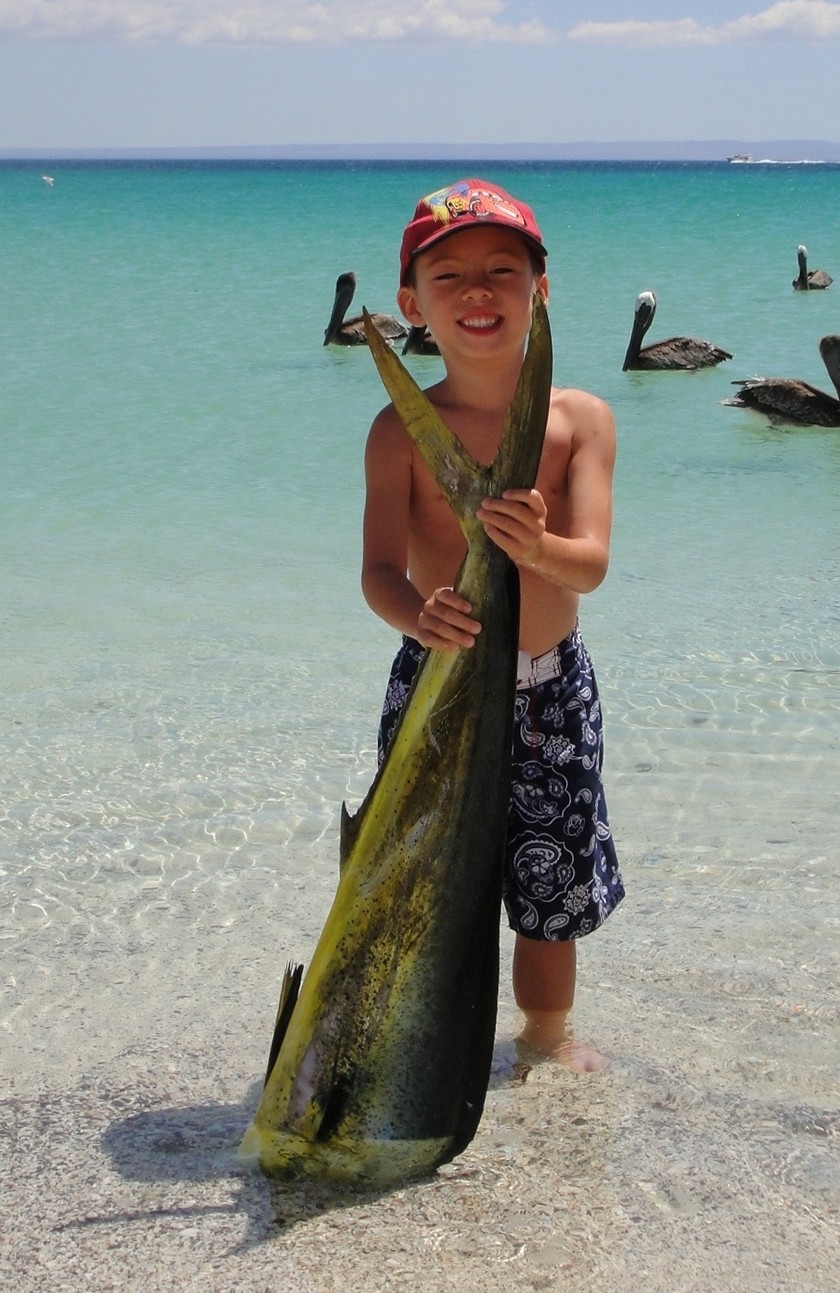
“You Mean I Can Keep It?”

What do you think?  It looks to me like Aiden's self-esteem is just fine!

Yes…I think we can bring this one home!

You Mean I Can Keep It?

Originally Published the Week of September 20, 2013 in Western Outdoor News

You Baja veterans should probably just web surf something else.  This might be old stuff to you.

But, often when you do something so long or something is “old hat” you forget that there’s still newbies out there who have valid questions about things that old Baja rats like us take for granted.

It’s a simple, but important issue.  I receive enough e-mails and phone calls asking if it’s OK to bring home fish.

Sometimes, my auto-response in my brain says, “Well..duh…that’s kinda dumb!  That’s like asking me if it’s OK to dip you chips in salsa!”

Of course, I can’t and would never say that because there are no such thing as dumb questions.  It’s a legitimate question and well-asked.   I mean, if you’re coming fishing in Baja, one would need to know if it’s OK to keep your catch.  Corollary to that, is it OK to bring some home!

But, I get asked about it enough as new folks are discovering Baja that I figured it was time to do another column about it and update my thoughts.

The question used to surprise me more.  But, having been in the industry now for almost 2 decades, us west-coast anglers might be surprised to learn that  there are many world-class fishing destinations that severely limit what you can keep.

Pay several thousand dollars a day and you get to keep say…one fish!  Or, you must release all fish.   Yes, it’s true!   For most of us who have fished the Baja since the age-of-dirt,  we pretty much always assume that as long as we’re within limits, everything hooked is coming home.

There may come a day when severe limits will be enforced, but that’s the subject of another column and someone with a lot bigger brain and bigger column than mine.

For now, the simple answer is yes, you may bring home your fish that you catch here in Baja.   As long as you’re within limits, by all means, bring some home.  Or have some cooked up while you’re still on vacation.  Nothing will taste better than fresh caught fish that was swimming around earlier that day!

Bringing fish home starts with taking care of the catch.  Treat it well and you’ll preserve the quality.

Once the fish is caught, if you can, have your captain or deckhand bleed it.  That’s not always possible when the action is fast-and-furious and lines are flying and it’s a three-ringed-water-circus out there.  However,  bled-fish…even lower-grade meat fish like bonito or skipjack will taste world’s better if it’s freshly bled.

Maybe the most important thing whether it’s bled or not is to keep it cold.  Warm water fish are…well…they’re warm!  As soon as they’re dead, like anything, they start to deteriorate.   And the hot Baja sun is not a friend to your future dinner!  Leaving a fish on the deck or even in a fish box without ice is pretty much like putting the fish in the oven.

So, at all levels from catch-to-stove or barbecue…keep your fish cold.  Ice is your buddy.   It’s a good question to ask when you book your trip if there’s ice aboard to keep your fish chilled.

After that, you need to store your fish while you’re still on vacation.

I see two cardinal sins all the time.  One is rinsing your fish in fresh water.  Or, even soaking it in fresh water.  That takes out all the flavor.  Secondly, the fresh water gets in and then freezes and now your have fresh water crystals in your fish which detracts from the quality and flavor.

Additionally, I often see people rinsing their fish in warm or tepid water.  Especially in Baja!  Water coming from pipes here is often very warm…or hot!  Amigo…not only is it fresh water, but moreso, you’re cooking your fish in the warm water.  If you have to use fresh water, make sure it’s cool water!    Ideally, clean saltwater is best.

The ideal method is to have your fish vacuum sealed.  It’s worth it!  Nothing is worse than beautiful fish fillets in a big giant frozen ball in your freezer.  You take it out and it’s either freezer burned or you now have a 10-pound ball of thawed fish.  And you really only need two fillets for dinner!  The rest get wasted.  Or the cats get it.

Vacuum sealing is the difference between fish that lasts a few weeks or fish that can last many months in your freezer so that your dorado caught in June tastes great in December!

If you can’t vacuum seal it, at least put it in good quality zip-lock style freezer bags.   Only put in what you’re planning to thaw for a meal.

An old Mexico trick is to put fillets in the freezer bag then lowering the bag into a bucket or sink of water.  The water forces the air out and then press the seal.  You get instant Mexican vacuum sealing!

Lastly, it’s really important to keep your fish in a good place while you enjoy the rest of your vacation.  As crazy as it sounds, we often encounter folks here who book their hotels and either do NOT have freezer or do not allow fishermen to store their catch.   That’s gonna be a buzz-kill.

Others, simply put, have crappy freezers that aren’t worth a hoot.   So, check on that.  The places that cater to fishermen or have a reputation for good fishing also have good storage facilities.  Or, if you’re booking through a charter operation, ask them about storing your fish in freezers.

Remember, that warm fish often takes awhile to freeze.  Or the freezers at a given hotel get a load of fish every night from all the anglers.  In even the best freezers it sometimes takes 24-hours to get solid.

If you’re leaving the next day, that could seem like a problem.  It’s not.  Put your least frozen fish on the bottom of your cooler.  Put your most frozen fish on the top (cold travels down).  Add extra insulation with crushed crumpled newspaper or your dirty fishing clothes and your fish will be fine!

That’s our story!

Jonathan

_______________

Jonathan Roldan has been writing the Baja Column in Western Outdoor News since 2004.  Along with his wife and fishing buddy, Jilly, they own and run the Tailhunter International Fishing Fleet in La Paz, Baja, Mexico  www.tailhunter-international.com.  They also run their Tailhunter Restaurant Bar on the famous La Paz malecon waterfront.  If you’d like to contact him directly, his e-mail is riplipboy@tailhunter-international.com  or drop by the restaurant to say hi!

______________

Jonathan Roldan’s

Tailhunter International


TAILHUNTER FISHING FLEET #1 Rated on Trip Advisor

TAILHUNTER RESTAURANT BAR #1 Rated in La Paz on Trip Advisor


Now follow us on FACEBOOK TOO

Website: www.tailhunter-international.com

U.S. Office: Box 1149, Alpine CA  91903-1149

Mexico Office: 755 Paseo Obregon, La Paz, Baja Sur, Mexico

Phones:

from USA : 626-638-3383

from Mexico: 044-612-14-17863

.

Tailhunter Weekly Fishing Report:

http://fishreport.jonathanroldan.com/

Tailhunter YouTube Videos:

http://www.youtube.com/user/pangapirate

“When your life finally flashes before your eyes, you will have only moments to regret all the things in life you never had the courage to try.”


Read Full Post »

“OOPS! Now What?”

problem

Oops…you really didn’t mean to kill that fish! That’s a buzz kill. What ya gonna do now?

OOPS!  Now What?

Originally Published the Week of Aug 22, 2013 in Western Outdoor News

It’s a dilemma I see all the time with our fleet here in La Paz as well as elsewhere I have been fishing.  Anglers wrestle with it all the time.  It’s the “Oops Event.”

It usually pops up in two different situations.

In the first one, you’re fighting a fish.  It’s a big one.  Usually, it’s a billfish like a marlin or sailfish or you hook onto a sportfish like a roosterfish or a jack crevalle.

You un-intentionally killed a fish.  You were going to let it go either because they just don’t taste good; or you don’t like to eat fish; or you didn’t intend to bring any home.  More likely, you’re just a good-guy-sportsman and planned to release the fish anyway.  It died.  Even after you tried to revive it.  Oops!

Or, hey…I’ve been there.  In the heat of battle, you’ve got the adrenaline running and the sweat pouring off your head and you didn’t speak up fast enough. And dangit…you WANT this beast in the boat for a photo! Well… An overzealous gaff swings and now there’s a dead fish on the boat.  Oh man…Oops!

Alternatively, in the other situation I see, anglers fish a few days.  They fish within limits.  The have a great time. They get what they want.  Release what they don’t.  All-in-all, just another great fishing trip to Baja.

Until, they pack up their fish to leave.  They start dropping frozen fish into the coolers and realize… “Hey, oh-oh.  We’ve got way too much fish.  It won’t fit in the ice chest and the airlines is gonna charge an arm-and-a-leg for being overweight.”  Oops.

Now what?  Dead fish on the deck.  Too many fish in the box.  Ice chest too heavy.  Oops!

I hear and see it pretty much every week.  When the fishing is running, it’s a common dilemma.   It happens.  No fish slaughter was intended.  No one broke any rules.  There was no malicious intent.  It’s just that suddenly there’s either an un-intended dead fish or there’s more fish than you wanted or needed.

I guess to me it’s really simple and there’s (to me) obvious solutions, but I’m asked about it often enough that it’s worth a column.

There’s several options.

First, feed yourself!  You’d be surprised when I tell people they can take fish to any local restaurant and have the eatery cook up fresh fish.  You should see the quizzical looks when I make the suggestion.   Really?  You can?  They will?

I mostly get this reaction from first-timers, who sometimes have a hard time wrapping their minds around the idea that you can just bring a bag of fish into a restaurant and have them cook it up.  When it hits them, they bust out the big smiles.  And the smiles get even bigger AFTER dinner when I ask them how it tasted.  It’s like an epicurean epiphany of sorts!

It’s just so uncommon to do that in the states, but here in Mexico, it’s pretty much given that some of the BEST meals you can have is taking your own fish to a restaurant to have it cooked up. Baja veterans look forward to it as one of the highlights of their trip.  It doesn’t even have to be a fancy restaurant.

We do it daily in our own Tailhunter restaurant here in La Paz with our own clients.  As I often tell our diners “nothing will ever taste better than fish that was swimming around that morning. That fish’s bad day will be YOUR great dinner!”

Secondly, remember.  Nothing gets wasted.

If you visit the touristy cities, or never leave the tourist areas,  it’s hard to conceive that many many people in Mexico virtually live on beans, tortillas and rice.  If that.

Sadly, that well-dressed waiter serving you that lobster dinner on the white table cloth has never actually eaten lobster or a piece of fresh tuna or dorado.  How would he ever afford it?  Believe it or not, most folks have never been fishing.  That’s what gringos do.

Or the smiling senora who diligently cleans your hotel room every day, probably goes home to a houseful of kids each night.   She makes-do with some dried machaca meat and beans or cup-o-noodles made with boiled water for dinner and some cans of Coke.

That great taxi driver who shuttles you all around town, earns 20 bucks a day after a 12 hour day. On a good day.  He goes home to a 2 BR apartment with a wife, 3 grown kids and 2 grandkids all living there and somehow that 20 bucks has to stretch.

Even in the pueblos, scarcity is even a bigger part of life.  Commercial and sportfishing captains and crews eat OK, but well…

Donations of fish are welcome, but most don’t have big refrigerators or freezers.  I know some that literally have the size-refrigerators kids put in their dorm rooms.  So, there’s not a lot of space for fish.  But, they have the means to catch food to eat.

However, friends and neighbors often do not have that ability.  So donations  of fish to any of these folks will usually be greeted with a huge grateful smile. Gifts to captains and crews get spread to the neighbors.

Even heads and carcasses that fishermen usually just toss into the garbage have huge amounts of meat on them and make great soup.  Nothing gets wasted.

As a third alternative,  most established fishing operations have charitable connections.  Be it a church, senior home or orphanage or the like.  If you leave fish with them, they’ll be sure to get it to folks who need it.

Bottom line is that never ever dump your fish.  There’s always someone who will be grateful for it!  Your  accidental “oops” can be turned into grins.

That’s our story!

Jonathan

_______________

Jonathan Roldan has been writing the Baja Column in Western Outdoor News since 2004.  Along with his wife and fishing buddy, Jilly, they own and run the Tailhunter International Fishing Fleet in La Paz, Baja, Mexico  www.tailhunter-international.com.  They also run their Tailhunter Restaurant Bar on the famous La Paz malecon waterfront.  If you’d like to contact him directly, his e-mail is riplipboy@tailhunter-international.com  or drop by the restaurant to say hi!

______________

Jonathan Roldan’s

Tailhunter International

Website: 

http://www.tailhunter-international.com

Mexico Office: Tailhunter International, 755 Paseo Obregon, La Paz, Baja Sur, Mexico

U.S. Mailing Address:  Tailhunter International, P.O. Box 1149, Alpine  CA  91903-1149

Phones:

from USA : 626-638-3383

from Mexico: 044-612-14-17863

.

Tailhunter Weekly Fishing Report:  http://fishreport.jonathanroldan.com/

Tailhunter YouTube Videoshttp://www.youtube.com/user/pangapirate

“When your life finally flashes before your eyes, you will have only moments to regret all the things in life you never had the courage to try.”
Read Full Post »

“COVERING THE SPREAD”

“COVERING THE SPREAD”

Originally Published the Week of Aug. 8, 2013 in Western Outdoor News

Lately, at least here in Southern Baja, there seems to be a dearth of live, or even dead bait.  It happens.  You still have to do your best to raise fish.  I mean, you’re already here.  It’s no one’s fault that the bait gods just didn’t happen to smile on your particular vacation dates.  So be it.

Be prepared.  Get ready to troll.  Cover some water.  I get asked all the time what would I recommend.

I usually don’t get hung up on having every color in the rainbow.  The days when I neede  two kinds of every conceivable lure is long gone and disappeared with the days of cheap airline tickets.  Besides, I’m too lazy and too old to carry that much gear anymore.

Now, I bring one dark and one light colored trolling feather in small, medium and large.  That’s it.  If my fishing partner or partners is bringing gear, I cut it back even further.   Let them carry the extra and pay for it!

But, honestly, agree among yourselves who is bringing what.  Gear can be shared as can the weight and the cost.

No sense in duplicating efforts and, given the penchance for airlines to charge for every extra bit of weight, it’s ridiculous to bring tons of stuff that will never get used.  Besides, you can only troll a limited number of lures at a time.  There’s no logic in bringing 20 or 30 lures!  Fight the urge.  You can do it!

Once you’re on the water, there’s a number of schools of thought on how to drag your lures and presenting a spread to the fish.  Veterans have their own multitude of theories and mine is just one guy’s opinion.

I used to subscribe to the technique of running light-colored lures during the brighter hours and the darker lures in the darker hours. Lots of fishermen do well with that.  But, for many years, now, I’ve been most productive with staggering my lure colors.

I run my brighter lures further back in the pattern.  I run my darker lures closer to the white prop wash.  If I have the ability to run more than 2 lures, I stagger them where one dark lure is right in the wash.  Another dark one on the edge of the wash and then two brighter ones staggered further back beyond says the 3rd and 5th wave behind the boat.

I believe the darker lures have a better presentation in the white water or near the white water where they create a more visible silhouette to the fish.

Regarding trolling speed, my general rule of thumb is somewhere in the neighborhood of 6-8 knots.  But I vary that.  The important thing is how the lures are swimming behind the boat.

I want the most action I can get from them so they create some kind of commotion.  I am also often reminding folks that pretty much any fish that has the ability to bite one of these feathers has the ability to swim way faster than the boat.  So goosing the throttle a few nudges to get the lures swimming correctly is a no-brainer.

That brings up another important variable.  Not all lures are created equal.  There are pusher heads (flat faced/ concave faced) .  Bullet heads (shaped like bullets natch).  Bubble/Jet heads (drilled with holes to make “smoke” bubble trails).  Slant heads (cut on an angle to dart back and forth or jump).  And others.

All of them have different characteristics.  Some work better at different times than others.

My general rule is the rougher the water, the more action I want from my lure to cut through all the surface disturbance on top of the water.  I want them to stand out as something “different” up there to potential predators.

To that end, again, trying to save space and weight is to pack bubble/jet heads or pusher head designs.  I like dragging them behind the boat so that they come jumping out of the face of trailing waves then dive back into the water with lots of splash and action.

Several stray suggestions:

If you only have small feathers or lures, consider making larger lures simply by sticking one inside of another.  Also, if you want to get down deeper, especially when nothing is close to the surface, either stick a torpedo sinker or egg sinker behind the head of the lure or simply tie a torpedo sinker to a leader ahead of the lure to make it swim deeper.

Give it a try!

That’s our story!

Jonathan

_______________

Jonathan Roldan has been writing the Baja Column in Western Outdoor News since 2004.  Along with his wife and fishing buddy, Jilly, they own and run the Tailhunter International Fishing Fleet in La Paz, Baja, Mexico  www.tailhunter-international.com.  They also run their Tailhunter Restaurant Bar on the famous La Paz malecon waterfront.  If you’d like to contact him directly, his e-mail is riplipboy@tailhunter-international.com  or drop by the restaurant to say hi!

______________

Jonathan Roldan’s

Tailhunter International


TAILHUNTER FISHING FLEET #1 Rated on Trip Advisor

TAILHUNTER RESTAURANT BAR #1 Rated in La Paz on Trip Advisor


Now follow us on FACEBOOK TOO


Website: www.tailhunter-international.com

U.S. Office: Box 1149, Alpine CA  91903-1149

Mexico Office: 755 Paseo Obregon, La Paz, Baja Sur, Mexico

Phones:

from USA : 626-638-3383

from Mexico: 044-612-14-17863

.

Tailhunter Weekly Fishing Report:

http://fishreport.jonathanroldan.com/

Tailhunter YouTube Videos:

http://www.youtube.com/user/pangapirate

“When your life finally flashes before your eyes, you will have only moments to regret all the things in life you never had the courage to try.”

Read Full Post »

“A Pedestrian Moment of Clarity”

Originally Published the Week of Nov. 23, 2012 in Western Outdoor Publications

It had been a bad day.  I was grumpy.  Not much of the day had gone right.  You know how it goes when you’re out-of-synch with the world.  A disturbance in the force.

It started poorly with no hot water in the shower.

My cell phone battery died.

I had erased something accidentally on my computer.

Friends canceled a lunch at the last minute and I had forgotten to do something my wife asked me to take care of.

The airlines had lost a client’s fishing gear and suitcase. Someone else had lost their passport.

I was now late for meeting and it was my fault.  And just realized I had forgotten my notes.

On top of it,  I just spilled half-a-cup of coffee on the floor  when I swerved to avoid some crater-sized potholes.  The  iterminable stop signs that tortured me block-after-block in the hot sun that blazed through my windshield sure wasn’t doing much for my disposition either.

I was pretty much spitting, snarling and growling at everything in Spanish and in English.  Ever have one of those days when it feel like the cosmos are going to have some fun at your expense?

And it wasn’t even noon yet.

I was in a hurry.  Cars ahead weren’t moving fast enough for me.  Go! Go! Go! I’m late.  Andale!

Someone ahead was trying to cross the busy street mid-block.   Cars were zipping by the lone pedestrian.  No one was gonna let him get across the street.

Serves him right.  Use a crosswalk, amigo!

He sure wasn’t moving very fast.  If he didn’t move faster, someone was surely gonna hit him.

C’mon…get going.  I didn’t want to stop.  I was going to pretend not to see him. No eye contact!  Like  the way you don’t look hitch-hikers in the eye when you don’t want to stop.

But, he came out from my right just fast enough that I had to stand on the breaks.  Grrrrr… Small screech.  Sigh.  Dangit.  I was about to let loose some choice Spanish phrases.  “Cabron!”  “Idiota!”

But I looked up at the same time he stopped right in front of my hood. And in the middle of my snarl he turned towards my car.    We made eye contact.

He looked directly at me and smiled. He mouthed a grateful  “Gracias” with a gentlemanly bow of his head.

He was old.  Or looked old. Grey stubble framed his dark and weathered cheeks and chin.   In Mexico, it can be hard to tell.  A hard life ages people pre-maturely down here.

He couldn’t move fast because he was hobbled.  Badly. I hadn’t seen before that he had a makeshift crutch under one arm. The kind that looked like it had been bound together with dirty duct tape.

His denim jeans were stained and wrinkled. I wasn’t sure if his shirt was cream-colored or simply as dirty as his his pants.

His eyes were tired, but clear.  And in a simple word they spoke to me.  Volumes.

I had to smile and wave back. How could I not?   And I was just about to…well, it’s hard to rip a guy a new one who smiles and bows to you and politely says, “Gracias.”

I waited and watched him struggle to the other side. Cars backed up behind me.  Let ‘em wait.

It was an effort to get up the opposite curb.   Sensing I was still there, he turned and waved an “I’m OK” wave.  Another smile. I waved back.

Some impatient driver behind me honked his horn to get going.

Every now and then, life throws a little high beam into the darker recesses of your spirit. Mine came in the form of a few nano-seconds of human contact on a bustling Mexican street.

This old caballero with the bum leg was  grateful for an unintended act of kindness.  It was un-deserved.  Benevolence nothing. Thanks for nothing.  I was gonna blow by the poor guy as he struggled to cross the street.

I’m so good at turning “inconveniences” into emergencies A cold shower.  A dead cell phone.  Too many potholes and stopsigns.

Seriously?  C’mon, man, I mentally kicked  myself.  Life  really doesn’t have that many “emergencies.” At least, not my life anyway.

In Mexico, I’m just  blessed to have a car.   A cell phone that just needs a charge.   A shower of any kind.  And a computer that can re-create whatever it lost; meetings that need attending; and clients who look to me for assistance. I have friends and family.  I had a cup of coffee to spill.

And it wasn’t even noon yet!

I should be more thankful.  I should be more grateful.  Even for “inconveniences”. Life’s actually pretty good.  Slow down.  Take a breath.  Every now and then, life makes you stop whether you intended to or not!

Happy Thanksgiving from Mexico. “Feliz Dia de Gracias!”

That’s our story…

Jonathan and Jill

__________________________

Jonathan Roldan has been writing the Baja Column in Western Outdoor News since 2004.  Along with his wife, Jill, they own and run the Tailhunter International Fishing Fleet in La Paz, Baja, Mexico  www.tailhunter-international.com.  They also run their Tailhunter Restaurant Bar on the famous La Paz malecon waterfront.  If you’d like to contact him directly, his e-mail is riplipboy@tailhunter-international.com  or drop by the restaurant to say hi!

______________________

Jonathan Roldan’s

Tailhunter International


TAILHUNTER FISHING FLEET #1 Rated on Trip Advisor

TAILHUNTER RESTAURANT BAR #1 Rated in La Paz on Trip Advisor


Now follow us on FACEBOOK TOO


Website: www.tailhunter-international.com
U.S. Office: 3319 White Cloud Drive, Suite A, Hacienda Hts. CA 91745
Mexico Office: 755 Paseo Obregon, La Paz, Baja Sur, Mexico
Phones:
from USA : 626-638-3383
from Mexico: 044-612-14-17863

.
Tailhunter Weekly Fishing Report:
http://fishreport.jonathanroldan.com/

Tailhunter YouTube Videos:
http://www.youtube.com/user/pangapirate


“When your life finally flashes before your eyes, you will have only moments to regret all the things in life you never had the courage to try.”


Read Full Post »

« Newer Posts