Feeds:
Posts
Comments

Archive for the ‘squid fishing’ Category

hogar-de-ancianos-santa-marta

LEAVING SOMETHING ON THE PLAYING FIELD

Originally Published the Week of July 9, 2013 in Western Outdoor News

In all the years down here in Baja, one of the funnest things I ever did had nothing to do with being on the water.  It had a lot to do with being on this planet.

But there we were…us and a handful of fishermen running up and down the aisles of the local La Paz grocery store tossing handfuls of everything in the basket.  Money and cost be damned!

It was like turning kids loose in a candy store!

Remember those old TV shows where the winner got 10 minutes to put as much of anything the could find into the shopping cart before the buzzer rang?  That’s what it was like.   Gleeful fun.  Giddy fun.

Store attendants looked on in horror!

Jimmy was putting bags of rice and beans in his cart and piling that-up with cartons of eggs.

Mike was literally doing a balancing act by pulling cans of soup or vegetables into his cart and making a mess dumping boxes of cereal and soap and juice into his overflowing cart.

Terry had parked in the produce section.  He was busy bagging tomatoes and apples, onions and oranges and trying to squeeze watermelon underneath near the wheels.

On the other end of the store, Larry already had some huge frozen hams in his cart.  He had just laid wasted to the bacon, poultry and hot dogs and was now assaulting the dairy section for milk, yogurt and butter.  See, Larry run!

Laughing like a little kid, I found Mario in the liquor aisle putting jugs of wine on top of boxes of cookies…donuts… and potato chips!

I looked at him puzzled…”Not exactly healthy stuff there, Mario!”

“Hey…they’re OLD…they’re not DEAD! They should have some fun!” he yelled back.

I had to laugh.  All of this “largesse” was headed to one of the old-folks home here in La Paz.  Yes…”old but not dead and certainly entitled to fun!”

As soon as all of this was loaded into the van, we were headed there to the senior home to play summer-time Santa Clause…a total surprise!

Every year this group pulls this crazy stunt.  Their last day in town is a “run through the market” followed by a visit to the senior home to big smiles, hugs, and grateful handshakes from a group so often forgotten.

The seniors are so often forgotten.  They’re not cute.  Many can’t speak.  They sit for hours just staring.     One of the gents gets a special smile as he pulls the bottle of tequila from the boxes of groceries and flashes a toothless grin!  I  would have bet the barn that he squirrels it under his shirt and sneaks back to his room!

But they aren’t the only ones.  We have another group of anglers that takes all the fish from their last day of fishing. They donate it to whatever cause seems to be the most needy.  Sometimes, it’s the seniors.  Sometimes it’s the kids.

It doesn’t matter.  It seems that they fish especially hard that  last day because they know that even “junk fish” like bonito will be more than welcomed.  Jack crevalle and triggerfish all go into the ice chests ready to fillet!

Again, the smiles are priceless.

I have another group of good-Joes.  They fish with us and eat at our restaurant.  They automatically put up $50 bucks a head.  They order and eat off the $50.

They order a 10-dollar burger or plate of tacos and nachos.  The remainder is a donation to charity.   If they have 10 or 20 guys…that can be a nice sum that buys a lot of dry goods,  toiletries, rice, beans and yes…pampers and toothpaste.

Others aren’t so grand, but bring whatever they can.

A dentist brings cases of the extra sample toothbrushes  sent to his office. He has us give it to an elementary school near Las Arenas.  A doctor gets boxes bandages.

A guy who sells paper products brings note pads and colored-pencils.  Kids who treasure each piece of paper act like gold,  bust out huge smiles.

Another group collects old sporting goods cast-off by their own kids who have outgrown them. They come down with baseball gloves,  a catchers mask,  some old rubber bases and deflated soccer balls and basketballs that can be inflated again.  Old sweaty baseball hats with MLB logos are treated like winning lottery tickets.

Eyes glow.  Handshakes exchanged.  No words necessary.   It’s universal.  Win-win.  Priceless friendship and gratitude.

Things that we so often take for granted like toothpaste and soap and shampoo are a luxury.   We go through sports gear as fast as we visit our sporting goods store and see a new model that promises to make us stronger, faster, or better.

We don’t give 2nd thoughts about how important something like pampers or socks or clean t-shirts might be.  Or just what a treat a cheap sip of wine might be  even if served in a Dixie cup.

You always hear athletes talking about “going all out” and “leaving it all out there on the court or field.”  Give it your all.  Regret nothing.

Here in Mexico, leaving even a little something behind on the playing field is makes everyone a winner.

That’s my story!

Jonathan

_______________

Jonathan Roldan has been writing the Baja Column in Western Outdoor News since 2004.  Along with his wife and fishing buddy, Jilly, they own and run the Tailhunter International Fishing Fleet in La Paz, Baja, Mexico  www.tailhunter-international.com.  They also run their Tailhunter Restaurant Bar on the famous La Paz malecon waterfront.  If you’d like to contact him directly, his e-mail is riplipboy@tailhunter-international.com  or drop by the restaurant to say hi!

______________

Jonathan Roldan’s

Tailhunter International


TAILHUNTER FISHING FLEET #1 Rated on Trip Advisor

TAILHUNTER RESTAURANT BAR #1 Rated in La Paz on Trip Advisor


Now follow us on FACEBOOK TOO


Website: www.tailhunter-international.com

U.S. Office: Box 1149, Alpine CA  91903-1149

Mexico Office: 755 Paseo Obregon, La Paz, Baja Sur, Mexico

Phones:

from USA : 626-638-3383

from Mexico: 044-612-14-17863

.

Tailhunter Weekly Fishing Report:

http://fishreport.jonathanroldan.com/

Tailhunter YouTube Videos:

http://www.youtube.com/user/pangapirate

“When your life finally flashes before your eyes, you will have only moments to regret all the things in life you never had the courage to try.”

Read Full Post »

THE BAJA HANDFUL OF KNOTS

They come in all shapes and sizes!

They come in all shapes and sizes!

MY BAJA HANDFUL OF KNOTS

Originally Published the Week of June 26, 2013 in Western Outdoor News Publications

If you ever want to start up a conversation among a group of fishermen or suddenly get a room of yakking party-ing guys to stop talking and gather around, there’s one sure-fire way that I’ve found.  It never fails.  Instant focus.

Just start talking about fishing knots.

Instant Pavlov’s dog and the dinner bells with 100-percent success.   It works even better if you happen to have a spool of line and some hooks.   If the crowd is relatively inexperienced, there’s almost a hush.

If the gathering has more veteran fishermen, it’s instant debate.  It’s like throwing bloody chum in the water or handfuls of  live bait into boiling tuna.  No one can resist plugging into the conversation!

I’m not even going to touch opening the subject with flyfishermen who’s knowledge and propensity toward complicated knot tying requires a PhD. In physics.

But for your average fresh and saltwater  weekend warrior and occasional Baja and long-range guy, everyone has an opinion on knot tying or is certainly “all-ears” to see what’s new and exciting or missing in their knot-tying arsenal.

I think almost all of us who have spent even a little time on the water know or, at some time back-in-the-day, learned the clinch knot or the improved clinch knot.  It’s the one they use to print on the back of packs of hooks and other accessories.  If  my fuzzy memory serves,  it was printed on a lot of Berkely produces and some still call it the Trilene knot.

I’m pretty sure it’s the one my dad first showed me.  Boy, did I practice and practice that one.  In fact, I remember mom catching me in my bedroom  floor long after bed-time.  I was  tying knots by the light of a flashlight  and using my 2nd grade scissors to trim off the tag ends! Mom just said, “Oh Jonathan…” and left me alone! I know when she told dad, he cracked up.

I guess in the passing of time, I’ve learned quite a few knots.   All serve their purposes.  What great names!  They sound like cocktails…The Bimini Twist…the Cat’s Paw…the Arbor…the Australian Braid…the Bristol…the Nail…the Blood knot…the Albright Special…the Orvis.  There are hundreds!

I once had a friend who would spend hours trying to develop some new knot just so he could claim it and have his name on it…forever…his legacy sealed in angling lore.  Terrible fisherman, but he sure knew how to tie knots!

Anyway, between you and me…frankly…the only reason to know that many knots is to impress people.  Like a name-dropper at a cocktail party.  People’s ears perk up when they hear names like the Palomar and the Spider Hitch.  And, I admit, when I want to direct attention to myself…like I said, start talking about knots and throw in some fancy names and it’s like a magnet!  Try it sometime.

Go get yourself a knot tying book or look up on the internet or youtube and there’s some great stuff to learn.  Then pull out some fancy names next time you’re among friends.  Like some guy who learned some card tricks, every fisherman within ear-short will be listening to you!

But, in full disclosure, for the several dozen knots I know,  there’s maybe only a handful that I ever really use and maybe only 3 or 4 that I use 95 percent of the time.  These are knots that you SHOULD know and with them under your belt, there’s not too much you can’t do.

It’s like rock ‘n’ roll.  If you know 3 simple chords and a decent 12-bar progression, you can probably play…well…just about anything!

The most important knot that I use is the San Diego knot.  I call it the most important because it’s the knot that joins my line to the hook.  It’s the last line of  attack and the part that attaches me to the fish.  So it better be a good knot!

It’s a variation of the Uni knot (you can look all of these up) and I’ve also seen it called the Duncan knot and the San Diego Jam knot.   It takes a few minutes to grasp the concept and a few more to learn it well.  But it’s worth it.

It has never failed.  The line might break but, in my experience, the knot has never broken, even on the largest fish I’ve tangled with.   I’ve seen tests run and it’s pretty hard to beat it’s breaking strength.  It’s variation called the  Double San Diego knot (merely doubling the lines) is even better and a standard knot here in Baja and on the long range San Diego fleet.

If you learn it well, it is also a handy knot to join to lines together like a mainline to a leader.

Which leads to my 2nd most important knot which is the Overhand knot.  It’s my personal favorite not only for joining lines, but especially to join lines of dissimilar diameter.  When you’re in a hurry to join  mono leader to braided line (not the best, but serviceable) it’s also handy.  If you know how to tie your shoe, this knot is that easy.  Learn it and remember it!

My last knot would be the Surgeon’s Loop.  It’s pretty much as easy as over…under…and through.  And you’re done!  Like the ads on TV…”even a caveman could do it.”  It’s great for …well…making loops to hold sinkers…to hold hooks.   I use it a lot.  I use it a lot more than the  dropper loop if I’m tying the loop to a sinker.

Fishing in rocks, if the sinker gets stuck on the bottom, the dropper will break easier than the dropper loop and at least let you get your main line back.

If I need a loop to tie the hook to…then the Dropper loop is my choice.

And that’s it!  Not much you can’t do with this handful!  Learn them and it will cover almost everything but the most specialized situations.

That’s my story

Jonathan

_______________

Jonathan Roldan has been writing the Baja Column in Western Outdoor News since 2004.  Along with his wife and fishing buddy, Jilly, they own and run the Tailhunter International Fishing Fleet in La Paz, Baja, Mexico  www.tailhunter-international.com.  They also run their Tailhunter Restaurant Bar on the famous La Paz malecon waterfront.  If you’d like to contact him directly, his e-mail is riplipboy@tailhunter-international.com  or drop by the restaurant to say hi!

______________

Jonathan Roldan’s

Tailhunter International

Website: 

http://www.tailhunter-international.com

Mexico Office: Tailhunter International, 755 Paseo Obregon, La Paz, Baja Sur, Mexico

U.S. Mailing Address:  Tailhunter International, P.O. Box 1149, Alpine  CA  91903-1149

Phones:

from USA : 626-638-3383

from Mexico: 044-612-14-17863

.

Tailhunter Weekly Fishing Report:  http://fishreport.jonathanroldan.com/

Tailhunter YouTube Videoshttp://www.youtube.com/user/pangapirate

“When your life finally flashes before your eyes, you will have only moments to regret all the things in life you never had the courage to try.”

Read Full Post »

squid martis tags

Giant Humboldt squid surprise alot of anglers when they first encounter them and find them to be voracious feeders and tough fighters when hooked!

squid

Squid can go upwards to…20, 30, 40 pounds or more…they don’t call them “giant” for nothing!

squid_beaktags

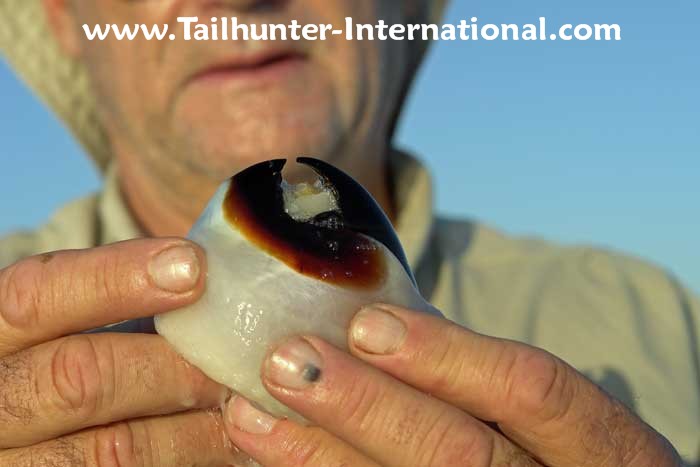
The beaks of the giant squid aren’t something to fool around with when still attached to their owners! They’re like big parrot beaks!

THE BIG UGLY

Originally Published the Week of Feb. 28, 2013 in Western Outdoor News

The Captain Victor tied on the heavy leaded lure and handed it back to the angler who looked at it curiously.   He hefted it in his hand and like a weapon.  And indeed, it looked like one.

“Pretty much looks like a medieval club or a torturing device,” he smiled. “a knight could do some damage with this sucker!”

He turned it around in his hand.  The heavy leaded pipe was about a foot long and filled with cement.  It was painted white.  The line was tied to one end.  At the other, it looked like a multi-pronged grappling hook with about a dozen 2-inch long up-turned sharpened spikes.

“Whatever bites this is gonna be interesting,” he said as he put his heavy 4/0 reel with 60 pound test into free-spool and dropped the lure over the side.  Weighing about 2 pounds, it dropped quickly into the depths about 500 yards off the rugged Baja coastline.

Mas linea..more line…more line,” said the captain with a mixture of hand gestures and broken Spang-lish.  “Muy profundo aqui…very deep here, “ as he pointed down into the cobalt morning waters.

“Ok-dokie, amigo” said the angler with a shrug.

The heavy rod and reel continued to play out line.

The captain touched the rod as a sign to stop.  The angler put the rod into gear and figured he was about 400 feet straight-up-and-down.

The Captain Victor motioned for the angler to reel slowly, but at the same time raising and lowering the rod in a sweeping motion stopping the retrieve and letting the heavy jig drop back and winding a few cranks more.

The angler took about half a dozen sweep-and-cranks and suddenly the heavy beefy rod went over double nearly pulling the angler to his feet!

“WHOA!  WHAT THE…???”

Grunting he struggled to turn the handle of the straining reel.  He looked up at the grinning captain now smiling smugly.

“Big squid! Calamar grande!” said Captain Victor with a big satisfied grin and arms folded across his chest.

Sometimes you really have to watch what you ask for.  Often folks want to know if the squid are biting and this just happens to be about that time.  They’re not always “on time” and the bite is cyclical,  but at least for us in La Paz, we get a run of squid in the spring and summer.

Like other sea creatures, it’s not like they send out a memo or anything.

But, when they show up, they generate alot of excitement.  Not only are they fun to catch and extremely feisty when hooked,  but they are just plain fascinating.  They’re the stuff of story, legend and sea-monster!

When folks come down, they normally, aren’t quite ready for what awaits.  The “Humboldt” squid we normally get can be as small as 5 pounders, but 40-100 pound beasts are not uncommon.

When the squid “float” (come near the surface from the cold depths) to where they can be caught, often many boats and pangas will pack the area.  If the big squid are there, it’s not long before heavy rods and double-bent anglers are pulling mightly as if small refrigerators are hanging on the ends…which isn’t too far from the truth!

The vessles are often quite close and once the bite starts, it can get pretty crazy as the wiggling-squirting cephalapods get close to the boats.  A good tip is to let the struggling animals finish their squirting BEFORE bringing them aboard! Between the vessels,  big firehose-sized geysers of water and ink are often seen raining down and spraying anyone within range.  Yells and laughs as well as choice bits of profanity often permeate the scene.

In fact, it’s often a good idea to dispatch the big uglies before bringing them aboard at all.  Squid are voracious and aggressive.  Just because they’re hooked doesn’t mean their beat.

A third of their body length is a mass of tentacles.  An, unlike an octopus, the “suckers” on a squid’s tentacles aren’t little suction cups.  They are concentric circles of teeth surrounding a little beak that can easily break skin when wrapped around the nearest leg, arm or finger.

Certainly, you don’t want to get an appendage near to it’s parrot-like beak which is capable of really doing damage and can take off a finger.  Or they can quickly gouge out a chunk of an angler.

Make no mistake, while small squid in a bait tank can be fun to play with, the Humboldts are dangerous critters.  They are opportunistic feeders and the large ones have been known to attack sharks, tuna and even the occasional diver…not to mention each other.

In fact, the heavy jig used to catch them is painted white to resemble a smaller squid enticing a larger squid to attack it.  Indeed, the squid are cannibalistic and many times, as you’re bringing a squid to the boat, it will often feel like it’s no longer struggling and has turned to dead weight.

If the water is clear enough, you can often see other squid attacking and hacking the one squid impaled on the jig.  There’s no fraternity below the surface.  Eat and get eaten!

It took some grunting and no shortage of sweat and elbow grease to get the big 50-pound squid to the panga.  As per the captains instructions, the angler let the big animal empty it’s jets of water and black ink before bringing it into the panga.

Wiping his brow, with the back of his fist, the angler laid down the rod in exhaustion.

Muy bueno por carnada…good for bait,” smiled Captain Victor as he hacked off one tentacle and wrapped it around a larger bait hook ready to go look for some real fish.

“Like heck!” laughed the angler, cutting off a huge chunk himself and bagging it for the ice chest.  “It’s going into some beer batter for fried squid dinner tonite!”

“But first, let’s catch a few more!” he added tossing the  heavy jig back overboard.

That’s our story!

Jonathan

_______________

Jonathan Roldan has been writing the Baja Column in Western Outdoor News since 2004.  Along with his wife and fishing buddy, Jilly, they own and run the Tailhunter International Fishing Fleet in La Paz, Baja, Mexico  www.tailhunter-international.com.  They also run their Tailhunter Restaurant Bar on the famous La Paz malecon waterfront.  If you’d like to contact him directly, his e-mail is riplipboy@tailhunter-international.com  or drop by the restaurant to say hi!

______________

Jonathan Roldan’s

Tailhunter International


TAILHUNTER FISHING FLEET #1 Rated on Trip Advisor

TAILHUNTER RESTAURANT BAR #1 Rated in La Paz on Trip Advisor


Now follow us on FACEBOOK TOO


Website: www.tailhunter-international.com

U.S. Office: 3319 White Cloud Drive, Suite A, Hacienda Hts. CA 91745

Mexico Office: 755 Paseo Obregon, La Paz, Baja Sur, Mexico

Phones:

from USA : 626-638-3383

from Mexico: 044-612-14-17863

.

Tailhunter Weekly Fishing Report:

http://fishreport.jonathanroldan.com/

Tailhunter YouTube Videos:

http://www.youtube.com/user/pangapirate

“When your life finally flashes before your eyes, you will have only moments to regret all the things in life you never had the courage to try.”

Read Full Post »

« Newer Posts