
OUTGUNNED BUT NOT OUTSMARTED
Originally Published the Week of June 3, 2019 in Western Outdoors Publications
I received quite a few e-mails about my last column that I entitled “ZING-POWIE FISH.” It was about big monster fish that lurk in the rocks and reefs that basically eat your lunch, their lunch and break your heart…and sometimes your rod!
With the e-mails coming in, I got to thinking of some other species, like big tuna.
Here in La Paz, we’re getting 50-150 pound yellowfin tuna. It’s one thing to hook a big beast like that sitting in a fighting chair in a big sportfisher with a 50W reel with a zillion yards of line.
It is quite another thing if you’re fishing, like we do here in La Paz, and many other places in Mexico…in a panga…with relatively light tackle.
Not only is your rod and reel lighter, but so is your line. Additionally, the fish doesn’t have to contend with a 1-ton boat to pull around the ocean. You just don’t have much leverage and it literally comes down to hand-to-hand combat in the sportfishing trenches.


There are some additional concerns with these ZING-POWIE fish or like the big tuna we have. They are picky and they have great eyesight.
With big fish, your natural tendency is to use heavier line or stronger line like braid/ spectra. Problem solved, right?
Well, spectra is very very visible. Also, if you are fishing with live bait, spectra soaks up water and gets heavy. So your bait does’t swim correctly so less chance of getting bit.
Heavy line is also visible. Plus, again if you’re using small baits, the line is pretty heavy and your bait tires faster.
On top of that, these fish, especially the tuna, like smaller baits like sardines. So, that means often using a hook the size of your fingernail… on fish the size of your living room coffee table.
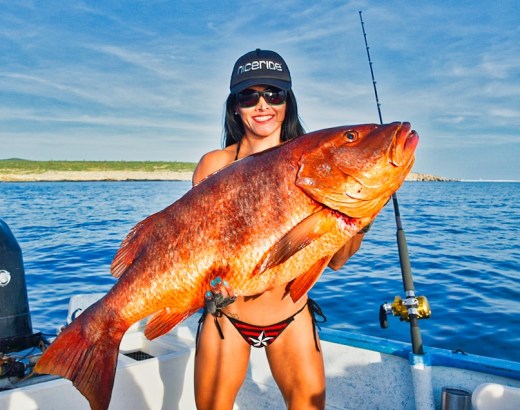
So, small hook…small bait…light line…small boat…
Yikes! It’s like going to war with a BB-gun.
So, back to my e-mails. Folks want to catch these fish, but how do you tip the odds a bit more in your favor?
Well, I haven’t quite figured out all the angles yet, but I do have a few personal tips when you’re in situations like this and feel outgunned.
For one, fluorocarbon leaders.
Largely invisible underwater. And, they are much more pliable than their were years ago. Plus, even if your mainline might be light, you can put on a few feet of fluro that is heavier which will also help guard against sharp teeth.


Secondarily, I change my rod.
Because of the size of the baits or other conditions, I might be using very light line. But this is one time, I don’t match my rod to the line class.
I might be fishing with 30-pound test, but I’m using a stout 80 to 100 pound stick. If I get bit I want the fish to feel that heavy rod pulling right back!
A heavy rod makes the fish work that much harder and tire faster. It also give me more leverage to put even more pressure on the fish.
To that end, my personal tuna rod and ZING-POWIE rod is about 5 feet long. Basically, it’s a trolling rod although I only have a roller tip on it.
My foregrip extends 3/5 up the length of the rod. This enables me to reach way high on the rod and really lean into a fish.
The last 2-3 feet of my rod has a fast taper and lots of backbone to really horse the fish and make it work or to help me pull it out’ve the rocks. Also, a shorter rod is much easier on your back and arms than a long rod with a lot of spring in it.
Finally, my reel is also something I can do something about.
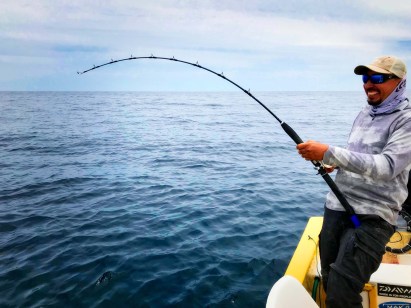
I don’t need a huge reel with a mile of line on it. If I’m fishing in the rocks, it’s not that deep and the big rock fish aren’t gonna go running off with 100 yards of line on burning runs. They take a little line and want to go back into their holes.
Big fish like the tuna will make blazing runs. But, I find a reel with at least 300-350 yards of line is fine. Being in a smaller boat…or even a big boat…you can always chase down the fish. I have rarely ever seen anyone spooled.
So, a smaller reel is fine. Or if I have braid/ spectra, I put that on the reel and top-shot it with at least 150 yards of mono. The spectra enables me now to have all the line I could possibly want.
The most important aspect are the drags on the reel. If you have a smaller reel, at least make sure the drags or in good working order and not sticky or worn.
Even better, many of the newly manufactured reels have huge drag systems or dual drag systems installed that have incredible stopping power. Those will help put the hurt on a fish! Reels by Accurate, Avet, Shimano, Daiwa and Okuma come to mind. Slightly more expensive, but well worth it.
That’s my story!

Jonathan
______________
Jonathan Roldan has been writing the Baja Column in Western Outdoor News since 2004. Along with his wife and fishing buddy, Jilly, they own and run the Tailhunter International Fishing Fleet in La Paz, Baja, Mexico www.tailhunter.com.
They also run their Tailhunter Restaurant Bar on the famous La Paz malecon waterfront. If you’d like to contact him directly, his e-mail is: jonathan@tailhunter.com
Or drop by the restaurant to say hi. It’s right on the La Paz waterfront!
_____________
Jonathan Roldan’s
Tailhunter International
Website:
www.tailhunter-international.com
Mexico Office: Tailhunter International, 755 Paseo Obregon, La Paz, Baja Sur, Mexico
U.S. Mailing Address: Tailhunter International, 8030 La Mesa Blvd. #178, La Mesa CA 91942
Phones:
from USA : 626-638-3383
from Mexico: 044-612-14-17863
.
Tailhunter Weekly Fishing Report: http://fishreport.jonathanroldan.com/
Tailhunter YouTube Video Channel:
https://www.youtube.com/channel/UCBLvdHL_p4-OAu3HfiVzW0g
“When your life finally flashes before your eyes, you will have only moments to regret all the things in life you never had the courage to try.”





 That's My Story
Leave a comment