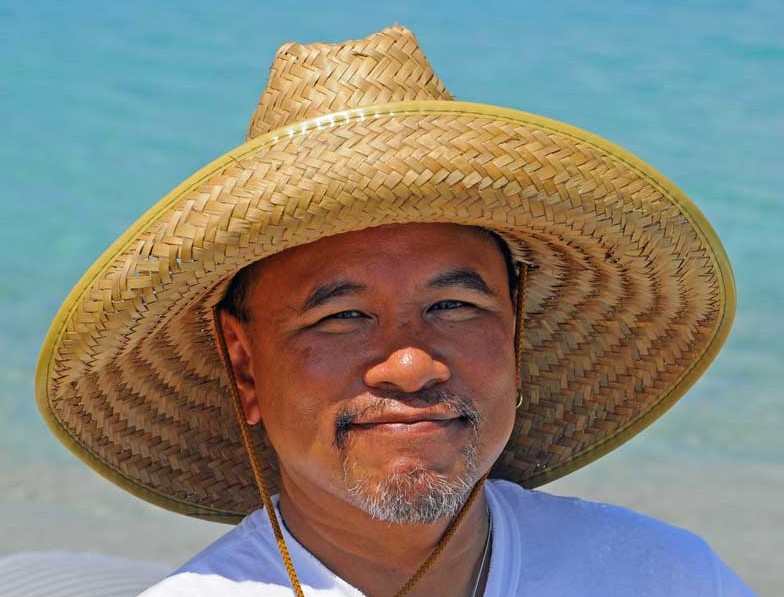
Hard to believe it’s been almost 17 years now in Baja. It’s been grand, but where did the time go? Comes a time when you realize you’ve got more fishing days behind you than ahead of you and you count all the blessings!
NEED NOT GREED
Originally Published the Week of April 4, 2013 in Western Outdoor News
I’m reminded of a father and son who attended a fishing school I had been giving many years ago at the old Hotel Las Arenas near La Paz. We were fishing along the shallows on the east side of Cerralvo Island and my fishing school was all about fishing for rockfish like pargo (snapper) and cabrilla (seabass).
Papa Fred and young adult son, Todd, were with me on the panga that day. It was their first time fishing in Mexico and it had been a number of years since they had fished together.
It was early morning and we were slow trolling the shallow reefs that ring the eastern side of the island. Dad had taken several nice three or four-pound cabrilla and had flipped a few smaller ones back into the water.
Todd, the son, hadn’t caught any of the the larger ones, but had kept several of the smaller ones. He had just hooked another and deftly popped it off the hook and tossed it into the fish box.
“Why don’t you let some of those smaller ones go, son?” asked Fred.
“The smaller ones are good to eat, Dad,” replied Todd. “And besides, if we let them go, commercial guys or someone else is going to catch them anyway so we might as well keep them,” he said with a smile and a shrug.
The older gent squinted into the rising morning Baja sun and said, “There’s this story I once heard about a big nighttime storm on the gulf coast. In the morning, the beach was littered with starfish. As far as the eye could see. The storm had washed all these starfish up on the beach above the water line. With the sun climbing into the sky surely, they’d start to bake and die off. “
A morning jogger came upon a young teenager walking from starfish to starfish picking them up and tossing them as far into the ocean as he could. One at a time.
“What are you doing?” asked the jogger casually, as he pulled up to catch his breath.
“The storm washed all these guys up here onto the sand,” replied the youngster. “I’m saving starfish,” as he picked up another and pitched it seaward.
“You’re crazy,” laughed the jogger standing tall and surveying with squinted-eyes all the starfish dotting the sand. “There must be thousands. You can’t hope to make a difference!”
“It makes a difference to this one…” said the teenager as he smiled at the jogger and picked up another starfish and tossed it back into the waves.
Little bits make a difference.
I will readily admit that in my fishing career, I’ve taken more fish than most. That “career” has now spanned more than 50 years (ouch!) and started with my first bamboo rod and some shrimp for bait. I’ve had the “bloodlust” where excitement over-rides better judgement and nothing is as important as hooking fish.
In those early days, it was about chest-thumping and high-fives. It was about catching more fish than the other fella and big heavy stringers. Who hasn’t gone down that road a time or two…or more? For me, that “road” was often a four-lane express-way and I was at the helm of a mack truck.
But somewhere in the last few years, that changed. I don’t know when or where fishing became more important than catching. Maybe it was realizing that I’ve probably got more fishing time behind me than ahead of me these days.
At some point, a day with my wife, family or friends on the water and a bit of sunshine has become more crucial to my well-being and self-esteem than tight lines. Reveling in a simple day when four walls…cell phones…and the internet weren’t sucking my soul dry were the best 5-star vacation ever invented.
Need vs. Greed. My need to just take a breath and put my toes in the sand trumps my former greediness to be putting fish in the boat…everytime…all the time.
And, although I still love catching fish and can do it with the best, maybe keeping just one or two for dinner, is enough. Especially if it means breaking bread…er…tortillas to share with family and friends!
And more than it ever did…releasing fish to swim away is even more of a kick and makes a big difference in a small way…to that one fish. And yes…to at least this one fisherman as well.
That’s my story!
Jonathan
________________
Jonathan Roldan has been writing the Baja Column in Western Outdoor News since 2004. Along with his wife and fishing buddy, Jilly, they own and run the Tailhunter International Fishing Fleet in La Paz, Baja, Mexico www.tailhunter-international.com. They also run their Tailhunter Restaurant Bar on the famous La Paz malecon waterfront. If you’d like to contact him directly, his e-mail is riplipboy@tailhunter-international.com or drop by the restaurant to say hi!
________________
Jonathan Roldan’s
Tailhunter International
Website: http://www.tailhunter-international.com
Mexico Office: Tailhunter International, 755 Paseo Obregon, La Paz, Baja Sur, Mexico
U.S. Mailing Address: Tailhunter International, P.O. Box 1149, Alpine CA 91903-1149
Phones:
from USA : 626-638-3383
from Mexico: 044-612-14-17863
.
Tailhunter Weekly Fishing Report:
http://www.tailhunter-international.com/fishreport.htm
Tailhunter YouTube Videos:
http://www.youtube.com/user/pangapirate
“When your life finally flashes before your eyes, you will have only moments to regret all the things in life you never had the courage to try.”










 That's My Story
“FINALLY READING BETWEEN THE LINES”
Posted in Baja, Baja Fishing, Baja Life, Baja Mexico Fishing, Baja Rockfish, Cabo San Lucas, cabrilla, dorado, Fishing, fishing reports, Fishing Tackle and Techniques, Fishing techniques, fishing tournaments, flyfishing, holidays in mexico, inshore fishing, inshore fishing in Baja Mexico, Jonathan Roldan, kids, kids fishing, La Paz, La Paz Fishing, Leisure, Living in Mexico, marlin, Mexican, Mexican business, Mexican culture, Mexico, Mexico economy, Mexico life, Panga Fishing, pargo, roosterfish, Salt Water Fishing, Sea of Cortez, Tailhunter International, tourism, Travel, Uncategorized, Western Outdoor News, Western Outdoor Publications, tagged baja, charters, commentary, fish, Fishing, fishing reports, Fishing Techniques, fishing tips, Jonathan Roldan, La Paz, mexican, mexico, mexico life, outfitters, sea of cortez, sportfishing, Tailhunter International, tourism, tourism growth, tours, travel, violence in mexico, western outdoor news, western outdoor publications on March 18, 2013| Leave a Comment »
Despite what many think, Mexico actually has one of the fastest growing tourism economies in the world as more folks are discovering Mexico as a great destination with Americans still comprising the majority of tourists with more than 24 million visitors expected this year.
“FINALLY READING BETWEEN THE LINES”
Originally Published the Week of March 20, 2013 in Western Outdoor News
It’s been an uphill battle.
Turn back the time machine about 2-3 seasons ago and it seemed that every other persons was asking me about the “violence in Mexico” or telling me they’d “Never go there again” or “I’d be in fear of my life!”
It seemed everyone had seen the news clips. Everyone had read the headlines. Everyone had a friend-of-neighbor-of-an-uncle-of-a-classmate who knew someone else who had been beaten, robbed, killed or eaten a bad taco.
Speaking at seminars and appearing at countless trade, travel, hunting and fishing shows over the years, it seemed the negativity was endless. Protest as I might…how could any of us who enjoy living and working in Mexico ever overcome the omnipotent power of the broadcast and print media?
We’re just little old us…mom and pop operations in Mexico…
How does one prove a negative? How do you prove something is NOT happening? How do we go up against CNN and FOX and the others and say, “Hey, thousands of tourists are NOT getting murdered!” “Hey, 200,000 Americans crossed the border today and NOTHING happened to them!”
Sigh…wring hands…shrug shoulders. Exhale. And hope.
But maybe things are changing. Lately, people specifically ask me if Baja is safe. Or is La Paz (where we live) or Cabo San Lucas safe. Things like that.
I tell them yes. Maybe show them some statistics and they’re fine with that. “I thought so,” they’ll usually say. Then, they move onto the good stuff like, “So, when’s the best time to come fishing?”
A few years ago, people would argue with me. Not so now.
Or, in the alternative, they affirm what we’ve been telling everyone.
They come out and pointedly tell me, that they’ve visited Cancun and Cozumel and Puerta Vallarta and Loreto and other tourist destinations and found them to be safer or at least as safe as being home. And enjoy travelling to Mexico. It’s a great value. The people are great. Love the food. Blah…blah…blah! Stuff we’ve always known, right?
Now, no one is saying Mexico doesn’t have a problem. Far from it. Mexico has some serious crime problems. But folks have been quick to point out that, “Hey, it’s not directed at tourists.”
“It’s in places we shouldn’t go anyway…like back alleys of Ciudad de Juarez!”
“Don’t do things you shouldn’t be doing and going to places you shouldn’t be going and you’ll be fine…like American cities. Every place has it’s bad areas. Don’t be an idiot. Stay out of bad areas!”
“I go to Mexico all the time. I feel safer there on the beach in San Carlos or Los Barriles than I do where I live in Phoenix and my car gets busted into all the time and several of my neighbors have been burglarized.”
“I’m tired of all the negativity. It’s in the news every time an American or tourist gets his wallet stolen in Mexico. How often does that happen in downtown New York and it never makes the news.”
It’s kind of refreshing in a strange way to have people trying to convince ME that it’s OK to be in Mexico. People are figuring it out on their own.
Unlike many tourist destinations, Mexico took 3 big strikes to it’s travel sector. First, was the economic downturn that seems to have hit the whole planet.
Second, of course, is the nervousness over violent crime.
Third, was the swine-flu scare. (Don’t get me started on that fiasco! Again… everyone knew a friend-of-a-friend-of-friend who had been stricken…sheesh).
But, Mexico’s on the rebound.
I’m not completely convinced yet that it’s due to an overall economic recovery for everyone. There’s still alot of bad stuff going on and we’re far from over. But, maybe folks are just adjusting to it all. Maybe they still know Mexico’s a good value and it’s close and yea…they’ve adjusted to the fact that it’s a pretty safe place to hang out with the bro’s and the family.
Indeed, statistics show that Mexico has one of the fastest growing tourist economies in the world. In excess of 24 million visitors take to Mexico yearly now. Americans make up the majority of Mexico’s tourism base as something like 4-8 million Americans visit annually. And suffer nothing more serious than a self-induced margarita hangover or a bad sunburn.
As a matter of fact, the fastest growing segment of Mexico’s tourism is coming from places like China, Russia, Columbia, Brazil and the Ukraine. And for years, having lived in Baja, the Italians, French and Japanese have been constant visitors as well.
This is all good news for Mexico and should be an assurance to those contemplating a trip south of the border where the most violent thing you encounter might be in the salsa you spoon into your tacos! Andale!
That’s our story!
Jonathan
_______________
Jonathan Roldan has been writing the Baja Column in Western Outdoor News since 2004. Along with his wife and fishing buddy, Jilly, they own and run the Tailhunter International Fishing Fleet in La Paz, Baja, Mexico www.tailhunter-international.com. They also run their Tailhunter Restaurant Bar on the famous La Paz malecon waterfront. If you’d like to contact him directly, his e-mail is riplipboy@tailhunter-international.com or drop by the restaurant to say hi!
______________
Jonathan Roldan’s
Tailhunter International
TAILHUNTER FISHING FLEET #1 Rated on Trip Advisor
TAILHUNTER RESTAURANT BAR #1 Rated in La Paz on Trip Advisor
Now follow us on FACEBOOK TOO
Website: www.tailhunter-international.com
U.S. Office: 3319 White Cloud Drive, Suite A, Hacienda Hts. CA 91745
Mexico Office: 755 Paseo Obregon, La Paz, Baja Sur, Mexico
Phones:
from USA : 626-638-3383
from Mexico: 044-612-14-17863
.
Tailhunter Weekly Fishing Report:
http://fishreport.jonathanroldan.com/
Tailhunter YouTube Videos:
http://www.youtube.com/user/pangapirate
“When your life finally flashes before your eyes, you will have only moments to regret all the things in life you never had the courage to try.”
Read Full Post »