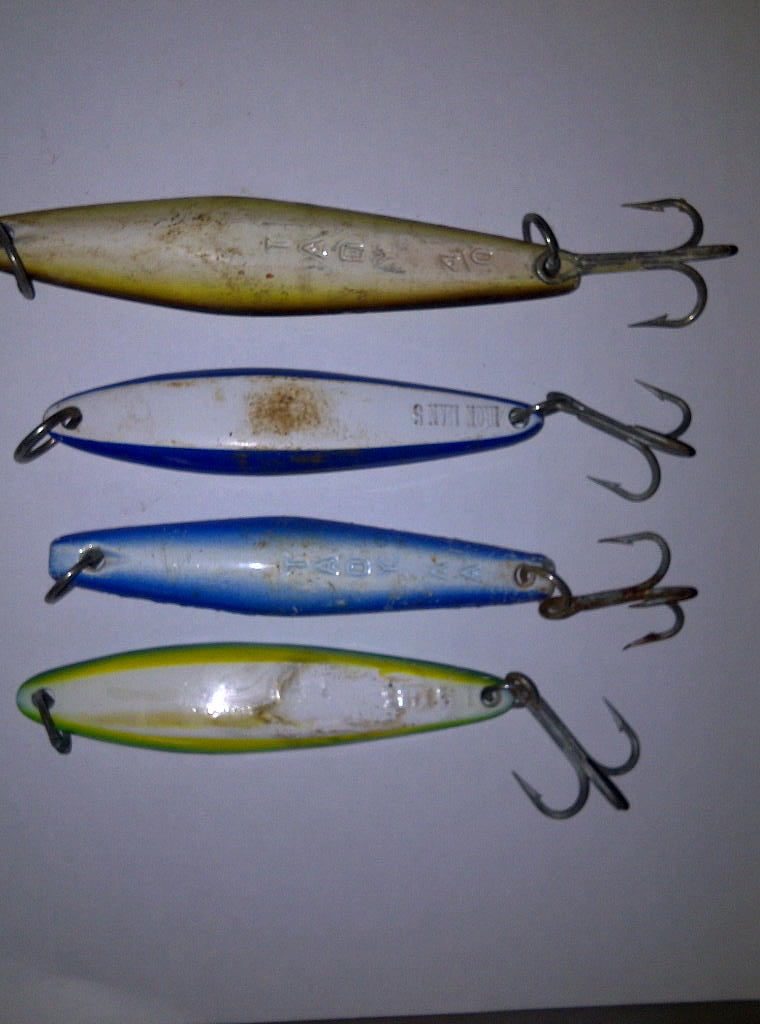
An effective line up of “iron”
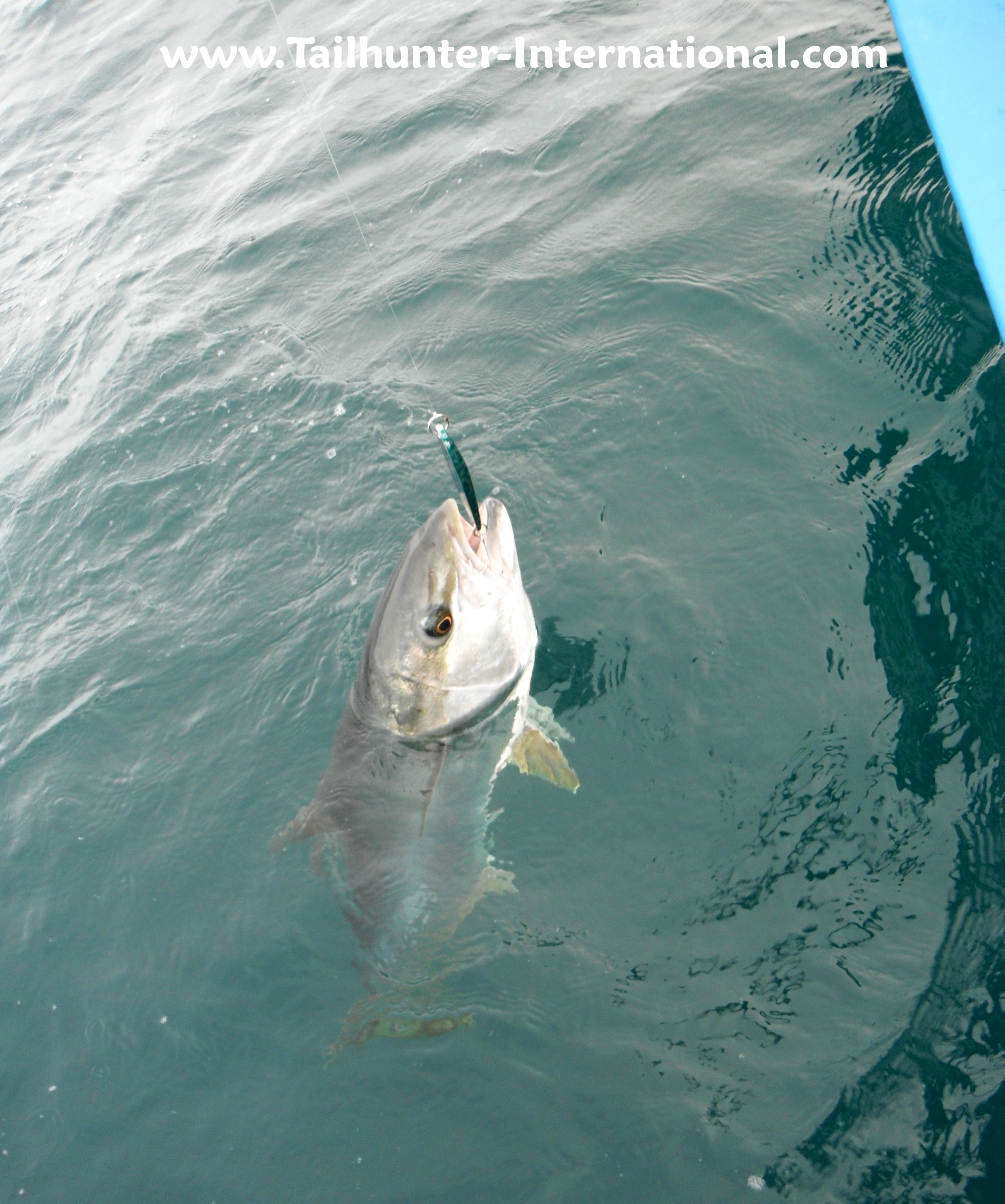
“Fresh one!” A yellowtail hanging on the iron! These guys will slam a fast-retrieved iron hard enough to hank the rod from your hands! A chrome-pattern did the trick on this big yellow.
BAJA PRIMER – “IRON” THE NEXT STEP
Orginally Published in Western Outdoor Publications
You’re ready to try something different. You’ve got a bit of strut in your step. You’ve been on your share of fishing trips. Into Mexican waters from San Diego. Some trips from Cabo and the East Cape. Maybe some mother-ship trips from San Felipe.
You’ve put some fish in the bag and a few fillets in the ice chest. You’re no rookie and think you can pretty much hold your own and know how to tie a knot and which side of the reel is up.
So, now what?
You’re been watching some of the other “hot sticks.” You realize you’ve caught all your Mexico fish with bait or trolling. Although it’s exciting and you fill your sack, you’re ready to step-up your fishing repertoire.
Yawn…
It dawns on you that everyone and anyone can catch fish with bait. And it’s a no-brainer to drag lures around the ocean waiting for a bite. In the fish-rich waters of Mexico, if the fish are hungry, they’ll eat a bait. If you drive the boat over the right patch of water, you get bit too.
What’s the challenge in that?
But, you notice the bit of swagger and yes, maybe even cockiness in the guys they call the “ironmen.” They’re the guys who can put a fish in the boat when nothing else is biting or no one else is getting bit. They get the bigger fish. They win jackpots. Plus it looks like fun and you want a piece of that!
It does’t take much to get started. Your local tackle shop can get you started. Do not be afraid to ask for help and don’t be afraid to admit you’ve never fished “the iron” before.
The best thing is that many of the most popular Mexican game fish like tuna and yellowtail are not only some of the most fun to catch on the iron, but also will readily bite iron lures.
“Iron” refers the class of lures that generally look like pieces of heavy sculpted elongated metal…a bit like a metal candy bar. Hence the moniker “iron.” They come in a dizzying array of shapes, sizes and colors, but just for learning sake, you can get by with just a handful that will cover most situations:
They involve combinations of chrome/ white/ blue/ green/ yellow/ brown. Have your tackle dealer point them out.
Manufacturers of many of the most popular include: Tady / UFO / Fire / Salas/ Raider / Hopkins / Williamson/ and Candy Bar…just to name a few.
Unless you know how to cast already, start with the heavier jigs. Something that will sink and cast easily like 3-6 oz lures are typical for starters.
If you don’t know how to cast yet, don’t let that stop you. You can “fish the iron” even if you don’t know how to cast. If you can do a simple underhand cast or sidearm cast or even just drop the jig overboard, you’ll do just fine.
The real secret in fishing the iron isn’t necessarily in how far you can cast. The real secret is in getting the jig to “swim” imparting it with a life-like action that will entice a fish to bite. And that’s where the fun comes in.
If you’ll notice, all lures have “edges.” These are the cuts and angles molded into the lures. They might give it the appearance of an elongated diamond. Or a twisted piece of metel or give it little indents or the appearance of “shoulders.” But these little bits and cuts make the lure “swim” as it’s retrieved through the water.
Some dart and dive. Others shimmy. Or spin. Or wiggle. All have their own characteristics which change depending on how you retrieve or use the lure. Some are even cut to flutter like a dead bait when simply sinking in the water.
There are different techniques to do all of this. One of the most common and the easiest for a beginner is to fish “on the slide.” While the trolling rods are out, I like to have a nice heavy chrome lure ready and tied to a shorter rod and and least 40-50 pound test. When the trolling reel goes off, the boat usually coasts or “slides” to a stop while someone battles the hooked fish.
Fishing the “slide” simply entails taking the reel out’ve gear and letting that heavy jig flutter down behind the boat. If there’s a school of fish, especially tuna following behind the hooked fish watch out!
This is one of the deadliest means of hooking that next fish as they swarm to the boat. A ferocious strike often occurs as the jig falls or when the reel is suddenly put in to gear! Hold on!
The second easiest way to learn to fish the iron is called “yo-yo” fishing. Again, this is as simple as dropping the jig overboard from a stopped boat. If you can do a side cast or a long under-handed cast all the better.
Let the lure fall. Once more, don’t be surprised if the lure is hit on the drop as it flutters down through the zones.
After a reasonable time, start winding. Now, this take a bit of watching. With some lures, if you wind too fast, the lure “propellers” and just spins. Not good. Too slow and the lure doesn’t move at all. It just hangs there as it comes back to the boat. Not good either.
So, watch and get a good “swim” on your lure. Some fish like yellowtail really go after a lure that’s moving fast. The faster the better. Others like tuna aren’t so picky. Remember, the point is to make the lure imitate a live bait that will interest the fish in biting.
Once you have that, try different motions. The “sweep” involves winding and lifting with the rod at the same time in a “sweep” motion. Then stopping and letting the lure flutter down again. Then winding again.
“Ripping” involves a fast vertical retrieve, then stopping. Throw the reel into free-spool and letting the lure fall back down. Then back into gear and winding quickly again.
If you can get a short cast out, try the “Z-pattern.” Winding back towards the boat. Stopping and letting the lure fall…then winding again….then letting the lure fall…then winding again in a “Z pattern” back to the boat.
Practice and watch. You’ll get better in now time and add something new to your fish-catching arsenal.
That’s my story!
Jonathan
______________
Jonathan Roldan has been writing the Baja Column in Western Outdoor News since 2004. Along with his wife and fishing buddy, Jilly, they own and run the Tailhunter International Fishing Fleet in La Paz, Baja, Mexico www.tailhunter-international.com. They also run their Tailhunter Restaurant Bar on the famous La Paz malecon waterfront. If you’d like to contact him directly, his e-mail is riplipboy@tailhunter-international.com or drop by the restaurant to say hi!
______________
Jonathan Roldan’s
Tailhunter International
TAILHUNTER FISHING FLEET #1 Rated on Trip Advisor
TAILHUNTER RESTAURANT BAR #1 Rated in La Paz on Trip Advisor
Now follow us on FACEBOOK TOO
Website: www.tailhunter-international.com
U.S. Office: 3319 White Cloud Drive, Suite A, Hacienda Hts. CA 91745
Mexico Office: 755 Paseo Obregon, La Paz, Baja Sur, Mexico
Phones:
from USA : 626-638-3383
from Mexico: 044-612-14-17863
.
Tailhunter Weekly Fishing Report:
http://fishreport.jonathanroldan.com/
Tailhunter YouTube Videos:
http://www.youtube.com/user/pangapirate
“When your life finally flashes before your eyes, you will have only moments to regret all the things in life you never had the courage to try.”





 That's My Story