Feeds:
Posts
Comments

Posts Tagged ‘Fishing Techniques’

When it comes to bait or any fishing techniques, if it results in a bent rod, it's hard to dismiss it! Try it. You never know!

IF IT WORKS DON’T LAUGH!

Originally Published the Week of Sept. 6, 2o11 in Western Outdoor News

I am often amazed at what catches fish down here.  Of course, us gringos are always looking for “live bait” like caballitos, mackerel, sardines and the like.  Plus we have all the “latest and greatest” technology has to offer in the way of lures, plugs and feathers. 


But, over the years, having worked with so many captains in so many areas of Baja, I’ve come across some pretty incredible things that have been used for bait…and they work!


BELLIES & STRIPS – Long ago when I lived in Los Frailes, the owner of the hotel turned me onto taking the oily juicy strips of belly meat from dorado and bonito and  pinning them on the hooks of my feathers and jigs, especially my marlin lures.  Strips of squid also work.  They add scent and flavor to your lures.  I also think gamefish tend to hold onto them more when there’s some “taste” to the lure.


Actually, even without the feather or jig, one of the most effective methods of attracting game fish is to simply pin a nice long strip of these species to a hook and leader (make sure you have a swivel) and drag it slowly behind your boat.  Bigger fish can’t seem to resist it.  Even large dorado will jump on dorado strips!


If you happen to get into a bite of the giant squid, give some thought to taking the whole head and sending it down deep.  I’ve gotten some monster tuna on 5-pound chunks of head.  Smaller giant squid worked when trolled and long-rangers will tell you that a big squid bounced on the waves from a kite are deadly.


It’s also  productive to chop the  squid legs (arms?) into chunks and just tossing handfuls into the ocean as chum then taking another big chunk and hook it, letting it all drift down to the game fish.  Often, even when the fish won’t take live bait, they WILL eat the chummed bait.


WHOLE FISH –  As much as we tend to hate needlefish down here as the scourge of fishermen, a smaller needlefish slow-trolled in the rocky areas will sometimes really get nailed by a big pargo, snapper or cabrilla. 


Sent down deep, this can be deadly for a big grouper around the islands…or even using a small bonito!  Cut off a fin and score a few knife cuts into the flesh to get it bleeding then send it down with a heavy weight and see what happens!  If it’s live, you better hold into your socks!


One of the strangest baits I have ever used was small puffer fish.  I often noticed that when we cleaned dorado we would find whole puffer fish in the stomachs of bull dorado.  (Maybe I can see eating one, but the thought of passing one of the spikey guys out the backside raises some eyebrows).


Anyway, I asked one of my captains and he said he often saw dorado eat floating puffer fish and that the smaller ones make good bait.  So we caught some floaters and put them in the bait tank.  When we got into a dorado bite we tossed some into the fray…like surface poppers and sure enough…WHAM! WHAM! WHAM!  Puffers were hit faster than sardines!  It worked!  Small barracuda work also or larger ballyhood.


INORGANIC BAITS


OK…here’s some of the crazier stuff I have seen work…


1.  Strips of tortilla cut like a “pig-and-jig” fork-tail and thrown into feeding dorado and bonito.


2.  Strips of white rubber liner like the kind you put on the bottom of your kitchen sink so that your dishes have a cushion.  Slow trolled or cut like the back end of a small bait fish…twitched along the reefs, you’d be surprised what comes out to chase it!  It’s a cheap swim bait!


3.  A mop head!  Old Mexican fishermen will tell you that they used to troll old mop heads without a hook.  The abrasive bill of sailfish and marlin are like a rasp.  They would hit the trolled mop head and it would wrap around their bills like velcro!  Hook up!  I’ve seen it used one time and it blew me away!


4.  Orange Crush bottle – I once saw commercial fishermen leave some orange soda in a bottle; put crushed tinfoil in it and re-cap it.  They tied it behind a panga and trolled it in the wake like a teaser!  I saw it raise several sailfish like this!


If it works, don’t laugh!


__________________________


Jonathan Roldan has been writing the Baja Column in Western Outdoor News since 2004.  Along with his wife, Jill, they own and run the Tailhunter International Fishing Fleet in La Paz, Baja, Mexico  www.tailhunter-international.com.  They also run their Tailhunter Restaurant Bar on the famous La Paz malecon waterfront.  If you’d like to contact him directly, his e-mail is riplipboy@tailhunter-international.com  or drop by the restaurant to say hi!           


_________________________


Jonathan Roldan’s
Tailhunter International


TAILHUNTER FISHING FLEET #1 Rated on Trip Advisor

TAILHUNTER RESTAURANT BAR #1 Rated in La Paz on Trip Advisor


Now follow us on FACEBOOK TOO

 
Website: www.tailhunter-international.com
U.S. Office: 3319 White Cloud Drive, Suite A, Hacienda Hts. CA 91745
Mexico Office: 755 Paseo Obregon, La Paz, Baja Sur, Mexico
Phones:
from USA : 626-638-3383
from Mexico: 044-612-14-17863

.
Tailhunter Weekly Fishing Report:
http://fishreport.jonathanroldan.com/

Tailhunter YouTube Videos:
http://www.youtube.com/user/pangapirate


“When your life finally flashes before your eyes, you will have only moments to regret all the things in life you never had the courage to try.”

Read Full Post »

It comes in all makes and models and can be confusing but the growth of it's popularity can't be understated! But do you really need it?

TO FLURO OR NOT TO FLURO!


Originally Published in Western Outdoor News the Week of May 12, 2010

              It used to be “back-in-the-day” when I was a kid that honestly, my day of fishing back in Hawaii involved a thin bamboo cane pole (no reel!); a rusty hook I sharpened on the driveway; a 10-cent bit of shrimp and a thin piece of string or even white thread if I could steal some from my grandma’s sewing box! (Oh the luxury!)

            And I would be happy as a dog in a forest of fire-hydrants all-day-long!  And I caught fish too. 

            All of us kids fished like that.  I’d climb out my window early in the morning so as not to wake the family and my buddy next door would climb out his window and actually shimmy down the drainpipe onto his garage roof.  With bait and cane pole over our shoulders, we’d trudge barefoot down the gravel road to the beach and fish all day long.

            The one defining difference in our fishing was the line!  If one of us happened to have squirreled-away or outright stole a bit of that white thread, it made all the difference in the world to what we would catch or, if we would catch much of anything at all.  (I don’t think I knew mono existed until I was about 10 years-old).

            Anyway, fast forward to the here-and-now. 

            It’s gotten a bit more complicated and sophisticated…not to mention alot more expensive than the days of my bamboo pole and rusty hooks. 

            And lines.  Where do we start?  Clear, blue, green, grey, pink, red, chartreuse (do real men use “chartreuse” fishing lines?) and on-and-on.  And that’s just the monofilament.

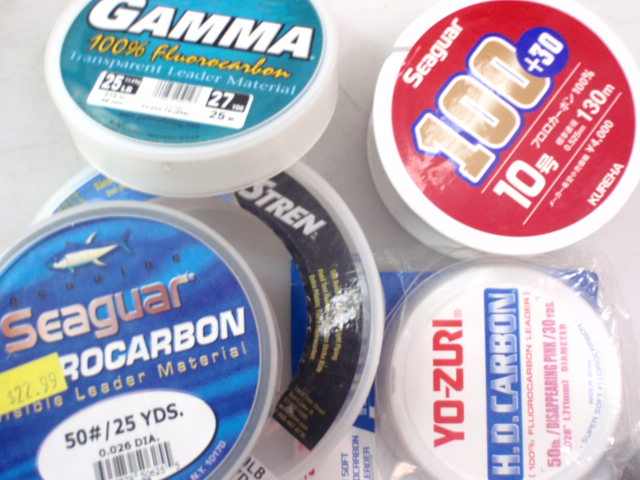
            Then, there’s braided lines and co-polymer lines.  But the one that seems funniest to me is flurocarbon.  It’s been around awhile, but it seems to have taken awhile to get a toe-hold here in Baja, especially among captains and crews.

            When many captains up and down the Baja coast fish like their papa’s did and his papa before him, there’s often resistance to new technology, e.g. circle hooks; spreader bars; teasers, etc.

            After all, if it aint’ broke don’t fix it and if their dad’s caught tuna a certain way, why mess up a good thing?

            Flurocarbon line looks like regular mono but it has the properties of being supposedly invisible underwater.  In a nutshell.  I don’t know.  Shrug.  I’m no scientist.    I can see it, but apparently fish can’t.  I’ve been a believer for years.

            Especially in outlying  Baja areas where technology comes slowly, it’s making believers out of many Baja captains and crews as well. 

            The thing is, it’s so darned expensive down here and often hard to get, even for tackle stores that it’s almost like a drug transaction sometimes.  As I’ve walked along some docks and beaches, I can’t tell you how many times I’ve been asked, “Pssst, amigo, do you have any fluro? Falta poquito favor.” (I just need a little please!)

            To many captains, a bit of fluro leader is sometimes the difference between catching fish and catching ALOT of fish!

            So, should you bring some down on your next trip?  Yes and no.

            As I said, even back in the states, it’s not cheap.  You definitely don’t want to fill a whole reel with the stuff.  Not only will it cost alot, but first, you don’t really need that much. 

            Second, although it’s supposedly invisible under the water, it tends to be stiffer and much more brittle than regular mono.  That means it breaks easier.  To me, it means that my baits might not swim as naturally, if it has to drag a 100 yards of stiff line behind it. 

            You also have to be careful.  Knot-tying can sometimes be a bit more difficult, especially on the heavier fluro.  Because it can be stiffer, make sure the knot is properly cinched. 

            Personally, I prefer it just as leader material.  A few yards will do ya.  After all, if it’s supposedly invisible underwater, then I really only need to cover the part that’s actually UNDER the water near the fish, right?  I don’t need a zillion yards of fluro on my reel.  A few yards as leader does me fine.

            Secondly, since the lack of visibility is utmost, I don’t much have need for it on my trolling lines or when using jigs or iron.  In my head, when a fish strikes a moving lure, it’s a reaction strike.  It’s actually moving in to whack the offering.  That thing is MOVING! 

             Unlike fishing a drifted bait, where a fish might check it out for a bit and line visibility might make a huge difference, I don’t think it makes much difference with a trolled jig  or lure that’s cast and retrieved.  The beauty of fluro is that it’s invisible ergo use it when visibility is actually a factor. 

            Lastly, it makes a great parting gift to your skipper or deckhand.  Watch him light up when you hand him your leftover spool. Por favor!          

 That’s my story

Jonathan

*Jonathan Roldan is the Baja Editor and Columnist with Western Outdoor News since 2004.  He lives in La Paz, Baja Sur, Mexico with his wife, Jilly, where they run their fishing fleet www.tailhunter-international.com and the Tailhunter Bar Restaurant http://www.tailhunter-international.com/tailhunter-bar-and-fubar-cantina.htm.  You can reach him directly at riplipboy@tailhunter-international.com

Read Full Post »

« Newer Posts