Feeds:
Posts
Comments

Archive for the ‘Uncategorized’ Category

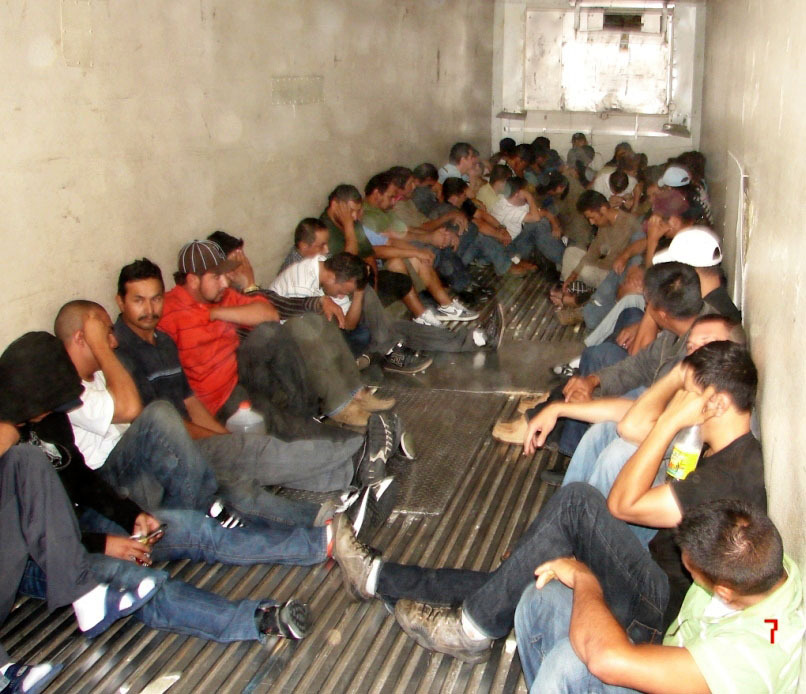
This photo from Fox News shows that it's not exactly a joy ride fun vacation for folks locked in a container truck doing it for real.

FAMILY FUN!

Originally Published the Week of Sept. 2, 2010 in Western Outdoor News

Do you ever read a story in a magazine or newspaper and then slap yourself on the forehead shake your head and say, “What the heck are you people thinking?”

You know about the popularity of “reality shows.” 

I’m sure you’ve heard of specialized vacations.  People bored with Waikiki, Vegas and camping in Yellowstone do things like trek down the Amazon River in a dugout canoe in a loincloth. They spend a week with National Geographic charting the migratory patterns of  one-eyed-parrots on some  remote island or  they go out with an archaeology crew to brush dust off the fortress ruins of Masada in the Holy Land. 

I can understand that.  I’m down with that.

Why ride down the Disneyland Jungle cruise when you can kayak over the falls on the Nile River?  Why go eat Italian food in Santa Monica when you can spend a week in a villa in Florence taking a cooking and wine class?  “Pirates of the Caribbean” movies or two weeks on a barefoot sloops off Grenada Island? We scuba with sharks here in La Paz.  No biggie. Great fun.

Well, I just read an article posted by Lorena Segura of Reuters and picked up by MSNBC online.   http://www.msnbc.msn.com/id/38840613/ns/travel-active_travel/

It appears that , “enterprising” travel agencies are now offering “black tourism” events whereby you can now  feel what it’s like to be a real-life poor person trying to find work across the border in the U.S.! Or hang out in a crime ridden Mexican slum. Or how about a jungle meeting with a real revolutionary!

That’s right!

What family wouldn’t jump at the chance to:

  • run through some of the most dangerous slums in Mexico at night
  • maybe the chance of getting robbed or beaten or worse
  • be chased through the dark in the desert
  • have to crawl under barbed wire and through other obstacles
  • get really dirty and have to keep up with a “coyote” (paid guide)  or you get “caught” and thrown into a  fabricated border patrol truck and bounced around
  • denied food and water
  • hide in bushes all night
  • maybe see a real live narco drug gang member or Zapatista revolutionary (but no pictures allowed!)
  • dress down…no Izod polo shirts or Tommy Bahama shirts allowed.  Dress to move and dodge and hide like a real desperate person trying not to get caught!
  • wade through rivers and creeks evading the border patrol


Sign me up!  What fun.

As one German tourist commented in the article that this provides “real insight” into “real Mexico” and, “Things like this don’t exist in Germany! I can’t get this in Cancun!”   How exciting!  (I guess she’s was too young to remember the Berlin wall.  You got caught, you didn’t get tossed in a truck…they ran you down with dogs and machine guns. Game over, Hans!).

The tourism agencies explain this as a way to “educate tourists about developing countries.”  And yes…we take VISA.

One agency runs a “safari” into an area where locals will not even set foot because it is such a danger zone and you stand a good chance of being robbed at gunpoint.  Oh, Joy.

Another provides “undercover tours in one city’s market area in Mexico City notorious for drug deals, underage prostitution and pirated goods.”  (sounds like Vegas or Hollywood to me!)

One local business in Hidalgo takes groups into the desert and does the simulated “border run” dash-sprint-hide-crawl so you can see what it’s like to try crossing the border at night or in the heat of the day. No water or food allowed.

In the remote mountain area of Chiapas they take you up into the rebel areas so you can possibly see real live rebels and meet one face-to-face. Take a photo with a Zapatista!

People are signing up for these things! 

What next?

Driving a  Humvee through an Iraqi minefield looking for weapons of mass destruction?  Or the night tour through downtown Mogadishu in Somalia waving a U.S. flag?  Jog through Central Park at midnight with a pocket-full of cash?

Give me a break…

_____________________________

Jonathan Roldan has been the Baja Editor for Western Outdoor News since 2006.  He lives with his wife, Jill in  La Paz, Baja Sur, where they own and operate the their fishing fleet as well as their bar and restaurant on the historic La Paz waterfront.  Their website is:   www.tailhunter-international.com  Jonathan can be reached directly via e-mail at riplipboy@tailhunter-international.com

Read Full Post »

Big roosters like this caught by our amigo, Dave Lester, reminded me about the use of the trap hook!

The TRAP HOOK. Simply effective!

THE FORGOTTEN TRAP HOOK!

Originally Published the Week of Aug. 17 in Western Outdoor News


So…you know how to tie three of the strongest knots ever invented and love showing all your buddies how good you are.

You know the difference between a #1 and a 1/0 hook.

You know that a Bimini Twist isn’t a Caribbean croissant and that a “circle hook” isn’t a boxing term.

Spectra isn’t a member of the Justice League comic book characters.

You’re even pretty good at not backlashing when you cast…most of the time!

But, you’re ready for something else.  One more trick.  One more chingadera. One more ace up your sleeve.   You’re looking for one more bit of an edge against those pesky pescado.  Not to mention something slick  and trick to blow the socks of your fishing buddies.

Sometime, when we fish,  we fall into the habits of doing the same things over-and-over-again because they worked in the past and SHOULD keep working again, right?   I mean, if it doesn’t work, it’s not OUR fault. It’s the fish that has the problem!

But that’s when we really SHOULD try something different.  Fish just do what fish do.  They swim; they mate; they eat. 

The eating part…that’s where fishermen come in.  Like that old saying, “Fish are like men, if they kept their mouths shut, they would never get in trouble.”

Our sport requires that we find a way to get them to open their mouths! And once they are open keeping them stuck on the line.

Some clients who fished with us down here in La Paz recently reminded me of a slick trick I had not used in a long time.  They had such a successful trip far-and-above our other clients that I asked them what they had been doing differently.

When, they told me, I had to slap myself in the forehead.  “Hey, I had forgotten that trick!”

It was the trap hook.  Effective. Relatively simple.  Easy to forget about.

Essentially, it involved tying one hook onto another. 

There are quite a few variations.  Some anglers tie one hook to the shank of the other.  Some, tie it to the curve.  Some tie it to the eye. 

I have seen some pros use wire.  Others use spectra or mono.   You know how “inventive” fishermen can be.

Here’s what Dave Lester of Temecula CA wrote to us after using his trap hook setup pictured above and having an outstanding week on big roosterfish, tuna, pargo and dorado.  It was his use of the set-up that reminded me about it’s effectivness: 

” I used single strand to connect.  I’m not that experienced with wire but the rig was pretty simple to create and each rig lasted for several large fish.  I used an 8/0 circle and a 3/0 bait hook.  I talked to a couple of the guys.  I think our historic hook up  rate (on a regular hook rig) was probably 70% on roosters using big baits like lisa and sabalo.  Not too bad but there was always the long take and the huge swings to set the hook.  Many of the fish were also gut hooked. 


With this (trap hook ) rig, we were more like 90% hookups and every hook was right in the corner of the mouth.  We used fairly light line (25 or 30 mono) so the corner hookups add a bit of safety factor.  I also have really gotten used to the simple “put it in gear and reel” to set the hook.  This rig also has an advantage if you miss the hook set or you just had an extra lively bait, you leave the bait in the zone without yanking the hook out of the bait.”

Sometimes the trap hook  is set-up so  the 2nd hook dangles free.  Other times, it is rigidly connected to the main hook.  Either to the shank or the curve.

In any respect, it’s a deadly device.

Trolling lure manufacturers and rigging professionals have been using them in their lures since the earliest days.  Two hooks instead of one.  Tandem hooks.  Hooks connected to each other at different angles. 

But, now consider a similar rig for live and dead bait.

By doing so, you help eliminate short bites where smart fish nip only the tails of your bait.  It makes for better hook-up-to-catch ratio as now two hooks often embed themselves into a fish.  In fact, sometimes, they embed themselves at different angles making it near impossible for a fish to torque itself off or come loose. 

Generally, it involves sticking the main hook into the bait.  If you’re losing live bait, then pin the hook in the bait as your normally would bait your hook.   Usually, you’re hooking it through a non-essential organ or part of the fish like a gill, a nose, a dorsal fin, etc. 

Remember, you want your bait to still swim naturally, so the 2nd hook is allowed to dangle free in some cases.  Or, as some anglers prefer, the 2nd hook is lightly embedded in the skin, tail or anal section of the bait.  This allows the bait to still relatively swim freely.  (Sometimes the 2nd hook is several sizes smaller than the main hook.)

If dead bait is used, obviously, no “swimming” is involved so sometimes both hooks are embedded.  Or one is left dangling.  

You may want to experiment a bit.  As mentioned above, sometimes, it’s more effective to use a smaller hook for the 2nd hook.  Circle hooks seem to work just as effectivelys as “J” style hooks.

Pargo…roosterfish…cabrilla…wahoo…I don’t know why I don’t think of it more often.  It’s one more trick to pull out of the bottom of your tackle box that often gets forgotten.

____________________

Jonathan Roldan lives and works in La Paz, Baja Mexico where he and his wife, Jill own and run the Tailhunter International Fishing Fleet since 1996  www.tailhunter-international.com  They also own and run the Tailhunter Restaurant and FUBAR Cantina on the historic La Paz waterfront.  You can contact Jonathan directly at riplipboy@tailhunter-international.com  He has been the Baja Editor for Western Outdoor News since 2004.

Read Full Post »

These days you may find that ordering wine in Mexico is coming on strong to beer and tequila!

REAL MEN DRINK…MERLOT?

Originally Published in Western Outdoor News the Week of July 20, 2010

I saw an advertisement for a liquor company in an American magazine someone left lying around the pool a few months ago.   As I recall, the ad showed some young couples toasting each other in a bar with hi-ball glasses and the words:

“Few good stories start with the words, ‘We began the evening with a glass of white wine…'”

I’m paraphrasing the slogan but for those of you who have partied in Baja…or anywhere for that matter…good-time stories in Baja usually start with words like…

“And then Joe decided to buy a round of tequila shots for everyone…”

“The beer drinking started about 6 a.m. and by 10 a.m….”

“One tequila…two tequila…three tequila…floor…”

“It’s not my fault.  Someone bet us to see how many margaritas we could drink…”

“Someone’s brilliant idea to order doubles…”

“They told me I had to eat the little worm at the bottom of the bottle…”

As you might imagine, images and memories in Mexico often lean towards tequila and beer.  I mean, it’s the frontier, right? Hard living.  Hard partying.  Grit and hard liquor!

Old stereotypes die hard.

Yul Brynner and the Magnificent Seven didn’t bust into the pueblo sipping merlot with guns a-blazing.  General Santa Ana and Davey Crockett didn’t toast each other with fluted chablis glasses before the final morning at the Alamo.   Antonio Banderas didn’t pull a pate brunch and a bottle of  cabernet from his machine gun case  before blasting  the cantina to smithereens. Humphrey Bogart didn’t stash mini-splits of chardonnay in his saddle bags to celebrate finding the treasure of Sierra Madre.

Heck, imagine old hardline outdoor writers like  Papa Hemmingway or former Western Outdoor News writers Ray Cannon or Fred Hoctor in bars after a day of fishing holding wine spritzers in hand and dabbing the corners of their mouths with napkins.  NOT! (Does Pat McDonnel drink wine?)

 Mens’ men drank real drinks in one gulp then wiped their salty dusty lips with the back of their grimy hands or blood splattered fishing shirtsleeves…especially en la frontera de Baja!

To be sure, Mexico is not the Napa Valley.  It’s not even Orange County, California.  Wine and tequila still predominate.  In fact, according to Wikepedia, the average consumption of wine per capita in the country is only two glasses.  I would bet some regions of Italy or France measure consumption in LITERS daily…not yearly!

The European influence on wine in Mexico began strongly as the Spanish conquistadores along with the padre missionaries, brought wine and grape cultivation along with them in the 1500’s.  In fact, necessity being the mother-of-invention, one legend has it that Hernan’ Cortes and his merry conquerors quickly depleted the wine they brought from Spain after destroying the Aztecs . One of his first acts as governor was to order grapes planted and wine production started to keep the troops happy.

However, by 1699, prudish Spanish King Charles II put a stop to the party and declared that wine could only be used for religious purposes in Mexico.  You can imagine how that went over.

Interestingly an increase in religious “celebrations” and rituals suddenly rose!  Instead of toasting “to king and country,”  toasting to “God and health” (with a knowing wink) gave drinking a “religious” bend!  Ahhh..semantics!

Some of the padres…god bless ’em…kept right on growing grapes and producing wines for fun and profit despite the imperial edict from Spain. 

Until the Independence of Mexico, commercial wine production virtually stopped.  Then rose again in the 1800 and 1900’s but hit another snag during the revolution.  It’s hard to grow wine grapes when Pancho Villa and Blackjack Pershing are trampling down the vineyards.

However, since then, wine production and interest in viticulture has risen.  Especially in the late 1980’s and 1990’s, both the quantity and quality of Mexican wines has improved dramatically.

In fact, Baja is now responsible for about 90 percent of the wine production in Mexico. And, most of that wine-making comes from the valleys and hills around Ensenada.

Once snickered at being the type of wines with screw-off caps and plastic corks, Mexican wines are finding quite a niche. In fact, the mild winters, dry summers and sea breezes in Northern Baja are enabling vintners to grow many of the same varietals found in California prompting afficionados to dub it the “next Napa Valley.”

With more than 62,000 acres of vines now planted, the region is following the marketing strategies of their U.S. neighbors with wine festivals (August) and “taster-friendly” wineries as well as tours and tour groups through the area.  Wine bars are popping up in Tijuana, Ensenada, Cabo San Lucas and La Paz. 

White wines such as chardonnay, chenin blanc, and sauvignon blanc are very popular while red varieties such as sirah, Bordeaux varietals and Grenache are doing well and giving the imports a run-for-the-money.

So, next time you’re in Baja…beer for the boat…but don’t be surprised if you’re handed a wine list when you do out for dinner!

____________________________________

Jonathan Roldan has been the Baja Editor/Columnist for Western Outdoor Publications since 2004.  He lives with his wife Jill and they run their fishing fleet in La Paz www.tailhunter-international.com as well as the Tailhunter Bar/Restaurant on the historic La Paz waterfront.  He can be contacted directly at riplipboy@tailhunter-international.com

Read Full Post »

If you hang around tourist areas, it's amazing some of the things that pass for "fact" if you do a little eavesdropping. It can be pretty amusing. The docks and beaches of Cabo San Lucas are ideal for a little fun!

YOU DON’T SAY!

(Things overheard from tourists!)

Originally Published the Week of June 22, 2010 in Western Outdoor News

You know…if you hang out on the docks or beaches where tourists gather long enough, you hear some really interesting and funny things from  folks.  You can’t help but eavesdrop, laugh and shake your head! 

Here’s a list of some things I’ve heard over the years.  And the most entertaining thing is that they are usually spoken with so much ” expert conviction” by the person saying it as he explains it to the others. Best part is the folks listening to these comments nodding like they totally understood and there had been a great revelation! 

“Really? ”

“You don’t say!”

 “I NEVER knew that!”

Imagine a guy in polyester shorts and black socks with black shoes or sandals talking. Tourist map in hand.  Camera around neck.  Faux-leather man-purse (murse)/fanny pack around the waist with “Members Only” on it.  Sometimes, just off the cruise ship or part of a tour group. He’s read all the tourist brochures so he’s the “authority” of the group. You get the idea. But you may not get the logic of some of these wacky statements:

1.  FROM THE FISHING EXPERT – Now THAT’s a fish-slaying machine!  Look at the “booms” on the back.  Those are for catching marlin and really big fish.  (He was pointing to the lifeboat davits on a small cruise ship)

2.  PANGAS vs. BONGOS – I hear that they catch fish in “BONGOS”. That’s what they call those small Mexican fishing boats.  The guys who captain Bongos are called  “Bongo-deros.”

3.  REAL AUTHENTIC MEXICAN FOOD – We ate at  REAL Mexican restaurant where they had the BEST hamburger I have ever had!

4.  THEY USE DIFFERENT COWS – I would never eat a steak in Mexico.  Have you seen the skinny cows on the side of the road?  Eat the beef tacos instead.  The smaller chunks for tacos come from smaller cows.

5.  TRANSFORMATION – It’s OK to use ice cubes in your drinks, just don’t drink the water once the ice melts in your glass.   Once ice turns to water, it’s not safe. 

6.  IT’S LOGICAL – The reason you get tanned more quickly here in the Mexico is because it’s closer to the equator, not because it’s hotter.

7.  SO BEER IS MADE FROM…? – Mexican beer tastes better because they don’t use water to make Mexican beer since it never rains in Mexico.

8.  FROM EXPERIENCE – Tequila is made from dehydrated worms that live in blue agave trees.  That’s why some companies put a worm in the bottom of the bottle to remind you of the ingredients.  Drinking tequila with lime kills the bacteria that might be in it because lime has acid in it.

9.  TELL IT TO THE OFFICER –  In Mexico, it’s OK to drive faster than the speed limit because everyone is always late.  

10.  MANANA MANANA –  In Mexico, everyone drives slower because it’s OK to be late for everything.  No one is in a hurry.

11.  THEY ALL HAVE POINTY NOSES – Cabo San Lucas catches more swordfish than any place else in the world (don’t know the difference between sailfish, swordfish, marlin).

12.  GETS CROWDED WITH THE SALMON – Dorado are fish that swim up rivers in Canada then migrate to Mexico which is why they are such colorful fish.  In Canada they are only grey and silver.

13. WORLD HISTORY REVISED –  Baja California once use to be part of California, but the missionaries from Spain gave it back to the Aztecs who were then conquered by Columbus when he discovered the new world. 

14. SURIVIVAL OF THE FITTEST –  Marlin have long “noses” so that they can battle other marlin underwater for food and swim faster which fall off every year and grow back like deer antlers.

15. VACATION VALUE –  Vacation days are longer in Mexico because everyone moves at a slower pace

17.  SEE IF YOU FOLLOW THIS – Everyone speaks Spanish in Mexico because Mexico was once ruled by France until Pancho Villa liberated it for the Mexicans but gave California back to the United States.

18.  DAVY CROCKETT IS WINCING – Cinco de Mayo is when Mexico won the battle of the Alamo in Veracruz.

This is why I like to keep a little pad and paper always handy!

That’s my story!

Jonathan

Jonathan Roldan is the the regular columnist and co-Baja editor for Western Outdoor News.  He and his wife Jill have run the Tailhunter Fishing Fleet since the mid-90’s and own the Tailhunter Restaurant and FUBAR Cantina in La Paz.  www.tailhunter-international.com  He can be reached directly at riplipboy@tailhunter-international.com
Read Full Post »

Not a day goes by that we don't learn something we didn't know about the wonderful people and culture here in Mexico. It makes it alot of fun!

THINGS I DIDN’T KNOW UNTIL I LIVED HERE IN MEXICO!


Originally published the week of June 8, 2010 in Western Outdoor News

Like living anywhere else, there are little nuances and bits of trivia you learn-as-you-go that either make you scratch your head in wonder; nod your head in approval; or just makes life more interesting.  Here’s then is a list of some of the things I have learned.

            Understand that these are just based on my own personal experiences and I can be way off base, but here goes.  Some are funny and nonsense. But here goes…

  • Most folks don’t know how to swim. We assume that since folks live next to the ocean, they MUST swim.  Surprisingly, many captains and deckhands I’ve met,  don’t know how to swim.  It always scares them when I jump overboard to cool off.  (Like pilots who say, “Why jump out of a perfectly good airplane?”) As one captain told me,” I never swim in water I can’t stand up in.”


  • Given where they live, most folks have never fished either.  We just assume everyone fishes or knows how to fish.  They don’t.  It’s a luxury.  It’s expensive. It’s what tourists do or commercial fishermen do.  Or folks who have money.


  • We assume everyone eats fish. They don’t.  It’s considered a treat to get fish. Same with meat.  We take eating fish and meat for granted.  Alot of folks can’t afford eating like that.


  • Locals don’t drink Corona as much as American TV leads us to think. Most think it tastes like..well, Corona!  They think it’s funny that Americans like Corona so much. Actually, more Pacifico is sold than any other beer (But Pacifico owns Corona so no loss.)  They also don’t see why Americans put a lime in it or why we need to drink tequila with lime and salt. Hang a sign around your neck that says “tourist.”  Cans of beer come in 8 packs, not 6.


  • If offered a choice (We own a bar now),  Mexicans think it’s crazy to do tequila shots!  (“It makes you crazy!”)  They are more inclined to order a beer or a shot of whiskey to sip.  Tourists drink tequila. Boy, that was an eye-opener!


  • Cinco de Mayo is not a big deal down here.  It’s big in the states because of the marketing to sell beer and promote parties.  Cinco de Mayo is like Armistice Day in the states.  When was the last time you went to the beach or saw a parade to celebrate Armistice Day? 


  • We’re used to sitting down in a restaurant and getting chips.  It’s an American thing.  Chips and salsa aren’t automatic.  If you get them automatically, you’re probably in a tourist restaurant. They often are not free either. And it’s a little basket and no free re-loads!


  • There’s no such thing as a “Mexican restaurant.”  Stop asking me for an “authentic Mexican restaurant.”  Mostly, Americans are looking for an El Torito-type chain restaurant like in the states.  That’s not authentic.   Locals don’t usually eat there at chains here.   They go to a seafood place or taco stands, but that’s authentic local faire.


  • Don’t give your loose pocket change as tips.  Giving your cab driver all your quarters and dimes is worthless.  American coins are as worthless down here same way pesos are worthless in the U.S.  However, U.S. paper money is fine. A one-dollar bill is worth more than five dollars in quarters and nickels.


  • Manana doesn’t always mean “tomorrow.”  It really means, “not now.”  If someone tells you “manana” enough times, it politely means “NEVER!” 


  • You can buy only ONE!  Many local folks don’t have enough money to buy the whole pack.  You can purchase one cigarette; one piece of paper; one piece of cheese; one hot dog from the pack, etc.


  • Your waiter is not being rude when they don’t bring you a check.  Americans are used to eating and running.  Mexicans take their time. They eat, drink, socialize.  It can take hours.  Much more civilized.  You’re expected to take your time.  So, you have to ask for your check.


  • Locals often dress up to go out.  Americans dress down.  You can pick out Americans in a crowd.   By the way, it’s considered bad form to walk around shirtless in a public place. 


  • People call it like they see it.  If you’re losing your hair, they will probably openly call you “Pelon” (Baldy).  If you’re fat, they will openly refer to you as “Gordo.” (Fat).  It’s not an insult.  Get used to it.  Actually, it probably means you’re liked enough to get a nick-name.  However, “Estupido” still means stupid. Be insulted. Find new friends.  I have been called all three.  Sometimes honesty is not so good. 


To be continued…I am still learning.

Jonathan Roldan is the Baja Editor/Columnist for Western Outdoor News since 2004 and lives with his wife, Jill, in La Paz, Baja Mexico where they have run the Tailhunter International Fishing Fleet since the mid-90’s.  www.tailhunter-international.com.  They also own and operate the Tailhunter Bar and Restaurant.  Jonathan can be reached via e-mail at riplipboy@tailhunter-international.com
Read Full Post »

What you say and what you mean and vice versa aren't always correct!

RELATIVELY SPEAKING!

Originally Published in WESTERN OUTDOOR NEWS the Week of May 28,2010


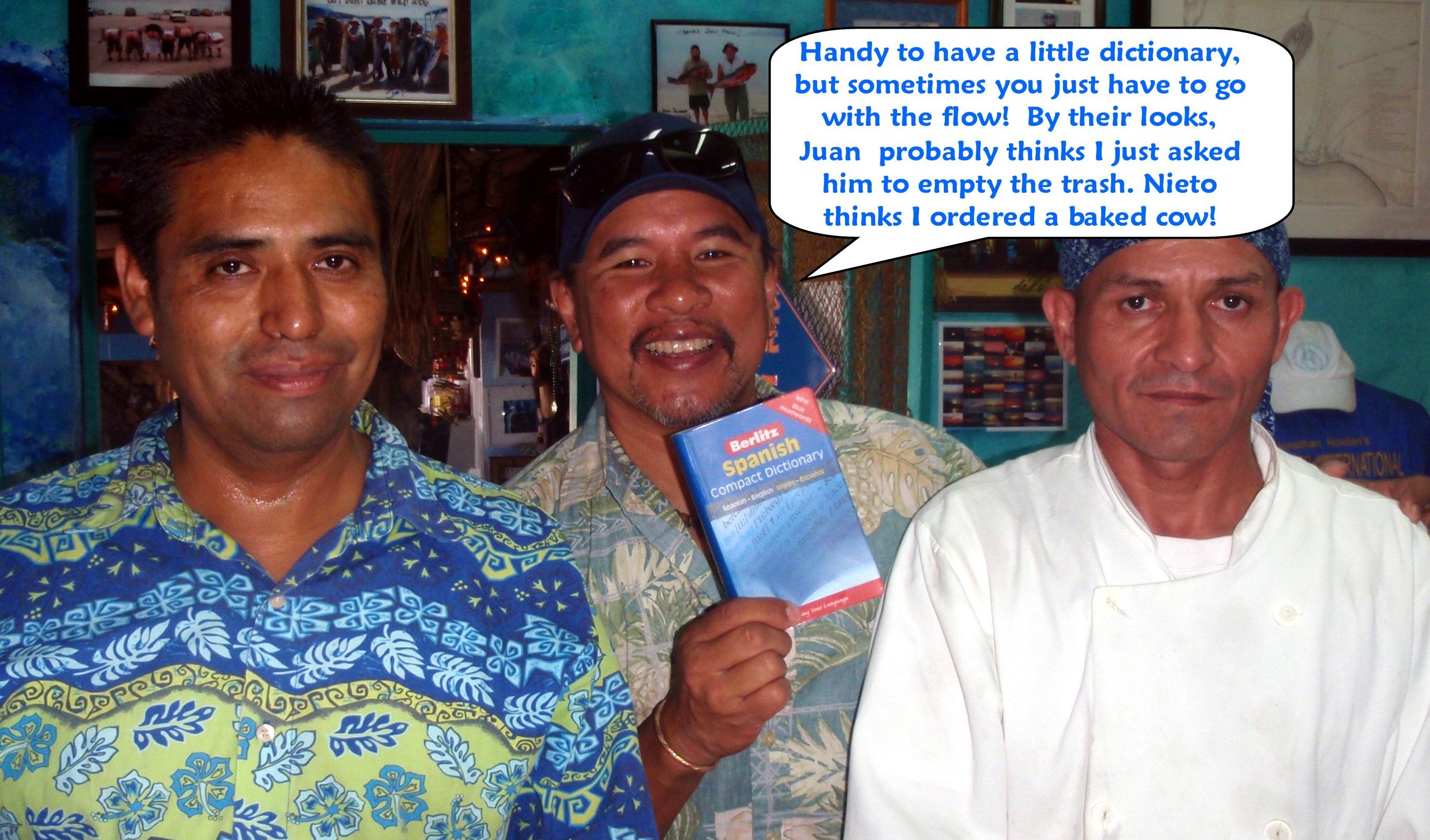
Having been down here now since the mid-90’s and been travelling down here to Baja since well before that,  you would think that I’m fluent in Spanish. Ashamedly, I’m not.  I’m better than most, I guess, but many times when someone is speaking to me, I nod my head alot.  I say, “Si. Si (yes yes)” alot.  Or ask them to “Como?”  (Repeat themselves) hoping with fingers crossed-behind-my-back that if they repeat themselves enough I might understand things in the context. 

            If they laugh.  I laugh.  They must have told a joke.

            If they look sad or disappointed, I have some handy Spanish phrases like “Oh that’s a shame” or “That’s really too bad,” to reflect that I sympathize.

            If they act disgusted or it’s obvious they’re cussing someone out, I have my handy-dandy Spanish cuss words to jump right in there!  Even when I’m not sure who or why they’re angry, but darnit, I HATE that same person too!

            Some targets are obvious…the government. . . neighbors…an employee or employer.  Those are easy.

             The harder ones are when  the bad joo-joo towards family members.  You have to tread lightly if they’re cussing out the wife (or husband).  If you jump in, YOU could be the next target.

             The last thing a guy wants to hear is you agreeing that his wife is a lazy money-spending- so-and-so.  Even if HE started the tirade.  One thing you can be sure of, they NEVER EVER EVER cuss out Mom!

            So, the last few weeks, I’ve been with fishing clients who (I say with a big smile) did the gringo-speak-Spanish for a whole week.  I’ve explained before.

             Often gringos encounter Spanish and do two things.  They speak LOUDER, but not slower or in more simpler terms.  Or, they do things like add “EL” to the beginning of any English word and the letter “O” to the end.  Ergo, we get funny  stuff  like “El bed-O” or “El beach-O” or “El suitcase-O”.  You get the idea.

            I was on a panga with two clients who were doing a combination of LOUD-speak as well as “El” and “O” to their words and happily assuming they were being understood as if they were Spanish fluent. 

            For the first hour, they would just jabber away with my captain who would do his best to understand as they shouted at him or masticated the language.  He did his best to grin and try to understand and respond when he could.

            I’d intervene when I could but often, our captain would repress a smile and roll his eyes when he’d look at me and we’d both stem a laugh.  After one point the clients sincerely thought they were having a good discussion with the captain about Mexican economics (of all things!), the captain could take it no more.

            “Senores, please to stop.  I think it is to be better if  all speak in English!” he yelled back at them in our own English.  There was a pause as it settled on the fishermen that the captain had just spoken pretty good English. 

            It was followed by a big laugh by us all. We communicated famously for the rest of the day.   It helps to have a good sense of humor in any language!

            My Spanish has great improved over the years and fortunately, I’ve been blessed with some very very patient friends and co-workers here in La Paz that try to steer me straight and keep giving me little Spanish lessons.

            Our latest uphill funny battle regards our newest businesses.  For over a year now, my wife, Jilly, and I have owned the FUBAR cantina and the TAILHUNTER restaurant right on the La Paz waterfront.

            After much handwringing and soul-searching “board meetings” over cold beers and nachos. We thought those were good names. 

            If you’re familiar with military acronyms like SNAFU (Situation Normal All “Fouled” Up) then you’re familiar with FUBAR (Effed- up or “fouled” up Beyond All Recognition).  If you knew what we went through to get the FUBAR open and what we started with and what we ended up with, FUBAR is more than appropriate for a Mexican bar!

            For the name “TAILHUNTER” it seemed that since our logo is a mermaid and our business is fishing, what better name than “TAILHUNTER?”  It seemed a nice play on words and good for marketing.

            Two problems.

            Our Mexican amigos and guests don’t understand either of the words FUBAR or TAILHUNTER.  There is no direct translation for being “effed-up” or “fouled-up” beyond-all- recognition.  I’ve reverted to using hand signs to explain it with a smirk and rolling my eyes as I pass my digital finger of one hand through a circle made by the index and thumb of the other.  That gets them laughing.

            Try it yourself as you move your one index finger through the “hole” made by the other.  Sorry for being crude. Hand signs are wonderful universal learning devices.  It’s an honest answer to a sincere question!

            TAILHUNTER also elicits some howls.  “Hunter” in Spanish is “cazador.”  Easy enough.

             But “tail” can be expressed as “cola” (the part on the dog that wags).  Or “culo” in slang, the part directly UNDER the dogs tail.  The words are very very similar and one slip in pronunciation throws it way off  kilter!

             “You hunt what?”  Incredulous eyes go wide and everyone laughs.  I have to explain that it’s “fish tails” We are hunters of fish tails!  Lord help me, life is always interesting down here!

 Jonathan Roldan is the Baja Editor for Western Outdoor News since 2006.  He lives with his wife, Jill, in La Paz, Baja Mexico where they operate the Tailhunter International Fishing Fleet and can be found at the Tailhunter Bar and Fubar Cantina Restaurant on the historic La Paz waterfront.  Come by and visit.  Website www.tailhunter-international.com or by e-mail riplipboy@tailhunter-international.com
Read Full Post »

It comes in all makes and models and can be confusing but the growth of it's popularity can't be understated! But do you really need it?

TO FLURO OR NOT TO FLURO!


Originally Published in Western Outdoor News the Week of May 12, 2010

              It used to be “back-in-the-day” when I was a kid that honestly, my day of fishing back in Hawaii involved a thin bamboo cane pole (no reel!); a rusty hook I sharpened on the driveway; a 10-cent bit of shrimp and a thin piece of string or even white thread if I could steal some from my grandma’s sewing box! (Oh the luxury!)

            And I would be happy as a dog in a forest of fire-hydrants all-day-long!  And I caught fish too. 

            All of us kids fished like that.  I’d climb out my window early in the morning so as not to wake the family and my buddy next door would climb out his window and actually shimmy down the drainpipe onto his garage roof.  With bait and cane pole over our shoulders, we’d trudge barefoot down the gravel road to the beach and fish all day long.

            The one defining difference in our fishing was the line!  If one of us happened to have squirreled-away or outright stole a bit of that white thread, it made all the difference in the world to what we would catch or, if we would catch much of anything at all.  (I don’t think I knew mono existed until I was about 10 years-old).

            Anyway, fast forward to the here-and-now. 

            It’s gotten a bit more complicated and sophisticated…not to mention alot more expensive than the days of my bamboo pole and rusty hooks. 

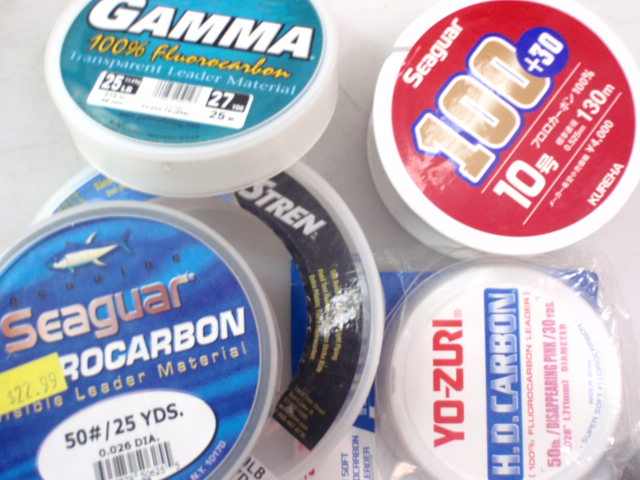
            And lines.  Where do we start?  Clear, blue, green, grey, pink, red, chartreuse (do real men use “chartreuse” fishing lines?) and on-and-on.  And that’s just the monofilament.

            Then, there’s braided lines and co-polymer lines.  But the one that seems funniest to me is flurocarbon.  It’s been around awhile, but it seems to have taken awhile to get a toe-hold here in Baja, especially among captains and crews.

            When many captains up and down the Baja coast fish like their papa’s did and his papa before him, there’s often resistance to new technology, e.g. circle hooks; spreader bars; teasers, etc.

            After all, if it aint’ broke don’t fix it and if their dad’s caught tuna a certain way, why mess up a good thing?

            Flurocarbon line looks like regular mono but it has the properties of being supposedly invisible underwater.  In a nutshell.  I don’t know.  Shrug.  I’m no scientist.    I can see it, but apparently fish can’t.  I’ve been a believer for years.

            Especially in outlying  Baja areas where technology comes slowly, it’s making believers out of many Baja captains and crews as well. 

            The thing is, it’s so darned expensive down here and often hard to get, even for tackle stores that it’s almost like a drug transaction sometimes.  As I’ve walked along some docks and beaches, I can’t tell you how many times I’ve been asked, “Pssst, amigo, do you have any fluro? Falta poquito favor.” (I just need a little please!)

            To many captains, a bit of fluro leader is sometimes the difference between catching fish and catching ALOT of fish!

            So, should you bring some down on your next trip?  Yes and no.

            As I said, even back in the states, it’s not cheap.  You definitely don’t want to fill a whole reel with the stuff.  Not only will it cost alot, but first, you don’t really need that much. 

            Second, although it’s supposedly invisible under the water, it tends to be stiffer and much more brittle than regular mono.  That means it breaks easier.  To me, it means that my baits might not swim as naturally, if it has to drag a 100 yards of stiff line behind it. 

            You also have to be careful.  Knot-tying can sometimes be a bit more difficult, especially on the heavier fluro.  Because it can be stiffer, make sure the knot is properly cinched. 

            Personally, I prefer it just as leader material.  A few yards will do ya.  After all, if it’s supposedly invisible underwater, then I really only need to cover the part that’s actually UNDER the water near the fish, right?  I don’t need a zillion yards of fluro on my reel.  A few yards as leader does me fine.

            Secondly, since the lack of visibility is utmost, I don’t much have need for it on my trolling lines or when using jigs or iron.  In my head, when a fish strikes a moving lure, it’s a reaction strike.  It’s actually moving in to whack the offering.  That thing is MOVING! 

             Unlike fishing a drifted bait, where a fish might check it out for a bit and line visibility might make a huge difference, I don’t think it makes much difference with a trolled jig  or lure that’s cast and retrieved.  The beauty of fluro is that it’s invisible ergo use it when visibility is actually a factor. 

            Lastly, it makes a great parting gift to your skipper or deckhand.  Watch him light up when you hand him your leftover spool. Por favor!          

 That’s my story

Jonathan

*Jonathan Roldan is the Baja Editor and Columnist with Western Outdoor News since 2004.  He lives in La Paz, Baja Sur, Mexico with his wife, Jilly, where they run their fishing fleet www.tailhunter-international.com and the Tailhunter Bar Restaurant http://www.tailhunter-international.com/tailhunter-bar-and-fubar-cantina.htm.  You can reach him directly at riplipboy@tailhunter-international.com
Read Full Post »

PHOTO 1: A new Tailhunter Poster Child!!!The angle of the photo might make this look a little bigger than it really is, but this is still a BIG fish!!! Make no mistake, this is a beast. It’s trophy! He surely knows how to pose in front of a camera. Actor and outdoor hunting TV show host, Rick Kasper, had a number of banner days fishing with us this week and got into some of the big yellowtail we found north of La Paz. Forty-pound fish were not uncommon and captains told me of larger fish that were lost to the rocks. “We lost several in the 50 pound class right next to the boat!,” said Rick.

PHOTO 2: Jeff Sakuda from Monterey Park CA has had some incredible trips with us over the years coming down twice a year or more. Fishing with our Tailhunter La Paz Fleet, Jeff put some meat in the cooler with this heavy fat yellowtail, he caught on a big bait…the secret to the larger fish…larger mackerel or caballitos for bait.
PHOTO 3: BUCKET LIST PHOTO! Before they went fishing that morning, John Carser, Tom Hinmon and Mark Rodman told me that they had been trying to catch a wahoo for year and that they wanted to try for wahoo that day. I told ’em that there’s wahoo, but it’s hit-or-miss and that they would have to commit the time and might not get any fish at all and then it would be too late to get anything else. But they said that wahoo was on their “BUCKET LIST.” OK…go for it. Well…what’dya know…they come back with THREE wahoo! One each. That’s incredible. That’s like telling someone you’re going to a ball game and saying you’re gonna hit a homerun! Then do it…

PHOTO 4: Rick Kasper and Dr. Doug Finn, visiting from New York on his first Mexico trip and first day ever on salt water scored 9 yellowtail, 10 doradol (most released), sierra and cabrilla.

PHOTO 5: Captain Archangel with our Tailhunter Las Arenas Fleet holds up one of the wahoo caught this week off the S. end of Cerralvo Island (when the wind wasn’t blowing!). The fish was caught by Harry Hsu, recently retired and on his first trip to La Paz. Note the big purple/black rapala dangling from the mouth

PHOTO 6: Dr. Doug Finn from the Bronx, NY, said it was “the best fishing of my life…like the stuff you only see on TV shows!” He was bruised and battered after a few days of fishing and trying to stop big yellowtail like this one.

PHOTO 7: Our amigo from Portland, Brent Layng, is an ultra-triathalete, but had his hands full with yellowtail and big cabrilla (seabass) like this one the past week. The big pargo took a blue and white lure fished on a fast retrieve in about 60 feet of water west of Ballena Island north of La Paz.

PHOTO 8: Did I mention that we’re catching more dorado these days?

PHOTO 9 : Todd Wheat from N. Cal specifically came down this past week to cross rods and wits with our tricky pargo and got a personal best with this big pargo liso (mullet snapper). Todd was fishing with our Tailhunter Las Arenas fleet and got in a few days before the winds ripped things up. The big pargo are right there in the rocks. It’s our largest of the season…so far!

PHOTO 10: Harry Hsu on his first trip with us got a wahoo as well as this nice female dorado fishing with our Tailhunter Las Arenas fleet. More dorado are moving into the area and Harry took this on a live sardine.

PHOTO 11: Bryan Layng came down from San Francisco to check our our spring-fishing and right off the bat, tied into this horse of a yellowtail that swallowed a nice caballito fished off the bottom. These heavy fish were off Espiritu Santo Island.

PHOTO 12: Popular Captain Jorge always seems to do well, especially when fishing with Jeff Sakuda who got into yellowtail, sierra, cabrilla and a prized-wahoo off S. Cerralvo Island after fishing several days with us.

PHOTO 13: Not a bad lineup for Todd Wheat and Greg Gregory fished 3 days with us but scored with pargo liso, big sierra, pargo mulatto, cabrilla and a rainbow runner.


PHOTO 14: They might not be big fish but they were fun fish, especially if you’d not ever done much fishing at all and our bonito schools were voracious this week and lots of fun on light tackle! Our family had a great time when they visited. Left to right, my daughter and son, Jessie and Jarrett Pfost, nephew-in-law Brian Palacios with the dorado; niece Summer Stevens and son-in-law Brian Reid who got several firsts on this trip. We were fishing with our amigo, Captain Lenny Bishop on his boat, “Pampered Lady.” He does a great job working the islands for fishing, snorkel and tour trips.

WEEKLY VIDEO CLIPS

A quick round up of some of the week’s action with both our Tailhunter La Paz and Tailhunter Las Arenas Fleet.

You have have seen him on espisodes of CSI, Cold Case, Vigilante, and Law and Order as well as many others. He also has his own TV show which he hosts for hunters. Actor Rick Kasper stopped by to fish for a few days with us along with Dr. Doug Finn from New York.


A MIXED FISH BOX OF GREAT FISH MARRED BY ROUGH WINDS LATE IN WEEK!

La Paz / Las Arenas Fishing Report for Week of April 18-25, 2010

It hasn’t been a great week of fishing but it hasn’t been a bad week either! Many of our anglers who fished with us this past week might tell you they personally had an exceptional time fishing. It all depended upon where you fished and what you fished for!

There are no so many different species lighting up the water here abouts and around La Paz that it’s hard to finger any of them or say any one of them is going off the charts. That old saying about “on any given day…” Well, this past week about anything could happen!

For instance, off the north and west side of Espiritu Santo Island north of La Paz, we had the best example of our crazy fishing. In about 60 feet of water, huge 30-40 pound homeguard yellowtail went off for the better part of the week with boats taking 1-8 fish each. The best baits were the big mackerel and caballito and tying them to a dropper loop or sliding egg sinker with 60-80 pound leader a few feet from the bottom with a stout rod; a reel with good drags and loaded with about 50-60 pound test. These were big thick fish and many were being broken off. Yo-yo iron on a fast retrieve in green/yellow and blue/white were also very effective.

The funny thing is that these are cold-water fish generally. Strangely, in the same area, schools of 5-15 pound dorado would suddenly move in and boats would take a limit or two of dorado in the same spots on iron, live sardines or slow trolled feathers.

In fact, if you looked anywhere in La Paz Bay and north towards the island you’d see low flying and dipping birds…a sure indication that there were dorado working the spots. Again, in the same spots as the dorado and yellowtail, big pargo and cabrilla as well as sierra (more cold water fish) and barracuda and bonito (more warm water fish) could be caught! Go figure! What it did was make for some fun fishing for lots of variety. The key to getting the big yellowtail was getting the larger live baits like mackerel or caballito.

In contrast, for our Las Arenas fleet, the bait situation for sardines continued to be a long run to the islands. Fortunately, enterprising commercial pangeros are running up there then coming back with bait to sell to the fishermen. The coolest thing was that at the south end of Cerralvo, we hit the wahoo every day! Not every boat, but at least one of our boats a day took 1`-3 wahoo that ran 20-60 pounds! Like the dorado, these fish are a bit early in the season but when they hit are eating the dark colored large Rapalas.

(We did have one day, THURSDAY, the winds were so strong, we were not able to fish. It was nuts! Like a baby hurricane with the sun out. We sent everyone home back to bed!)

Inshore, look for roosters, jack crevalle, big-eye jacks, cabrilla and big time pargo that are more frustrating than anything else. As well, marlin and sailfish are here ,but still not quite ready to openly feed, but every other day or so someone hooked on that quickly broke off. Most times, they sit there and just sun themselves until you almost run over them with a panga!

That’s our story!

Jonathan and Jill
Jonathan Roldan’s
Tailhunter International

Website: http://www.tailhunter-international.com/
U.S. Office: 3319 White Cloud Drive, Suite A, Hacienda Hts. CA 91745
Mexico Office: 755 Paseo Obregon, La Paz, Baja Sur, Mexico
Phones:
from USA : 626-638-3383
from Mexico: 044-612-14-17863
.

Tailhunter Weekly Fishing Report:
http://www.tailhunter-international.com/fishreport.htm

Tailhunter YouTube Videos:
http://www.youtube.com/user/pangapirate

“When your life finally flashes before your eyes, you will have only moments to regret all the things in life you never had the courage to try.”

Read Full Post »

DON’T BE A VICTIM

Originally Published in Western Outdoor News the Week of April 26, 2010

OK, so this isn’t especially about fishing, but it is about Baja. With more gringos moving; driving; vacationing; purchasing; and spending time down here in Mexico despite the scares of drugs wars, swine flu and whatnot, I thought I’d pass on the following letter to you.

The topic of traffic stops by Mexican policia has often been a hotly debated topic, especially with the concern over un-ethical police practices, I think you’ll find the following interesting as it’s a letter written by a Mexican attorney praciting in La Paz to gringos.

Check this out from Lic. Jacques-Edouard Beaulne:

Everyone has the same rights of stopped or arrested:

When arrested, you have a right to:
1. be treated physically and verbally with courtesy.
2. be explained the charge(s);
3. Refuse to let police search on your property if search warrant is not presented;
4. one phone call;
5. be represented by lawyer, private of public defender;
6. an official translator paid by the State;
7. refuse to sign any documents’
8. refuse to make any declaration;
9. be examined by a doctor before being incarcerated;
10. be visited while in jail;
11. bail if the crime accused of is minor;
12. any denunciation against arresting officer.
13. be judged as innocent until proven guilty.

When stopped by police on the highway or street:

Right to ALL of the above, plus,
1. ask the policeman to be taken to station;
2. ask for policeman’s ID.
3. refuse to pay any amount to police officer, all
4. pay city’s traffic violation only at TRANSITO office (police station);
5. pay the fine emitted by Federal police in relation to a violation to the regulations on
highway to the bank.
6. refuse inspection of the vehicle if the police does not have a search warrant.

In the event that one is stopped by a traffic policeman one must NOT be intimidated by surrounding polices with guns, whatever is the caliber.

One must ask what is the reason for been stopped, one has to present his driver’s license and registration papers. The police can detain the driver’s license and registration papers but cannot by law remove the license plate. All mentioned documents must be returned to the driver immediately after the fine is paid.

Fines are paid at the bank regarding federal fines and at the city’s central police station (Transito) when it is for a violation of the traffic regulations in the city or town.

Fines paid in within 48 of the date of emission are charged at 50% of the amount listed in the back of the ticket or on the list at the police station.

It is illegal to give to any police officer any amount of money to cover a fine, BASTA CON LA CORRUPTION ( no more corruption ) is the call from the President of the country…so please respect it.

If one does a mistake while driving that results in an infraction one must NOT contribute to corruption and be abused by police officers ONE MUST ASK FOR THE TICKET AND PAY THE FINE.

In case of harassment present to the police officer a sheet of paper on which you wrote:

Nombre / Name:
Numero de su credencial:
Typo de infracción / Type of infraccion:
Por favor llévame a su superior / Take me to your superior.

Personally, my general rule is don’t break any traffic laws to begin with. A red light in the U.S. is still a red light in Mexico. Speeding is speeding. Driving drunk is the same north and south of the border. Being on vacation with a pocket full of dollars doesn’t give you free reign to treat the place like your personal Disneyland. Every place has rules. Respect garners respect…in Mexico as in the U.S. Etc. Etc. Don’t forget you’re a guest!

Most Mexican police officers are professional and strive to perform their duties well, so don’t assume the worst and let the few bad ones taint all Mexican police officers. The ones I’ve met really take their jobs seriously and have a disdain for unethical practices. With the internet and so many message boards and websites as well as cell phones, it’s hard for the bad ones to stay anonymous any longer.

That’s our story
Jonathan

*Jonathan Roldan is the Baja Editor/Columnist for Western Outdoor News since 2004. He lives in La Paz, Baja, Mexico and is the owner/operator of Tailhunter International Fleet with his wife, Jilly, as well as the Tailhunter Restaurant and FUBAR Cantina. http://www.tailhunter-international.com He can be reached directly at riplipboy@tailhunter-international.com

Read Full Post »

PHOTO 1: A darned nice day for Don and Mary Busse of Lakewood CA. Fishing with our Tailhunter Las Arenas Fleet, the couple got 9 sierra, a pargo, a 25 pound roosterfish (see below released); this nice wahoo and lost a bigger one! It was Don’s first wahoo and rooster. Maybe a little early for wahoo, but the fish kept popping up south of Cerralvo Island.

PHOTO 2: What? Dorado in April? Can it be? For the last month, bits of sargasso weed have been gathering around in the currents which usually means dorado are coming and little dink dorado have been biting here and there. However, they turned on nicely at the end of the week north of town as shown by these two nice grade mahi held by Phil Bonnet and Chuck Lascheid from Sacramento CA with Espiritu Santo Island in the background. Check out how close to shore they are! They got a limit of the nicer fish!
PHOTO 3: Good as it gets. Blue water, white sand and a bull dorado held by Phil Bonnet…our largest so far of the season as dorado turned on north of La Paz!

PHOTO 4: The kids did alright! Yellowtail and pargo mixed it up big time around the El Bajo Seamount now that winds backed off a bit. My son, Jarrett Pfost and nephew Mike Stevens got multiple bites that were lost to the rocks but still took these 3 yellowtail and hefty pargo on live mackerel and y0-yo iron (blue and white!).

PHOTO 5: Cole Chavirra for years has been a regular poster-child for Tailhunter International. He’s one of the most talented anglers I’ve ever seen at the old-age of 12! He’s been down here numerous times since he was about as tall as a tackle box. Check out this trophy barred pargo!

PHOTO 6: “Ma” Janille Todd (mi suegra!) from Spring Valley CA and Jennifer Enright from La Mesa CA proudly hold up a couple of their sierra while standing in front of their catch of sierra and jack crevalle (Captain Victor wanted them for his dogs!) while fishing with our Tailhunter La Paz fleet. This was Jen’s first time to La Paz and first time fishing. My Ma has been here several times and always does well!

PHOTO 7: 12-year-old Cole Yates from Carlsbad CA on his first trip to La Paz did some damage including this over-sized sierra while on a panga.

PHOTO 8: I don’t know who taught these two how to pose, but Mitch Chavira and son Cole show off two of the nicer fish we’ve seen…a big yellowtail and big cabrilla. Mitch said he lost one fish estimated at 50-pounds. I rarely ever doubt either of these two when they go fishing!

PHOTO 9: Family portrait with two of the many pargo hooked this week. My son and daughter, Jarrett (Alpine CA) and Jessie Pfost (Las Vegas NV) strike poses with my niece and nephew Summer and Michael Stevens from Alpine CA. This is Muertos Bay. The pargo are there to be hooked, but so few get taken to the boats! Tough tough fish!

PHOTO 10: Captain Armando helps out with the fish…sierra and big eye jacks (good eats!) for Margo Donohue (Carmel CA) and MaryAnn Hendren (San Diego CA) who had a great day with lots of variety.

PHOTO 11: We had a bunch of happy first-timers this week who had a blast! Kim and Bob Perry from San Diego thought “it was a blast” despite rather rough seas and (to us) slow fishing that day but they had a day full of action on sierra, bonito and two nice pargo. They are already planning to come back before the year is out.

PHOTO 12: Don Busse had caught a wahoo and lost a wahoo this day. Both were firsts ,but claimed that this roosterfish (also his first) was even MORE fun since he hooked it on a light baitcaster outfit. “It took 25 minutes!” he said. “I”m coming back soon just for roosterfish!” was his comment. We’re seeing larger roosters moving into the beaches!

PHOTO 13 : Every day should be so good. My lovely wife and partner, Jilly, celebrated her birthday this week with a day in the pangas; some fish and of course…a bottle of chilled champagne! Cerralvo Island in the background…sierra in the right hand…champagne in the left!

PHOTO 14: Our new favorite fishing fan! This is 13-year-old Kaileigh Otsuka from San Jose CA. Fishing with Captain Chito and our Tailhunter La Paz fleet, Kaileigh hooked, fought and boated this fat striped marlin all by herself. The fish was not able to be released but was Kaileigh’s first marlin.

PHOTO 15: Yea…sometimes even the old guy catches a fish! It was a bad-hat day, but the fish were kind to me and I hooked this yellowtail on a caballito about 60 feet down on the Marisla Seamount. I gave the fillets away, but Jill and I kept the collars to barbecue with teriyaki sauce! It’s one of the best parts of the fish that everyone throws away! Nomm…Nomm…Nommm!!!

STRANGE WEEK OF GOOD AND BAD FISHING STILL PRODUCES SOME INCREDIBLE VARIETY!

La Paz/ Las Arenas Fishing Report for Week of April 11-18, 2010

We had much better fishing conditions this week, but it’s taking awhile for things to recover as water was still a bit bumpy and off-color. But…wow…fishing ran the gamut from really poor to really spectacular. I”m just glad we have two fleets here with Tailhunter. It was like night and day.

For our Las Arenas fleet, it was tough fishing. The biggest problem is that the bait is way up the east side of Cerralvo Island. It’s a long run. There was a spot of tuna that showed up, but for the most part it was a frustrating week trying to tackle the tough pargo along the island and around Punta Perrico. Some boats did better than others.

Sometimes, you look at the numbers and it looked like there were no fish and sometimes that was the case, but they talking to our anglers, these tough fish were busting off so often that they hooked many but lost almost all of them. However, there were some nice roosters and plenty of sierra to even things out, but overall, it was tough fishing. The highlights were the fact that flyfishers and light tackle fishers got into schools of fiesty bonito and we did get a few wahoo at the south side of the island as well.

It was a complete opposite for our La Paz fleet. Normally, during this time, the winds are blowing fierce and it’s awfully tough fishing straight north of La Paz. However, not only did the winds lay down, but we got the big mackerel baits that are like candy to some of the bigger game fish.

Boats were getting into a nice grade of yellowtail up to about 30 pounds…using heavy gear and sliding sinkers…the fish are hunkered on the high spots and we’re losing about half of them. However, in those same areas, big pargo and trophy sized cabrilla were also caught on the big mackerel, sardines and also heavy lures.

The real surprise was that over the past few days, I’ve seen more and more sargasso weed showing up…which is usually a good sign of dorado and we’ve seen quite a few small ones cruising and often biting in La Paz Bay…but the latter part of the week…the dorado went on a tear with fish 10-30 pounds! It was like summertime. Whether this stays or not, we’ll see, but this sure is exciting!

NEED YOUR DAILY FISHING FIX?

OK…I draw the line at Twitter. I do NOT “tweet.”

However, if you’re a fan of FACEBOOK, you can check out my facebook page JONATHAN ROLDAN and throughout the week I post snippets of how the fishing is going day-to-day often with photos. If you really need to know how things are going and can’t wait for the weekend report, check out the FACEBOOK page.

I get hundreds of e-mails a day and can’t answer every FACEBOOK comment, but at least you can check things out that may not necessarily get into the weekend fishing report!

You can also become a FAN of TAILHUNTER INTERNATIONAL, our bar and restaurant and check out what’s happening at the bar and see who’s dancing on the dance pole or had a few too many margaritas!

That’s our story!
Jonathan and Jill

Jonathan Roldan’s
Tailhunter International

Website: http://www.tailhunter-international.com/

U.S. Office: 3319 White Cloud Drive, Suite A, Hacienda Hts. CA 91745
Mexico Office: 755 Paseo Obregon, La Paz, Baja Sur, Mexico
Phones:
from USA : 626-638-3383
from Mexico: 044-612-14-17863
.

Tailhunter Weekly Fishing Report:
http://www.tailhunter-international.com/fishreport.htm

Tailhunter YouTube Videos:
http://www.youtube.com/user/pangapirate

“When your life finally flashes before your eyes, you will have only moments to regret all the things in life you never had the courage to try.”

Read Full Post »

« Newer Posts - Older Posts »