Feeds:
Posts
Comments

Archive for August, 2010

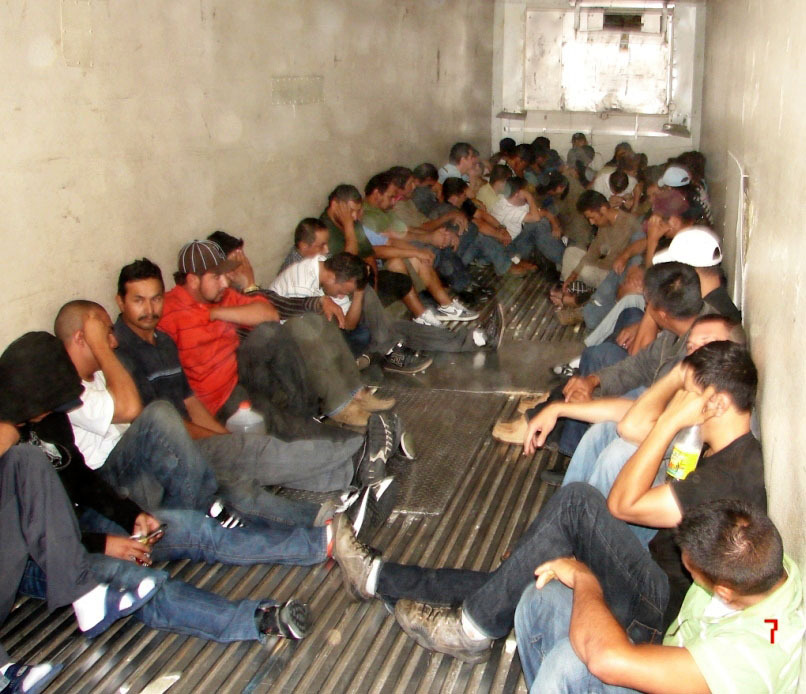
This photo from Fox News shows that it's not exactly a joy ride fun vacation for folks locked in a container truck doing it for real.

FAMILY FUN!

Originally Published the Week of Sept. 2, 2010 in Western Outdoor News

Do you ever read a story in a magazine or newspaper and then slap yourself on the forehead shake your head and say, “What the heck are you people thinking?”

You know about the popularity of “reality shows.” 

I’m sure you’ve heard of specialized vacations.  People bored with Waikiki, Vegas and camping in Yellowstone do things like trek down the Amazon River in a dugout canoe in a loincloth. They spend a week with National Geographic charting the migratory patterns of  one-eyed-parrots on some  remote island or  they go out with an archaeology crew to brush dust off the fortress ruins of Masada in the Holy Land. 

I can understand that.  I’m down with that.

Why ride down the Disneyland Jungle cruise when you can kayak over the falls on the Nile River?  Why go eat Italian food in Santa Monica when you can spend a week in a villa in Florence taking a cooking and wine class?  “Pirates of the Caribbean” movies or two weeks on a barefoot sloops off Grenada Island? We scuba with sharks here in La Paz.  No biggie. Great fun.

Well, I just read an article posted by Lorena Segura of Reuters and picked up by MSNBC online.   http://www.msnbc.msn.com/id/38840613/ns/travel-active_travel/

It appears that , “enterprising” travel agencies are now offering “black tourism” events whereby you can now  feel what it’s like to be a real-life poor person trying to find work across the border in the U.S.! Or hang out in a crime ridden Mexican slum. Or how about a jungle meeting with a real revolutionary!

That’s right!

What family wouldn’t jump at the chance to:

  • run through some of the most dangerous slums in Mexico at night
  • maybe the chance of getting robbed or beaten or worse
  • be chased through the dark in the desert
  • have to crawl under barbed wire and through other obstacles
  • get really dirty and have to keep up with a “coyote” (paid guide)  or you get “caught” and thrown into a  fabricated border patrol truck and bounced around
  • denied food and water
  • hide in bushes all night
  • maybe see a real live narco drug gang member or Zapatista revolutionary (but no pictures allowed!)
  • dress down…no Izod polo shirts or Tommy Bahama shirts allowed.  Dress to move and dodge and hide like a real desperate person trying not to get caught!
  • wade through rivers and creeks evading the border patrol


Sign me up!  What fun.

As one German tourist commented in the article that this provides “real insight” into “real Mexico” and, “Things like this don’t exist in Germany! I can’t get this in Cancun!”   How exciting!  (I guess she’s was too young to remember the Berlin wall.  You got caught, you didn’t get tossed in a truck…they ran you down with dogs and machine guns. Game over, Hans!).

The tourism agencies explain this as a way to “educate tourists about developing countries.”  And yes…we take VISA.

One agency runs a “safari” into an area where locals will not even set foot because it is such a danger zone and you stand a good chance of being robbed at gunpoint.  Oh, Joy.

Another provides “undercover tours in one city’s market area in Mexico City notorious for drug deals, underage prostitution and pirated goods.”  (sounds like Vegas or Hollywood to me!)

One local business in Hidalgo takes groups into the desert and does the simulated “border run” dash-sprint-hide-crawl so you can see what it’s like to try crossing the border at night or in the heat of the day. No water or food allowed.

In the remote mountain area of Chiapas they take you up into the rebel areas so you can possibly see real live rebels and meet one face-to-face. Take a photo with a Zapatista!

People are signing up for these things! 

What next?

Driving a  Humvee through an Iraqi minefield looking for weapons of mass destruction?  Or the night tour through downtown Mogadishu in Somalia waving a U.S. flag?  Jog through Central Park at midnight with a pocket-full of cash?

Give me a break…

_____________________________

Jonathan Roldan has been the Baja Editor for Western Outdoor News since 2006.  He lives with his wife, Jill in  La Paz, Baja Sur, where they own and operate the their fishing fleet as well as their bar and restaurant on the historic La Paz waterfront.  Their website is:   www.tailhunter-international.com  Jonathan can be reached directly via e-mail at riplipboy@tailhunter-international.com

Read Full Post »

Big roosters like this caught by our amigo, Dave Lester, reminded me about the use of the trap hook!

The TRAP HOOK. Simply effective!

THE FORGOTTEN TRAP HOOK!

Originally Published the Week of Aug. 17 in Western Outdoor News


So…you know how to tie three of the strongest knots ever invented and love showing all your buddies how good you are.

You know the difference between a #1 and a 1/0 hook.

You know that a Bimini Twist isn’t a Caribbean croissant and that a “circle hook” isn’t a boxing term.

Spectra isn’t a member of the Justice League comic book characters.

You’re even pretty good at not backlashing when you cast…most of the time!

But, you’re ready for something else.  One more trick.  One more chingadera. One more ace up your sleeve.   You’re looking for one more bit of an edge against those pesky pescado.  Not to mention something slick  and trick to blow the socks of your fishing buddies.

Sometime, when we fish,  we fall into the habits of doing the same things over-and-over-again because they worked in the past and SHOULD keep working again, right?   I mean, if it doesn’t work, it’s not OUR fault. It’s the fish that has the problem!

But that’s when we really SHOULD try something different.  Fish just do what fish do.  They swim; they mate; they eat. 

The eating part…that’s where fishermen come in.  Like that old saying, “Fish are like men, if they kept their mouths shut, they would never get in trouble.”

Our sport requires that we find a way to get them to open their mouths! And once they are open keeping them stuck on the line.

Some clients who fished with us down here in La Paz recently reminded me of a slick trick I had not used in a long time.  They had such a successful trip far-and-above our other clients that I asked them what they had been doing differently.

When, they told me, I had to slap myself in the forehead.  “Hey, I had forgotten that trick!”

It was the trap hook.  Effective. Relatively simple.  Easy to forget about.

Essentially, it involved tying one hook onto another. 

There are quite a few variations.  Some anglers tie one hook to the shank of the other.  Some, tie it to the curve.  Some tie it to the eye. 

I have seen some pros use wire.  Others use spectra or mono.   You know how “inventive” fishermen can be.

Here’s what Dave Lester of Temecula CA wrote to us after using his trap hook setup pictured above and having an outstanding week on big roosterfish, tuna, pargo and dorado.  It was his use of the set-up that reminded me about it’s effectivness: 

” I used single strand to connect.  I’m not that experienced with wire but the rig was pretty simple to create and each rig lasted for several large fish.  I used an 8/0 circle and a 3/0 bait hook.  I talked to a couple of the guys.  I think our historic hook up  rate (on a regular hook rig) was probably 70% on roosters using big baits like lisa and sabalo.  Not too bad but there was always the long take and the huge swings to set the hook.  Many of the fish were also gut hooked. 


With this (trap hook ) rig, we were more like 90% hookups and every hook was right in the corner of the mouth.  We used fairly light line (25 or 30 mono) so the corner hookups add a bit of safety factor.  I also have really gotten used to the simple “put it in gear and reel” to set the hook.  This rig also has an advantage if you miss the hook set or you just had an extra lively bait, you leave the bait in the zone without yanking the hook out of the bait.”

Sometimes the trap hook  is set-up so  the 2nd hook dangles free.  Other times, it is rigidly connected to the main hook.  Either to the shank or the curve.

In any respect, it’s a deadly device.

Trolling lure manufacturers and rigging professionals have been using them in their lures since the earliest days.  Two hooks instead of one.  Tandem hooks.  Hooks connected to each other at different angles. 

But, now consider a similar rig for live and dead bait.

By doing so, you help eliminate short bites where smart fish nip only the tails of your bait.  It makes for better hook-up-to-catch ratio as now two hooks often embed themselves into a fish.  In fact, sometimes, they embed themselves at different angles making it near impossible for a fish to torque itself off or come loose. 

Generally, it involves sticking the main hook into the bait.  If you’re losing live bait, then pin the hook in the bait as your normally would bait your hook.   Usually, you’re hooking it through a non-essential organ or part of the fish like a gill, a nose, a dorsal fin, etc. 

Remember, you want your bait to still swim naturally, so the 2nd hook is allowed to dangle free in some cases.  Or, as some anglers prefer, the 2nd hook is lightly embedded in the skin, tail or anal section of the bait.  This allows the bait to still relatively swim freely.  (Sometimes the 2nd hook is several sizes smaller than the main hook.)

If dead bait is used, obviously, no “swimming” is involved so sometimes both hooks are embedded.  Or one is left dangling.  

You may want to experiment a bit.  As mentioned above, sometimes, it’s more effective to use a smaller hook for the 2nd hook.  Circle hooks seem to work just as effectivelys as “J” style hooks.

Pargo…roosterfish…cabrilla…wahoo…I don’t know why I don’t think of it more often.  It’s one more trick to pull out of the bottom of your tackle box that often gets forgotten.

____________________

Jonathan Roldan lives and works in La Paz, Baja Mexico where he and his wife, Jill own and run the Tailhunter International Fishing Fleet since 1996  www.tailhunter-international.com  They also own and run the Tailhunter Restaurant and FUBAR Cantina on the historic La Paz waterfront.  You can contact Jonathan directly at riplipboy@tailhunter-international.com  He has been the Baja Editor for Western Outdoor News since 2004.

Read Full Post »